


Todas las subastas / Arte Antiguo / YOSHITOSHI • Ghost Genji • 100 Aspects of the Moon •...

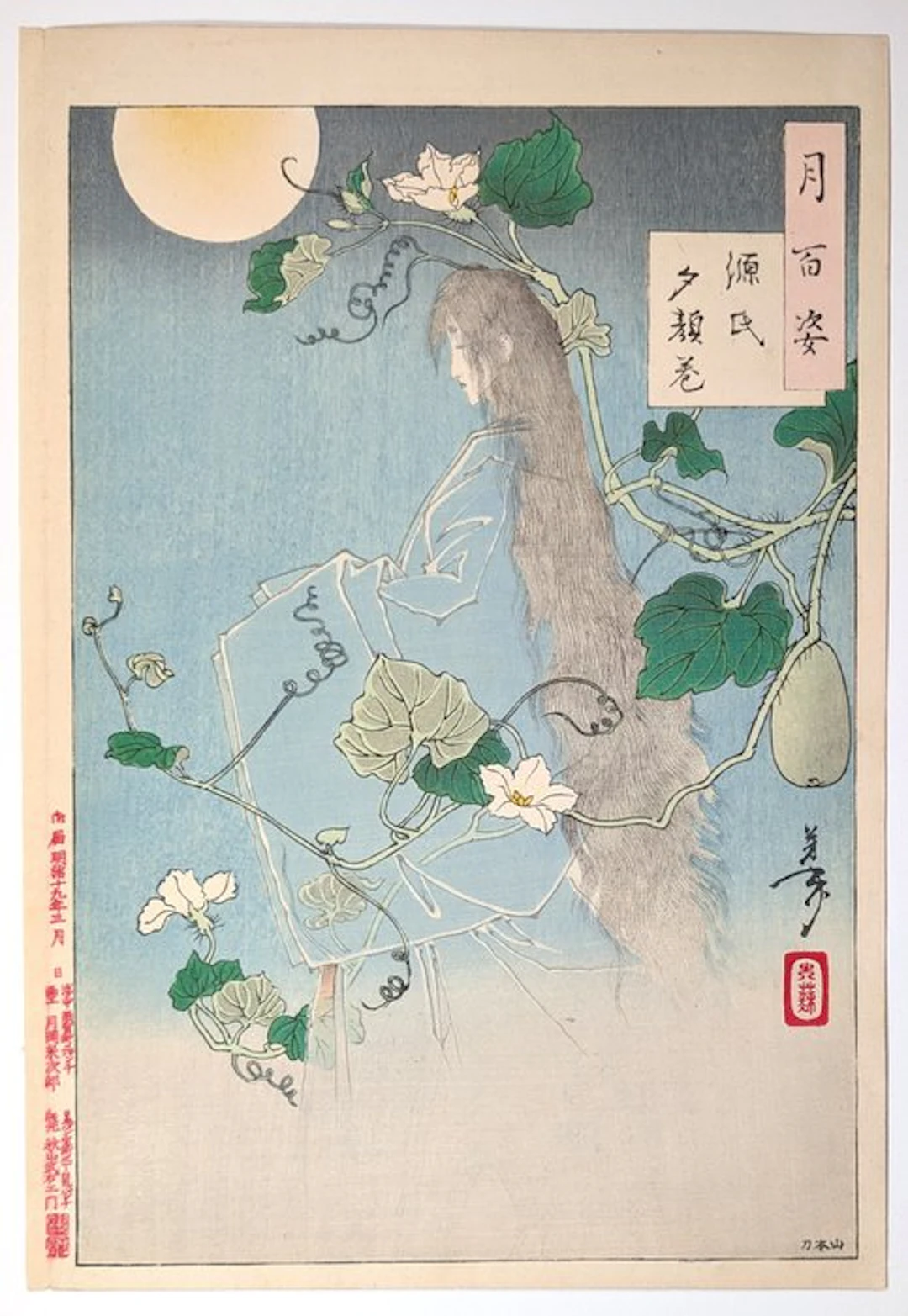
** This is the top design of Tsuki Hyakushi, and the Japanese trade prices it accordingly. A major international dealer offered it last year for ¥700,000 and currently has an impression available for ¥800,000. A price reflects its rarity! ** Artist: Tsukioka Yoshitoshi (月岡芳年, 1839–1892), signing Yoshitoshi 芳年 with the red Taisō seal Series: Tsuki Hyakushi (月百姿) — One Hundred Aspects of the Moon, published 1885–1892 Title: Genji yūgao maki (源氏夕顔巻) — The Yūgao Chapter from The Tale of Genji Date: Meiji 19, third month (March 1886) Publisher: Akiyama Buemon (秋山武右エ門) Block-cutter: Carver's mark Yamamoto tō (山本刀) in the lower right of the image Technique: Woodblock print (mokuhanga), polychrome nishiki-e Format: Ōban tate-e — approx. 36 × 24.5 cm References: Stevenson 29 · Keyes, Courage and Silence, 478-28 · Segi, Yoshitoshi the Splendid Decadent, no. 30 · van den Ing & Schaap, Beauty and Violence, 54.28 · Ōta Memorial Museum 2009, no. 2.29 · Iwakiri, Yoshitoshi, no. 231 CONDITION Excellent. A superb impression — the keyblock is sharp throughout, holding the hair-fine tendrils of the vine, the individual whiskers on the gourd, and the hatched strands of the ghost's loosened hair without a break. The colour is fresh and unfaded: the grey-slate of the night sky carries clear woodgrain from the block, the bokashi transition from night down through bay blue into the pale ground at the base is smooth and unbroken, the leaf greens are deep and evenly laid, and the moon disc retains its soft warm tint rather than the bleached white of a tired printing. The blue of Yūgao's lips — the convention for the dead — reads clearly. Colour on this design is the first thing to go; here it has not gone. Paper Excellent. The sheet is untrimmed and complete, retaining both publication margins: the full red registration and publisher inscription down the left edge. The paper is clean and even, with only the light warm tone proper to washi of the 1880s. The sheet carries an album backing from an earlier Japanese mounting — the standard survival route for this series, and the same state in which the best Japanese-market impressions of this design are offered today. We have left the backing in place: removal on a sheet of this quality risks the fugitive red and the delicate white printing for no gain in appearance The ghost who is not in the novel There is a small, perfect problem at the centre of this print. Everyone calls it the ghost of Yūgao — and in The Tale of Genji, Yūgao has no ghost. She is the woman a jealous spirit comes for, not the spirit that comes. Genji finds her in a ruined house at Gojō, her fence smothered in white gourd flowers; she will not give her name, so he names her after the blossom; within hours of taking her to a deserted villa she is dead, and the novel closes over her. Murasaki Shikibu never lets her come back. She comes back on the nō stage. Two plays — Hajitomi and Yūgao — take up what the novel abandons. In Hajitomi, a monk at Unrin-in performs a service for the flowers offered on the altar and a woman appears at dusk holding a white bloom. Asked her name, she says it will be known soon enough; she has come, she says, from the shadow of this flower — and vanishes into it. When the monk goes looking, he finds the derelict house at Gojō with moonflowers climbing the half-shutter, and it is from behind that shutter that Yūgao's spirit finally steps out, tells her story, dances, and asks to be prayed for before dawn takes her. The whole play is the monk's dream. That is the tradition Yoshitoshi is drawing on: not the chapter but the dream of it, four centuries of stage practice in which the woman and the flower become one thing. Read the sheet that way and its strangeness resolves. She is not haunting the garden — she is what the garden is made of. The series, and where this sheet sits in it Tsuki Hyakushi occupied Yoshitoshi from 1885 until his death in 1892 — one hundred ōban designs, issued in small batches by Akiyama Buemon of Nihonbashi, each built around the moon and around a figure drawn from Japanese or Chinese history, legend, poetry and the nō repertoire. New designs were awaited by collectors and sold out fast. It is the last great series of the ukiyo-e tradition, and by common consent Yoshitoshi's masterpiece. Shortly after his death in June 1892 the complete hundred were issued as a bound album with a preface and table of contents — which is why so many surviving sheets, this one included, come out of Japanese albums. Within the hundred, the Yūgao is the one nearly everybody names. It is the design that gets chosen for exhibition posters and book jackets, the one that carries the series' reputation for atmosphere, and — in the plain evidence of the Japanese trade — the one that is priced in a different bracket from its neighbours. It is also, as the London dealer Israel Goldman has noted of the design, one of the hardest sheets in the set to find in an early impression: the pale printing that makes it work is the first thing lost in later pulls.
Estimación:€3,900
Ir a la subastaVer todos los artículos deCatawikioArte Antiguo
Estimación:
€3,900
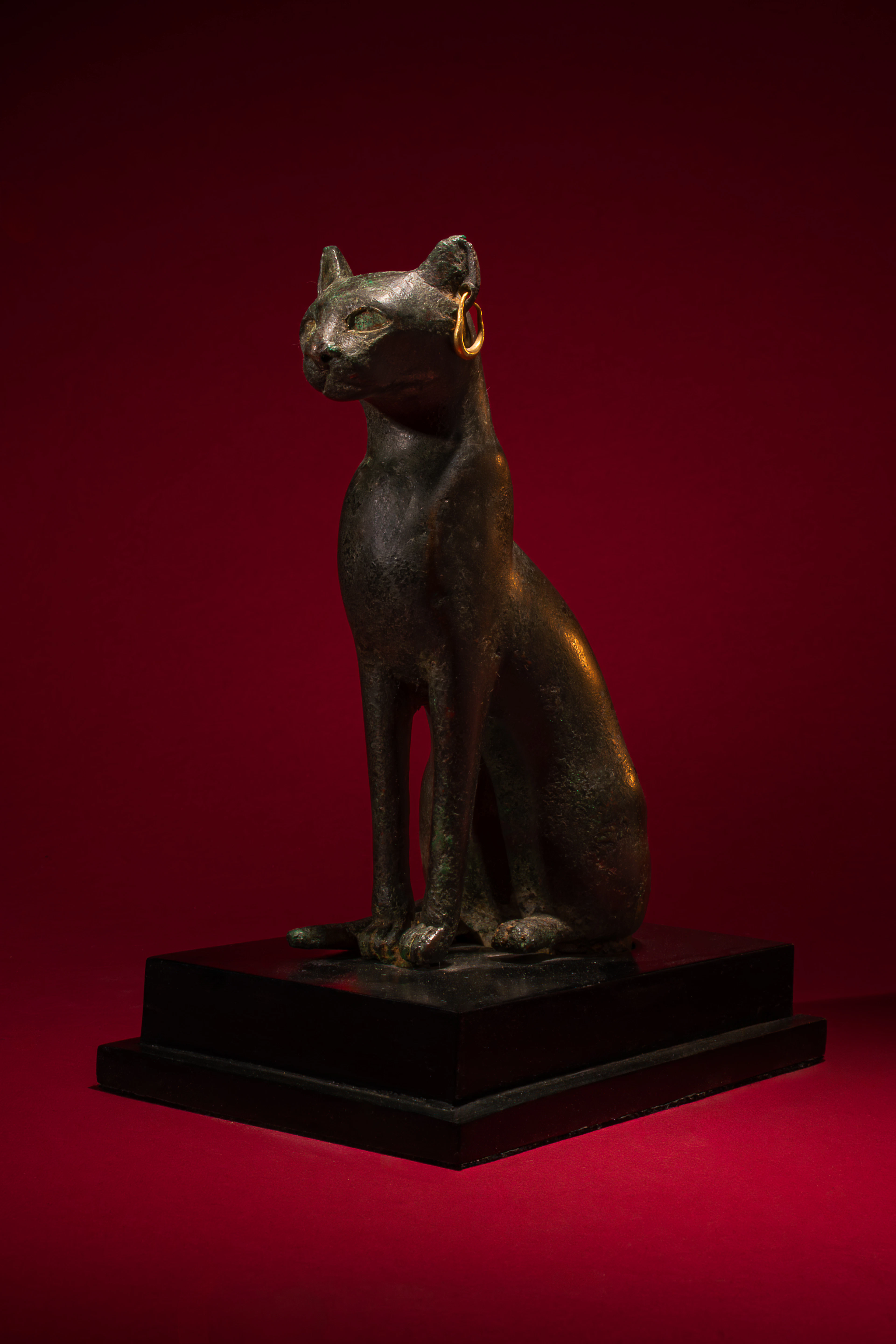
RARE EGYPTIAN BRONZE CAT STATUETTE WITH GOLD EARRINGS - LARGE SIZE
06/21/2026

€25,506.4
Est.: €23,095.64
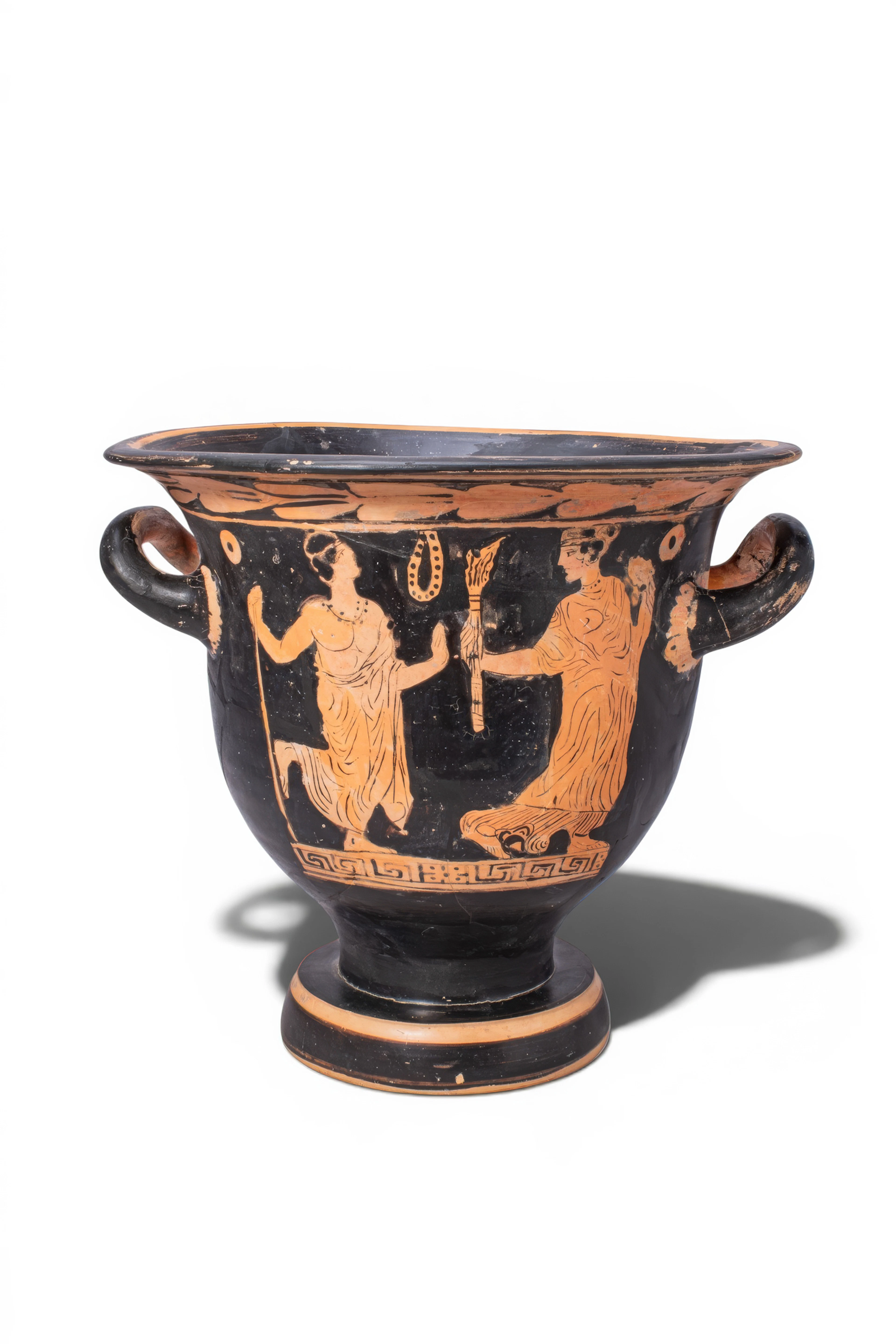
APULIAN RED-FIGURE BELL KRATER WITH KOMASTOS AND MAENAD - TL TESTED
06/21/2026
€3,014.39
Est.: €2,304.2

OCT 27 | 4:00 PM
¡Lleva tu subasta a coleccionistas de todo el mundo!
Publica ahoraAl suscribirte, aceptas la política de privacidad. Cancela tu suscripción en cualquier momento.
Barnebys HQ
Brahegatan 10
BOX 5038
114 37 Stockholm
