Wall sconce (2) - Bronze - Pair of brass wall sconces
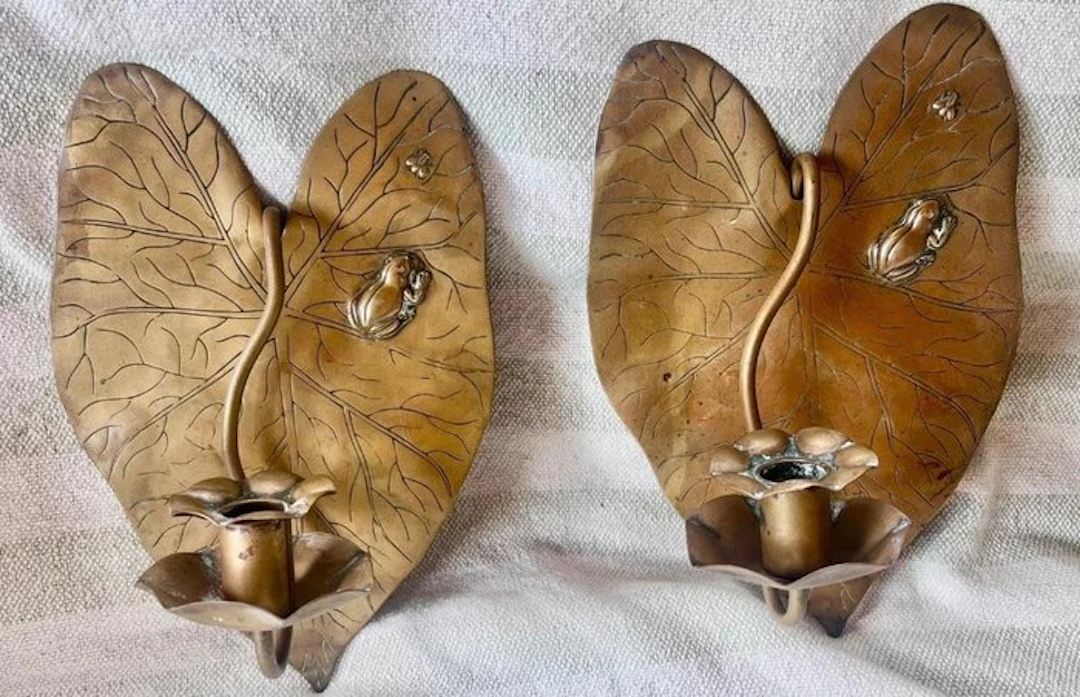
Pair of wall-mounted brass Art Nouveau style candle sconces, lily leaf-shaped, signed Liberty & Co. (England). Each sconce is equipped with a single light. They feature raised details, including leaf venation and an image of a frog chasing a fly. Probably manufactured during a revival period of their iconic style, likely in the 1960s. Dimensions: 28 cm x 118 cm and depth 11 cm In 1876, Arthur Lasenby Liberty (1843-1917) opened a shop on Regent Street in London, opposite his former employer, Farmer & Stiles. He had begun working there in 1862, during the second Great London International Exhibition held in Kensington, and had been particularly drawn to the Japanese crafts on display. Appointed manager of their Oriental objects warehouse in 1864, he acquired a substantial number of pieces and eventually decided to open his own specialized shop. With three employees and a sizeable loan from his future father-in-law, Liberty’s quickly gained a reputation for ornaments, fabrics, and art objects from Japan, India, and the Orient that he offered. In eighteen months, he had repaid the loan and acquired the second half of his building, then expanding into neighboring properties as his business grew. In 1884, he created the costumes department, led by Edward William Godwin (1833-1886), a renowned architect and founding member of the Costume Society. With Arthur Liberty, he created a house-made clothing line to compete with Paris fashion. In 1885, nearly a third of Regent Street’s block was acquired to meet the growing demand for carpets and furniture. The basement, named the Eastern Bazaar, served as a sales space for what was described as “decorative furnishings objects.” He named the property Chesham House, in homage to Chesham House, the place of his childhood in Buckinghamshire. The store became London’s shopping hub, and Liberty fabrics were used for clothing and furnishings. In November 1885, Liberty brought forty-two Indian villagers to recreate a living village of Indian artisans. During the 1890s, Liberty established close relationships with many English designers, including Archibald Knox, and encouraged Arts and Crafts and Art Nouveau styles. The company allied itself with this new style, to the extent that in Italy Art Nouveau took the name Stile Liberty, referring to the London shop. In 1924, the store was almost entirely rebuilt in a neo-Tudor style, using timbers from two ships, the HMS Impregnable (formerly HMS Howe) and the HMS Hindustan. Arthur Liberty died in 1917, seven years before the store’s completion, but the company continued to prosper despite the Great Depression and World War II. In the 1950s, Liberty continued its tradition of trendy yet eclectic design, developing contemporary and classic collections and experiencing significant expansion with the opening of stores in Manchester, Bath, Brighton, Chester, York, Kingston upon Thames, Exeter, and Norwich. In the 1960s, extravagance and Oriental influences made a big comeback, accompanied by a renaissance of the Art Deco style, and Liberty drew on its archives to create new furniture models. Since 1988, Liberty has had a subsidiary in Japan, where its products are available in many major department stores. In 1996, Liberty abruptly announced the closure of its twenty non-London stores and focused on smaller outlets in airports. The London Liberty store was sold and then leased to the company in 2009.
Estimación:€500
Ir a la subastaVer todos los artículos deCatawikioVarios