

OCT 8 | 3:00 PM

¡Lleva tu subasta a coleccionistas de todo el mundo!
Publica ahoraAl suscribirte, aceptas la política de privacidad. Cancela tu suscripción en cualquier momento.
Barnebys HQ
Brahegatan 10
BOX 5038
114 37 Stockholm
Todas las subastas / Varios / VIEUX PARIS - Vase (2) - Vases with double handles in pure gold

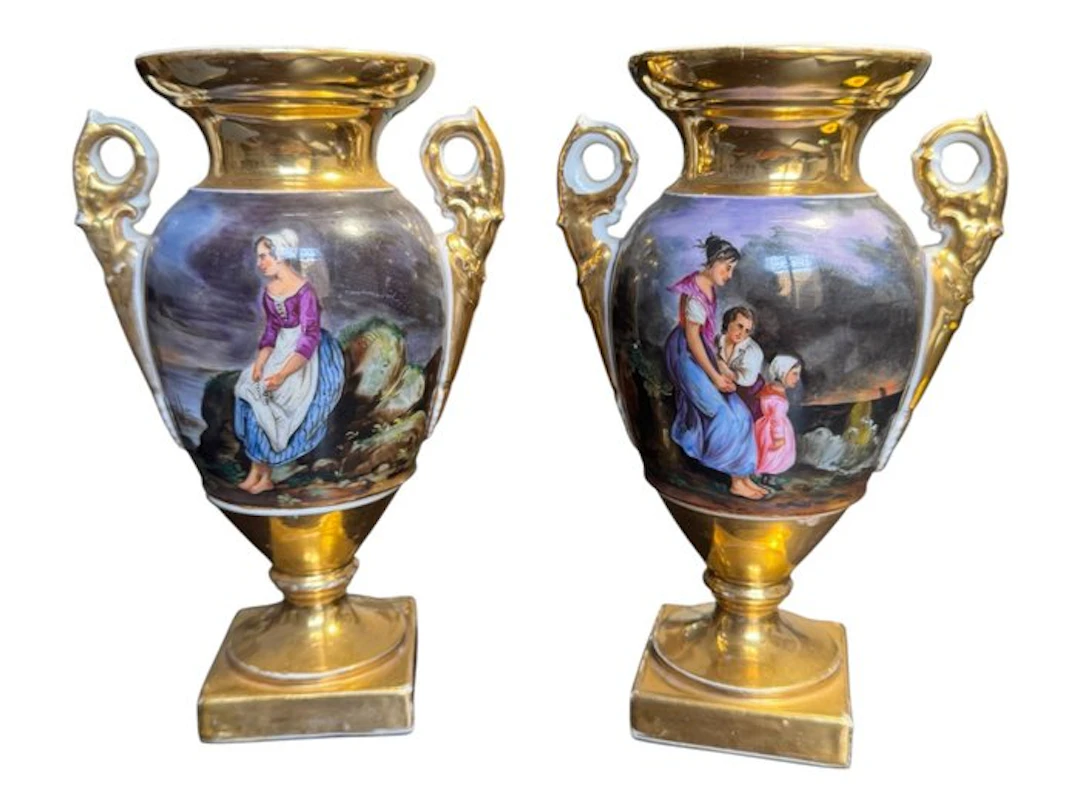
SHIPPING: I can ship within 24–48 hours, which is why the shipping is a little higher; the item will be wrapped with bubble wrap and cardboard with maximum care since it is a fragile and valuable object. In addition, to avoid any issues, it will also be insured. -Are you on vacation? I offer a premium service, maximum delivery flexibility: I can ship to the pickup point nearest to you, so you can collect it calmly whenever you prefer. GUARDED IN A CLOSED DISPLAY I am one of the few sellers who can ship worldwide thanks to possession and registration of the EORI CODE, which ensures peace of mind and faster shipping even outside the European Union. Historical-artistic description Elegant and rare pair of porcelain vases, painted and gilded, attributable in type and decorative language to the Franco-Napolitan production of the first half of the nineteenth century. The neoclassical-style form, with an ovoid body, wide flared neck, sculpted handles, and a square base, directly recalls Parisian porcelains imported into the Kingdom of the Two Sicilies and subsequently decorated in the refined Neapolitan ateliers. The quality of execution of the pair is particularly high. The harmonious proportions, the complexity of the handles, the extensive use of gilding, and especially the meticulously painted figurative scenes indicate a production intended for a high-profile commission, quite different from ordinary serial decorative porcelain. In this kind of object, the vase was not merely an ornament, but a true element of representation for aristocratic and bourgeois interiors of the 19th century. Raffaele Giovine and the Neapolitan milieu In style, subjects, and decorative conception, the pair shows interesting affinities with the work of Raffaele Giovine’s workshop, a famous miniaturist and decorator of porcelains active in Naples in the first half of the nineteenth century. After the crisis of the Real Fabbrica Ferdinandea, white porcelains imported mainly from Paris were brought to Naples and entrusted to local specialists to be painted and gilded. Giovine was one of the most important figures of this phenomenon and enjoyed the patronage of Francesco I of Bourbon, King of the Two Sicilies. The comparison is particularly interesting because many auction houses have documented Parisian porcelain vases, circa 1825, likely decorated in Naples by Raffaele Giovine, characterized by a gilded background and figures or groups of people inserted into Italian rural landscapes. The General Catalogue of Cultural Heritage also preserves works attributed to Giovine in which French porcelain is enriched with figurative painting and gold. Hand-painted throughout The central scenes are painted by hand with an extremely precise painting technique. The faces, hands, folds of the garments, the color variations of the fabrics, and the atmospheric construction of the landscape reveal the miniature taste typical of the finest 19th-century porcelain decoration. The contrast between the intense tones of violet, blue, and pink in the clothing and the darker, more muted landscape that envelops the figures is particularly refined. Raffaele Giovine and his workshop used exactly this repertoire of figurative subjects. The Ministry of Culture documents, for example, a work attributed to Giovine with young women and a child in Neapolitan costumes, linked to the engravings of Raffaele Aloja drawn from designs by Giacomo Milani. This demonstrates how central images of the people and costumes of the Kingdom of Naples were in the decorator’s repertoire. The extraordinary gilding One of the most impressive aspects of the pair is the extremely rich gilding, which covers the neck, the rim, the handles, the lower part of the body, the foot, and the base. The surface still retains considerable luminosity and in many spots presents a nearly mirror-like shine, characteristic of gilding that has been properly fired and subsequently burnished. The breadth of gilded areas required costly and technically delicate workmanship. In 19th-century luxury porcelain, gold was applied to a glazed surface, fixed by firing, and could subsequently be burnished to achieve greater brightness. The conservation of such extensive gilding is therefore one of the most appreciable decorative elements of the pair. The precise composition and karat of the gold, of course, can only be determined by instrumental analysis, not by looking at photographs alone. First vase – female figure in the landscape The first vase features a young woman in traditional dress, characterized by a blue skirt, bodice in violet tones, a light apron, and a headdress. The figure is set in a rocky, natural landscape, built with deep tones and atmospheric transitions. The subject belongs to the nineteenth-century taste for picturesque representations of local populations and their costumes. These images were particularly sought after by Grand Tour travelers and by the European aristocratic clientele, fascinated by scenes of daily life in southern Italy. The figure is not conceived as mere ornament but as a true small painting transferred onto the porcelain surface. Second vase – family group in costume The second vase presents an even more complex composition, with three women of different ages, including a girl, grouped in the foreground within a landscape. The clothing in blue, violet, white, and pink creates a strong focal point against the darker background. The scene can be interpreted as a representation of family or popular life in southern Italy. The presence of an adult woman together with the younger figures gives the composition an intimate, narrative character. The subject finds significant parallels in Neapolitan repertory of the time, and, in particular, in depictions of women and children in costume associated with the circle of Raffaele Giovine. Historical context In the period roughly between 1820 and 1840, Naples was one of the leading European centers for porcelain decoration. Unpainted porcelains could be purchased from French manufactories and subsequently transformed by Neapolitan artists into luxury wares. Museum documentation also confirms that Giovine’s workshop worked on porcelains from important foreign manufactories. Giovine himself had relations with the Bourbon court, and his workshop produced objects intended as royal and diplomatic gifts. Notable works attributed to him include large vases with portraits of the Bourbon royal family.
Estimación:€700
Ir a la subastaEstimación:
€700

OCT 8 | 3:00 PM
¡Lleva tu subasta a coleccionistas de todo el mundo!
Publica ahora€739.09