"The Short Happy Life of Francis Macomber"
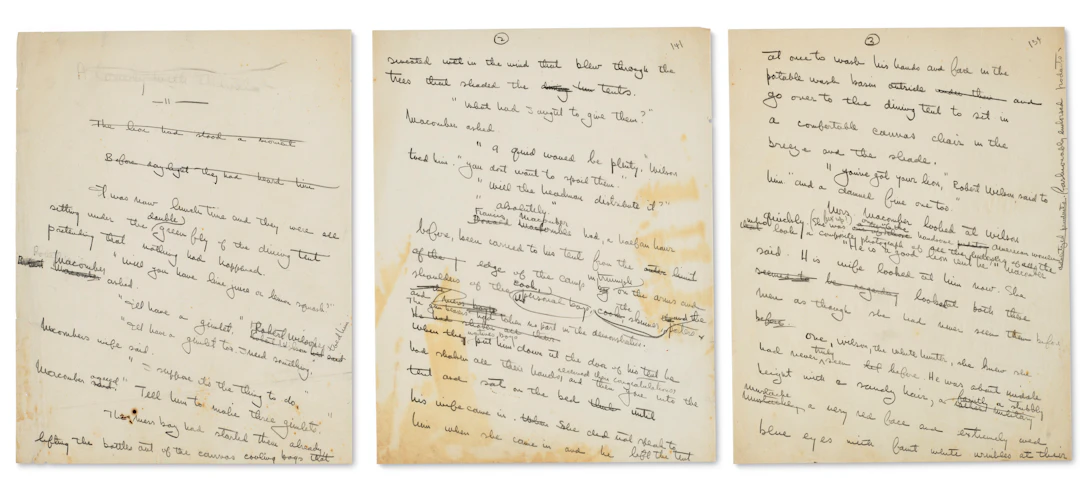
HEMINGWAY, Ernest (1899-1961). "The Short Happy Life of Francis Macomber." [Key West, finished April 1936]. 104 pages (including three inserted pages), 270 x 210mm, in pencil on rectos only (first few leaves with some creasing/stains and a few mended tears; acidic paper stock with mostly marginal minor losses except for pp 55/58/64 which are repaired at margin with loss to a few words in 55⁄58; light tidemark at lower edge of p 95 to end; overall excellent condition considering the quality of the paper). Housed in custom red archival binder, chemise, and morocco-labelled slipcase, with each leaf in its own acid-free sleeve. A working first draft with very extensive revisions by Hemingway of one of his longest and finest stories. “Wearing down seven number-two pencils is a good day’s work" (Hemingway Paris Review interview) Hemingway seems to have made a start on "The Short Happy Life of Francis Macomber" in fall 1934, but it wasn't until spring 1936 that the safari tale—which had been developed along with "The Snows of Kilimanjaro" (his only other story set in Africa)–began reaching its final form. After rejecting a number of titles—the tentative "A Comedy with Animals" has been erased at the head of the first page, but is discernable—Hemingway gave the story its present title. It is his longest story both in terms of manuscript length ("Big Two-Hearted River" is next) and printed text (edging out "The Undefeated" by some three pages). "The Short Happy Life of Francis Macomber" was first published in Cosmopolitan (September 1936) and was then collected in The Fifth Column and the First Forty-nine Stories (1938), where it is the opening story. It has since become one of his most celebrated and reprinted stories. ( The Macomber Affair , a movie based on the work and with a script more faithful to Hemingway's text than most, was released in 1947). "Short Happy Life" is the story of a 35-year-old wealthy but emotionally immature American sportsman on his first safari in East Africa with his wife of eleven years, Margot, and a skilled but white hunter, Robert Wilson. During a lion hunt Francis is overcome by fear and bolts when the wounded beast springs; the lion is then bravely killed at close range by the seasoned but cold and morally compromised Wilson. Margot, described as a beautiful socialite, is unhappy and bitterly contemptuous of her husband; she seemingly taunts him and has an affair with the white hunter (who travels with a double-size cot for just such circumstances). The next day during a buffalo hunt when they encounter three large bulls, Francis is able to conquer his fear. During his brief period of elation over his newly found courage and assertiveness, he lives his "short happy life." In his excitement, however, he aims too high at a charging wounded buffalo. He adjusts his aim and then feels a "sudden white-hot, blinding flash explode inside his head and that was all he ever felt." Hemingway describes it most exactly: "Mrs. Macomber, [who had been left behind] in the car, had shot at the buffalo with the 6.5 Mannlicher as it seemed about to gore Macomber and had hit her husband about two inches up and a little to one side of the base of his skull." Was it an accident? Readers have never been able to resolve her intentions. The character of Margot was notably based on the socialite Jane Kendall Mason, who was a muse and rumored lover of Hemingway's. She was also the model for Helene Bradley in To Have or Have Not . Probably at some point in the spring or summer of 1936 Hemingway gave Jane Mason this manuscript: the portrait, no matter how unflattering she might have found it, was at least of her. It was in her papers that the manuscript was first rediscovered in 2000. "The Short Happy Life of Francis Macomber" was written when Hemingway was at a peak of his creative powers—"The Snows of Kilimanjaro" and "The Capital of the World" also date from this time—and the manuscript exhibits his artistic command of the material. Although there are extensive revisions, the manuscript is very close to the printed text. The dialogue comes out very nearly as in the published form: whole pages are written with little or no revisions. Most of Hemingway emendations involve descriptions of terrain or landscape or of his characters: at pages 21-22, for instance, nearly a page of manuscript is crossed out; in several other places whole sentences are scored through and throughout the manuscript single words and phrases are altered. At the very beginning two false starts are crossed out; and in the early pages Macomber's name changes from "Robert" to "Donald" to finally "Francis." But once Hemingway gets underway, the story which had germinated since his own African safari of 1933-34, pours forth from his pencil (actually pencils, since several were used). There are extensive insertions interlinear and continuing into margins—often added the next day after Hemingway read over his work. All of his crossed through copy, since it is done in pencil, can easily be read. In a story that is complex in shifting points of view and in time changes, the following quotation from the manuscript—one amazing sentence—shows Hemingway at work (replaced words are in brackets): "He heard the [roar cara-wong] ca-ra-wong! of Wilson's big rifle, and again in a second crashing [roar] carawong! and turning saw the lion, horrible looking now, with half his head seeming to be gone crawling toward Wilson in the edge of the tall grass while the red faced man worked the bolt on the short ugly rifle and aimed carefully as another blasting carawong! came from the muzzle and the [great, pitiful] crawling, heavy, yellow bulk of the lion stiffened and the huge, mutilated head slid forward and Macomber, standing by himself, in the [field] clearing where he had run holding a loaded rifle, while two black men and a white man looked back at him in contempt, knew the lion was dead." Of other manuscripts of the story, Young and Mann 81 A-D list four autograph manuscript fragments, totaling 16 pages, of "an extremely early draft" at the John F. Kennedy Library; and Hanneman F6a locates a "corrected typescript, signed, 39 pages," at The Morris Library, Southern Illinois University at Carbondale.
Estimación:€176,004
Ir a la subastaVer todos los artículos deChristie'soLibros, mapas, papel & manuscritos