




Todas las subastas / Juguetes y otros coleccionables / Tamiya - Toy Lotto "Germania 1939/45" con 5 kit nuovi da...

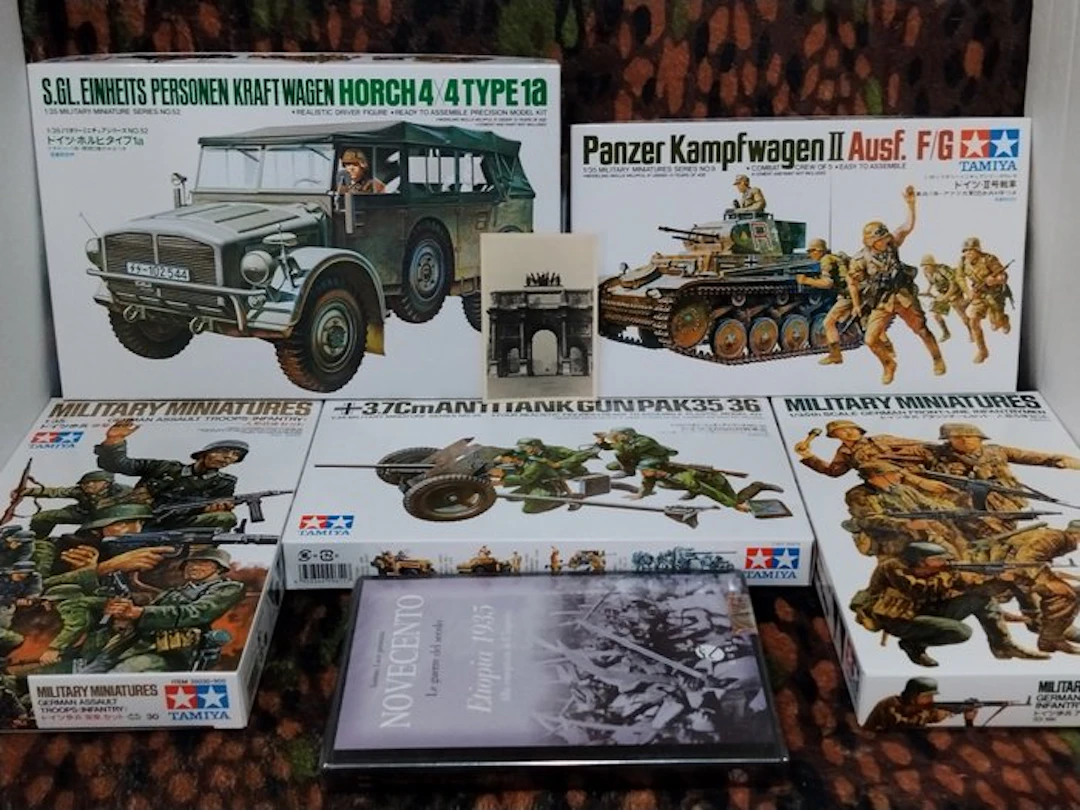
Lotto Tamiya 'Germany 1939/1945' with 5 new plastic kits to assemble and paint in 1:35 scale + 1 photograph from 1943 + 1 DVD: 1) 1 panzer + 5 figures in tropical uniform 2) 1 vehicle + 1 figure 3) 1 anti-tank cannon + 4 figures 4) 1 German assault troops kit with 5 figures 5) 1 assault troops kit with 8 figures 6) 1 sealed history DVD 7) 1 photograph from 1943 The lot contains in total: 1 Panzer + 1 car + 1 cannon + 23 figures + 1 photograph + 1 DVD - Static modeling of military vehicles allows you to immerse yourself in the history and technology of the machines used in war. You can faithfully reproduce artillery, tanks, half-tracks, wheeled and tracked vehicles, dedicating many hours to building the models and using materials such as plastic, metal and wood. With this hobby you can appreciate the beauty and complexity of these vehicles, as well as their strategic importance. Your collection of finished models will be a real miniature museum, telling the history of many conflicts and battles. Discover the pleasure of building your own collection of static military vehicle modeling in miniature with static modeling, and immerse yourself in the history and technology of the machines used in war. 1) German Panzerkampfwagen II Ausf. F/G - type: medium tank - Tamiya - Limited Edition - code: 35009 - scale: 1:35 - nation: Germany - period: 1939/1945 - includes: 5 figures in tropical uniform - kit new/sealed bags - plastic kit to assemble and paint - glue and paints not included Manufacturer information: kit for assembling a 1/35 scale plastic model depicting the Panzerkampfwagen II, which contributed to the early German successes in World War II. The compact shape of the armored vehicle with a 20 mm cannon is captured in style. The commander's hatch can be assembled open or closed. It features five figures, 1 in tropical uniform and 4 in Afrika Korps attire. 2) S.GL. Einheits Kraftwagen Horch 4x4 Type 1A - type: heavy multi-role vehicle - Tamiya - code: 35052 - scale: 1:35 - nation: Germany - period: 1939/1945 - includes: 1 figure - kit new/sealed bags - plastic kit to assemble and paint - glue and paints not included Manufacturer information: this plastic assembly kit recreates the Horch Type 1a, a vehicle used by German forces during World War II to transport personnel, weapons and more. Notable features such as side spare wheels and complex suspension are presented with ease. The front window can be depicted lowered, or folded and covered with a tarp, while the fabric hood can be mounted vertical or horizontal. Includes components to recreate the MG34 machine gun, as well as the pilot figure. 3) German 37mm Anti-Tank Gun - type: anti-tank gun - Tamiya - code: 35035 - scale: 1:35 - nation: Germany - period: 1939/1945 - includes: 4 figures - kit new/sealed bags - plastic kit to assemble and paint - glue and paints not included Manufacturer information: this is a 1/35 scale plastic model kit depicting the 37 mm Pak35/36 anti-tank gun used by German forces in World War II. The gun consists of many parts for an authentic look. It features elevating and traversing movement. Choose between standard and late-war barrels. Comes with various accessories and four figures as a self-contained diorama. 4) German Front-Line Infantrymen - Tamiya - code: 35196 - scale: 1:35 - nation: Germany - period: 1944/1945 - includes: 5 figures - kit new/sealed bags - plastic kit to assemble and paint - glue and paints not included Manufacturer information: during World War II, German soldiers from armored divisions wore camouflage smocks and M44 field uniforms. This is a plastic kit of five figures featuring a non-commissioned officer and a soldier in loading poses armed with a Panzerfaust and an MP44 assault rifle, a soldier firing with a MG42 from his torso, a soldier throwing a hand grenade, and another NCO firing his MP44 from his knees. The weapons and accessory parts such as water bottles and gas mask canisters have a sharp and detailed finish. 5) German Assault Troops - Tamiya - code: 35030 - scale: 1:35 - nation: Germany - period: 1939/1945 - includes: 8 figures - kit new/sealed bags - plastic kit to assemble and paint - glue and paints not included Manufacturer information: it is a 1/35 scale plastic model kit depicting the German assault troops of World War II. From the officer directing his troops to soldiers brandishing weapons and other accessories, the set is full of life thanks to realistic poses. Uniforms depicted range from mid-World War II onwards. 6) Istituto Luce - Series: Novecento - The Wars of the Century - Issue 11: Ethiopia 1935 - The Conquest of the Empire - black and white historical document - Istituto Luce - DVD Video - Univideo - year: 2004 - language: Italian - duration: 45' - condition: sealed 7) Photograph from 1943 - dimensions: 9.5 x 6.5 cm - used, good condition, ordinary signs of use and time - The Panzer II was designed in the early 1930s as a replacement for the light Panzer I (produced in about 2000 units) to meet the Wehrmacht’s need for a new light tank. Powered by a rear-mounted Maybach 140 HP engine, it could reach a top speed of 40 km/h and a range of 200 km. Armament consisted of a 20 mm cannon and a coaxial MG34 7.92 mm machine gun mounted in the turret. The light armor never allowed it to be used extensively as a combat vehicle during World War II, quickly outclassed by the much more powerful and armored Pz.Kpfw. III and IV. Its high mobility, however, made it ideal for forward reconnaissance roles. It was used throughout the conflict by German armored divisions as a reconnaissance and infantry-support tank. It formed the core of German armored divisions during the campaigns in Poland and France, and was used also during the invasion of the USSR in 1941, though its parameters were surpassed. It was almost completely withdrawn from the front lines between 1942 and 1943, relegated to training, crowd control and anti-partisan duties; the versatile hull was reused for several self-propelled and anti-tank projects. - The Horch 1A was a German heavy off-road car used during World War II. The first prototypes were built in the mid-1930s, with serial production starting in 1938 and ending in 1941. The vehicle length was 4.85 m, height 2.04 m, width 2 m, and empty weight up to 3,600 kg. The transmission came from a single Auto-Union eight-cylinder engine with a capacity of 3.8 liters and up to 81 HP. Over time, however, the engine was replaced in Germany with a Ford-produced engine of 78 HP. The Horch 1A was developed to meet the needs of the German armed forces, who, together with rapid growth after 1933, aimed to obtain a universal, light, and potentially reliable passenger off-road vehicle. Horch’s plant met these needs by developing the vehicle shown below. The vehicle uses features such as all-wheel drive, independent suspension on each wheel, and the ability to turn all wheels. It is worth noting that during World War II the car’s design was simplified, for example by removing recesses in the fuselage for spare wheels. The Horch 1A served in the German armed forces on virtually all fronts until 1945. - The 3.7 cm anti-tank gun, from Rheinmetall, was the first of the modern anti-tank artillery designed for anti-armor combat and was widely used in the first decade of service. Designed in 1925 for the German army, it initially had wooden spoke wheels, later replaced with solid steel wheels as motorized vehicles became more widespread. The new gun was called the Pak 35/36, had a 45-caliber barrel, a well-sloped shield, a very light weight (440 kg in travel position, 328 in combat) and a firing angle of -8/+25 degrees. The projectile with initial velocity of 750 m/s could penetrate 38 mm at 30 degrees at 360 meters, weighing 350 g. There were HE projectiles of 650 g. Production, initially limited, exploded after Hitler’s rise to power. The gun was widely exported: Ethiopia (where it was used against Italians), Italy (“37/45 gun”), the Netherlands, the Soviet Union (M1930), Japan and studied by US technicians for their own weapon of similar caliber. In the first year of World War II it was used successfully both as a towed weapon and as a tank gun under the designation 3.7 cm KwK 36. Mobility and aggressive tactics of Pak units were the reason for their successes, even against well-protected English and French tanks (Char B1, SOMUA S35, Mk II Matilda) but less mobile that could be attacked on the flanks and hit on the tracks. Also in the USSR the gun had success, thanks to the light armor of T-26 and BT-7 tanks, which were wiped out in their counterattacks against German positions, rapidly defended by mobile anti-tank units. Against the T-34 they were also used, but the era of the 37 mm gun had ended, and the only way to stop new Soviet vehicles was to shoot at the tracks or at the turret ring, trying to jam it. Then there was quickly a need to double the caliber of anti-tank weapons. In the final stages of the war, a special projectile was devised that, fired from a projectile inserted at the muzzle, could cause devastating damage. It was a hollow-charge projectile consisting of a body with escape holes and metal fins to stabilize its trajectory, since the projectile had no spin, the warhead contained, indeed, a hollow-charge warhead with a highly sensitive fuze: the projectile was not screwed, but simply slid onto the muzzle of the 3.7 cm. Inside the projectile there was a cylindrical rod, fixed to the projectile, that extended into the bore and had a seal to prevent loss of launch charge power. The projectile weighed 8.5 kg and the muzzle velocity was 110 m/s. The 3.7 cm anti-tank gun remained in front-line service apparently longer than expected, but this was justified by the introduction of a new projectile called 3.7 cm Pak Pzgr 40, which increased its penetration by 30 percent. - Note: I attach great importance to correct description and good photos of the lot. The photos are part of the lot description and provide a lot of information on the lot, its condition and completeness. I always advise studying the numerous photos carefully. Photos always take precedence over the written text. - Photos of the assembled and painted model are for illustration purposes only. - For destinations outside the continent including islands and overseas territories, additional charges will apply. Tracked shipping.
Estimación:€20
Vendido por€20
Ver todos los artículos deCatawikioJuguetes y otros coleccionables
Vendido por:
€20
Estimación:
€20
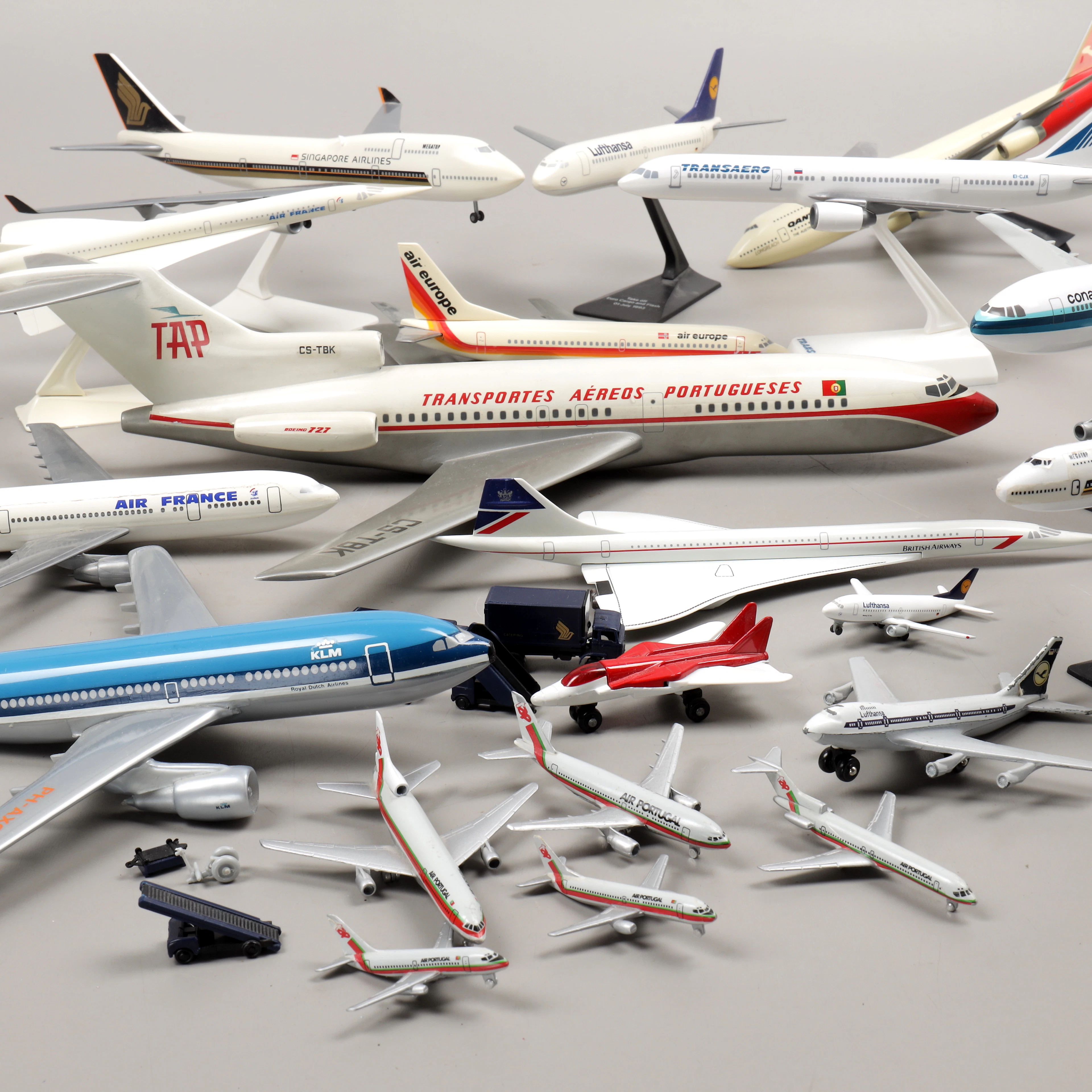
MODELLFLYGPLAN med mera, 26 delar, 1900-talets andra hälft.
10/21/2026
€116.93
Est.: €179.76

LISA LARSON. Figuriner, 4 dlr, "Adam I", "Eva I" samt "Adam II", Eva
10/21/2026
€238.18
Est.: €269.64


OCT 27 | 4:00 PM
¡Lleva tu subasta a coleccionistas de todo el mundo!
Publica ahoraAl suscribirte, aceptas la política de privacidad. Cancela tu suscripción en cualquier momento.
Barnebys HQ
Brahegatan 10
BOX 5038
114 37 Stockholm
