Sceau chinois de lettré en agate-calcédoine et cornaline...
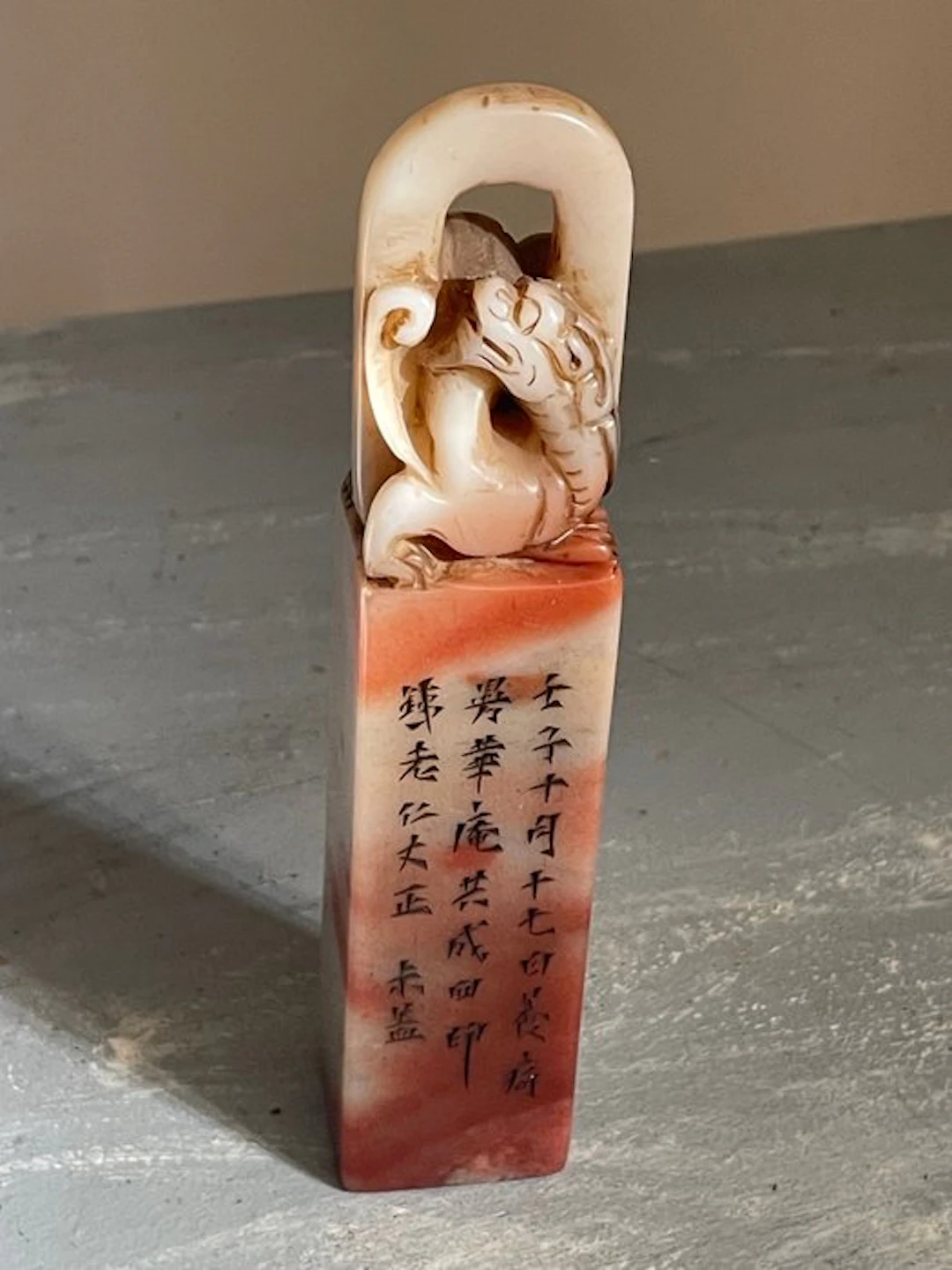
Chinese Scholar’s Seal The stone displays remarkable natural variations, ranging from cream-white, slightly translucent, to red-orange and brownish-red of carnelian-type, contrasts that the sculptor has exploited in creating the decorative motif. The upper part is entirely carved in the round and partly pierced. It depicts a chilong dragon (螭龍) with a sinuous body, coiled around the summit of the seal. The chilong, an archaizing dragon in Chinese tradition, enjoys particular favor in courtly arts and among scholar’s objects during the Qing dynasty. During the reign of Emperor Qianlong (1736-1795), taste for forms inspired by ancient Chinese antiquity was especially developed: archaizing dragons, motifs from ancient bronzes, and hard-stone sculptures were reinterpreted with rich decorative flourish. On this specimen, the treatment of the dragon — heavily contorted body, rounded volumes, deep carving and openwork separating certain parts of the animal from the mass of the stone — contributes to this archaizing aesthetic associated with the Qing productions and constitutes one of the elements supporting stylistic attribution to the Qianlong period. Inscriptions One side bears an important Chinese inscription engraved vertically in three columns, in literary style. It includes notably a calendrical indication in 壬午 (rénwǔ), “Renwu year,” paired with an indication of the tenth month, as well as various literary expressions. Among the identifiable characters is 翠華 (cuìhuá), a traditional poetic expression capable of evoking the entourage or imperial presence. Also noted is 愛石 (ài shí), literally: “loving stones” / “stone enthusiast” A phrase particularly appropriate to the world of Chinese literati and collectors, for whom stones, seals, calligraphy and ancient objects occupied an important place. The overall meaning of the inscription can be rendered thus: “In the year Renwu, in the tenth month... [evocation of] the presence or the imperial entourage in the capital... Inscribed/composed on this day, by the stone lover.” Some parts evidently correspond to a name, a literati pseudonym, or signature formula and are kept in their calligraphic form. Base of the seal The base constitutes the impression matrix of the seal. It is deeply engraved with large Chinese characters extremely stylized in seal script 篆書 (zhuànshū), the script traditionally associated with the Chinese seal arts. The characters are stretched and interwoven to form a composition that harmoniously occupies the entire surface of the matrix. The seal was intended to be branded with red seal paste and then applied to a painting, a calligraphy work, a document or a book. The object thus brings together several emblematic elements of literati Chinese culture: hard stone, chilong dragon sculpture, archaizing references, calligraphy, and the seal-cutting art. Attribution: China, Qing dynasty, Qianlong period (1736-1795) Dating proposed: 18th century Material: white chalcedony-agate with red-orange zones of carnelian type Summit decor: carved and openwork chilong dragon (螭龍) Inscription: three-column calligraphic text with calendrical indication and literary elements Bottom: matrix in seal script (zhuanshu) Function: scholar’s seal / collection seal.
Estimación:€3
Ir a la subastaVer todos los artículos deCatawikioArte Asiática