
Todas las subastas / Arte, Pintura & obra gráfica / René Magritte (1898-1967), after - De man met de bolhoed

René Magritte (1898-1967), after - De man met de bolhoed
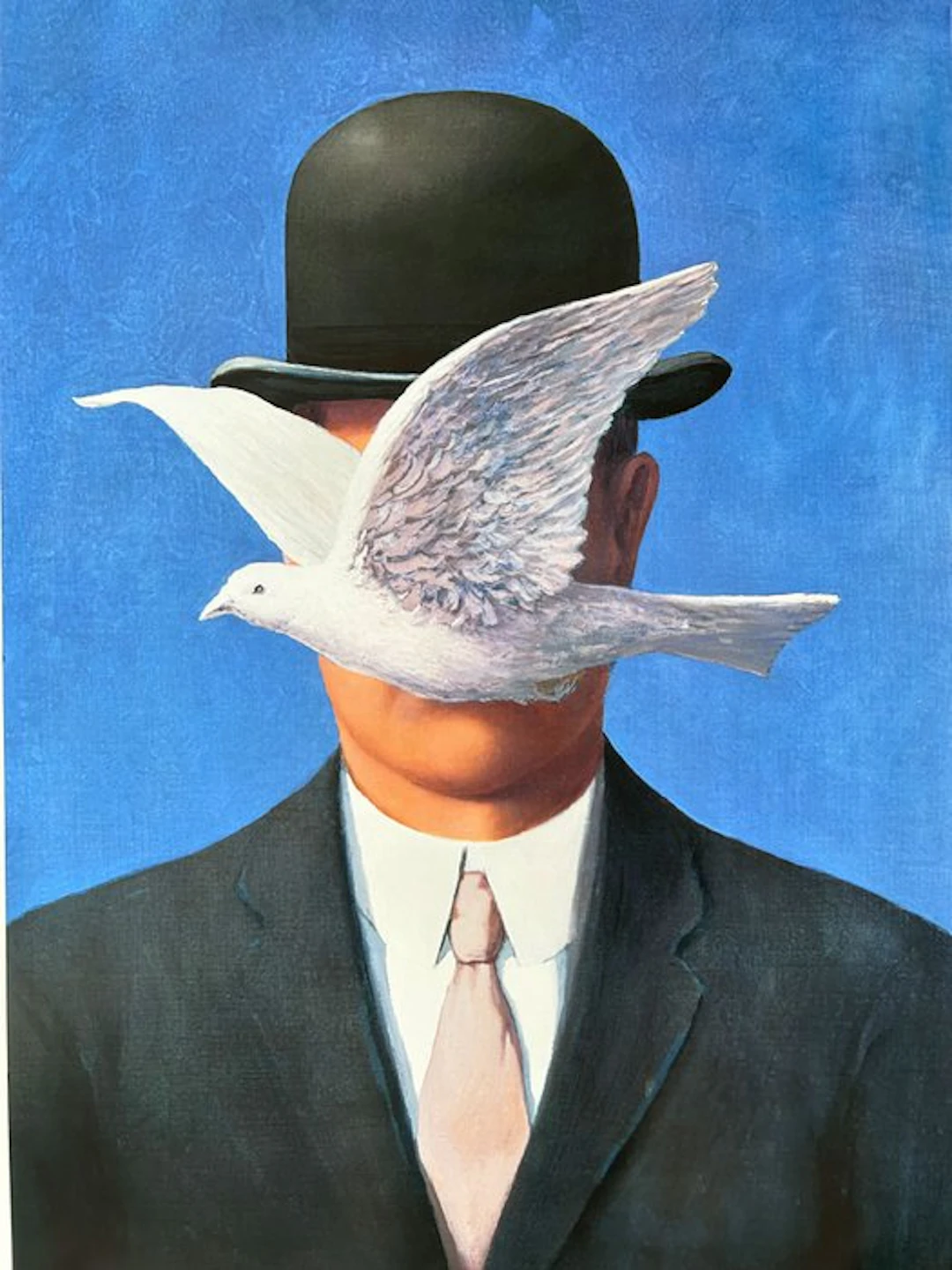
René Magritte - The Man with the Bowler Hat - Offset lithograph/poster print - 70 x 50 cm Name: René Magritte Title: The Man with the Bowler Hat Type: Original art poster - High-quality offset print/poster reproduction of the original work from 1954 Publisher: KMSKB - Magritte Foundation - Standaard Uitgeverij Style: Modern - Surrealism Characteristics: - Mint condition: A+ - 70 x 50 cm - Signed in print - Based on the original work by Magritte from 1954 EXTRA ARTIST INFO: René François Ghislain Magritte (Lessines, November 21, 1898 – Schaerbeek, August 15, 1967) was a Belgian surrealist painter. Magritte initially worked as a designer at a wallpaper factory and later also created many posters. Magritte's debut in painting was in a cubist, futurist, and abstract style, influenced by his supervisor Victor Servranckx at the wallpaper factory UPL (Les Usines Peters-Lacroix, in Machelen). After encountering Giorgio de Chirico's work in 1925, Magritte began to assimilate surrealist elements. De Chirico depicts objects in a very realistic manner but in entirely different causal and temporal contexts. In this way De Chirico emphasizes the enigmatic nature of the world of objects. The conventional order and placement of things are thus ironized. Magritte primarily created paintings (oil on canvas), but also gouaches, objects, and collages. Under the guidance of E.L.T. Mesens, he contributed to the journal Oesophage and in 1927 had his first solo exhibition at the gallery "Le Centaure" in Brussels. Between 1927 and 1930 Magritte stayed in a suburb of Paris, where his surrealist vision was rewarded with the friendship of Paul Éluard and André Breton, who had already written The Surrealist Manifesto in 1924. When Breton insisted that Magritte's wife remove a cross pendant, he decided to return to Brussels.[1] When in 1930 the "Galerie Le Centaure", where Magritte was under contract, went bankrupt, E.L.T. Mesens was able to purchase all his works, at that time about 200. In 1934 Magritte and his entourage applied the technique of the cadavre exquis to images in the wake of the linguistic experiments in which a poem is written by multiple poets. Between 1934 and 1937 Magritte, under the pseudonym 'Emair', drew film posters for the German sound film distributor Tobis Klangfilm. The City Archive of Leuven preserves seven posters designed by Magritte. During World War II Magritte worked and lived in the French town of Carcassonne. He forged art to support himself, mainly works by De Chirico, Picasso, and Braque.[1] During a short period, between 1940 and 1946, Magritte enriched his palette slightly with an impressionistic accent (the so-called 'Renoir period') on the advice of his agent. This style sold better. In 1945, after his return to Belgium, he joined the Communist Party of Belgium. In 1948 he briefly painted in a cartoon-like style, but also without success.[1] But after a short time Magritte returned to his earlier, almost photorealistic style, somewhat more aggressive, due to the turbulent relationship with his former surrealist circle (Goemans, Scutenaire, Nougé, Lecomte, Souris, E.L.T. Mesens). Magritte's black humor often led him to morbid imagery, further surrealized by sometimes impossibly unlikely titles he gave his works. In 1953 Magritte created the wall paintings in the Casino of Knokke on the Belgian coast, commissioned by the Nellens family. These are now protected by the Royal Commission for Monuments and Landscapes. In 1960 he was awarded the Belgian State Prize for all his work, the first time the prize had been awarded to a painter. In the 1950s Magritte's work was highly sought after by New York collectors. This explains the prominent presence of Magritte's work in American collections today. His best-known icon La Trahison des Images is also there. Magritte died in 1967 in Schaerbeek of pancreatic cancer and is buried in the municipal cemetery there. The majority of Magritte's oeuvre, stylistically, belongs to surrealism, one of the major art movements of the 20th century. In many works, naked women and accurately painted fish appear. This is probably a reference to the fact that Magritte found his mother naked in the Sambre after she had committed suicide. Magritte's work, like that of Salvador Dali and Carel Willink, is very finely painted, which emphasizes the realistic effect of imagery that would be impossible in reality. The best-known Magritte work is without a doubt La Trahison des Images (1928-29) or "The Treachery of Images" with the painted caption: Ceci n'est pas une pipe under a highly realistic image of a pipe. In this painting Magritte depicts a pipe with the caption: This is not a pipe. He wants to remind himself and the viewer that this is a painting, not a real pipe. Any reference to a real pipe betrays the fact that a pipe is, in fact, an idea and thus originates in the mind. By continually questioning ourselves and deceiving, Magritte forces us to think about art. In that light, the titles of Magritte's works can be seen as well. These titles usually have little to do with the painting's subject. Later conceptual artists pushed this line to the extreme with installations, performances, or happenings and reduced the artwork to an idea. This is also a critique of artists who believe they must depict reality as truthfully as possible, such as the later hyperrealists. René Magritte believed that the painter's task is to place reality in another frame. His art always raises more questions than it answers. A testament to this is the painting of a mermaid, depicted with a fish head and human legs. A sketch is also the painting of a very realistically depicted fish that, at its tail end, becomes a burning cigar with curling smoke (painting "l'Exception" 1963). Magritte's work also shows an exceptionally high mastery of oil painting on canvas. Much of Magritte's work shows metamorphosis, a transformation of one object into another. Or the work is otherwise impossible, for example the series of houses at night with a bright daylight sky above. Or a moon hanging over the leaves of a tree. Owls or other birds emerging from the ground like plants. He is related to the following artists: Morris Louis Yves Klein Lucio Fontana Piet Mondrian Niki de Saint Phalle Otto Piene Heinz Mack Kazimir Malevich Jean Tinguely Rainer Maria Latzke Jef Verheyen Pol Bury Walter Leblanc Rene Magritte André Racz Pierre Alechinsky Victor Vasarely Georges Vantongerloo Yves Klein Otto Piene Heinz Mack Lucio Fontana Piero Manzoni Jesús Rafael Soto Victor Vasarely Karl Otto Götz Gerhard Richter Anselm Kiefer Georg Baselitz Jannis Kounellis Cy Twombly Antoni Tàpies Hans Hartung Pierre Soulages Mark Rothko Kazuo Shiraga Bridget Riley Agostino Bonalumi Jean Tinguely Niki de Saint Phalle Guy Vandenbranden Marcel Duchamp Joseph Beuys Jean Tinguely Alexander Calder Nam June Paik Claes Oldenburg Chris Burden Richard Buckminster Fuller Karel Appel Asger Jorn Constant Nieuwenhuys Corneille Jean Dubuffet Jackson Pollock Willem de Kooning Hans Hartung Joan Miró Antoni Tàpies Sam Francis Franz Kline Mark Tobey André Masson Lucio Fontana Eduardo Chillida Kazuo Shiraga Zao Wou-Ki
Estimación:€150
Ir a la subastaVer todos los artículos deCatawikioArte, Pintura & obra gráfica
Estimación:
€150
Artículos similares

Resultados de subastas para artículos similares
A group of Thirteen framed works: 19th century cut-paper sil...
09/30/2026

€17.59
Est.: €23.33
A group of Thirteen framed works: 19th century cut-paper sil...
09/29/2026
€17.56
Est.: €23.31
Pauline Duvernay som Nayade i Jean-Pierre Aumers Törnrosa i skogen
07/17/2026
€77.64
Est.: €360.62
¡Lleva tu subasta a coleccionistas de todo el mundo!
Publica ahora