
Todas las subastas / Varios / Pieter Paul Rubens (1577-1640), Follower of - Il Giudizio di Salamone

Pieter Paul Rubens (1577-1640), Follower of - Il Giudizio di Salamone
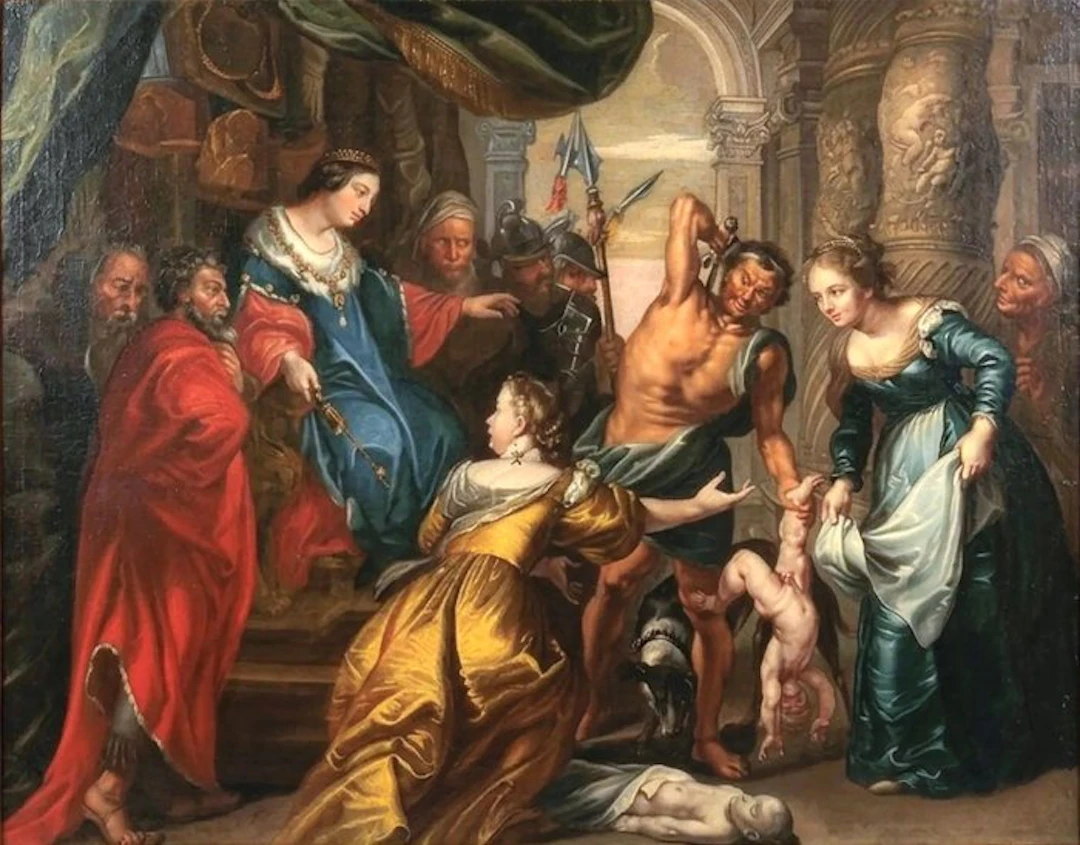
Follower of PIETER PAUL RUBENS (Siegen, 1577 – Anversa, 1640) Salomone’s Judgment Oil on canvas, cm. 82 x 104 Frame size cm. 94 x 116 x 5 approx. NOTE: Publication catalog of works from the Intermidiart collection. Certificate of Legitimate Provenance. Work with gilded and elaborated frame (defects): We present in the catalog a splendid oil on canvas, true pittorial jewel executed with notable technical skill, depicting a subject iconographically of great fortune in the artistic tradition and widely attested in Christian art: the biblical episode of Solomon’s Judgment (1 Kings 3, 16-28). The scene represents the culminating moment in which King Solomon orders the division of the contended child into two, thus testing the mothers’ maternity to identify the true mother, willing to renounce the child to save its life. The episode indeed tells of two women living in the same house, both mothers of a baby. During the night, one of the children dies; the mother, realizing the tragedy, substitutes her dead son with the living child of the other woman while she sleeps. Brought before Solomon, both claim the motherhood of the surviving infant. In the absence of witnesses or certain proof, the sovereign orders the famous “test of the sword,” commanding to divide the living child in two and assign one half to each woman. At that moment, the true mother, moved by supreme compassion, begs the king not to kill the son and to give him to the other woman instead, in order to save his life. The other, conversely, coldly accepts the division, declaring: “Neither mine nor yours; cut him in two.” Solomon immediately recognizes the first as the authentic mother and entrusts her with the child, thus revealing his wisdom. The style, the chromatic range and the typology of the protagonists suggest a northern European origin of the author and an evident correlation with the version on panel realized by Pieter Paul Rubens (Siegen, 1577 – Anversa, 1640), today preserved at the Statens Museum for Kunst in Copenhagen and largely attributed to the workshop (Jaffé 1989, p. 218, no. 371, ill.). The original prototype, dated 1616 and now lost, was probably destined for the Court Room in the Town Hall of Brussels (see O. Koester, Flemish Paintings 1600–1800, Copenhagen 2000, pp. 198-204). The extraordinary critical and figurative fortune of the model is documented, with numerous replicas and copies known (see Jaffé 1989, p. 218, no. 371), today housed in museums and private collections, among which Delft, Rouen, Courtrai, the Liechtenstein Museum in Vaduz and the Seville Cathedral. Stylistically, the work fits coherently within the great Flemish Baroque sacred painting of the 17th century, revealing the hand of a painter with solid training and assured execution. The composition, of intense emotional impact, combines formal rigor with painterly ease, employing a vibrant chromatic language and effective chiaroscuro contrasts, clearly derived from the lesson of Peter Paul Rubens (Siegen, 1577 – Anversa, 1640). The present painting, presumably attributable to a follower or an artist active in the Rubens circle, shows significant iconographic, chromatic and compositional affinities with the works of the great Flemish master and his closest collaborators. While maintaining a prudently formulated attribution, one cannot rule out the involvement of a high-quality painter working near Rubens’ workshop in the 17th century. Executed by a hand of undeniable quality, the work stands out for the careful orchestration of the scene, the balance of the figures, and the skilled use of color, elements that testify to a deep interpretive sensibility and solid figurative culture. It is, therefore, a painting of notable historical-artistic interest, worthy of further critical investigation and specialized study, for both its iconographic value and the high quality of its execution. Regarding its conservation state, the canvas presents generally fair conditions considering the painting’s age, the surface shows a patina. Visibly, the painting shows losses, color losses clearly visible from photos, scratches, stains, warping and restorations with small pigment reinforcements and abrasions. The surface is also covered by an old protective varnish that has oxidized. This patina alters the original brightness of the colors, giving the entire composition a warm, amber tone. The stability of the canvas suggests that the work may have undergone a past lining consolidation. The condition report we provide should be understood as accurate and thorough but in any case partial and not exhaustive, as it was not performed in specialized laboratories with technical equipment. Under sunlight a fine craquelure is visible, related to the period. The canvas measures cm. 82 x 104. The work is enriched by a beautiful gilded frame, very striking (frame dimensions cm. 94 x 116 x 5 approx., with defects). “The frame shown in the photos above has been added to the artwork by the seller or by a third party. The frame is provided at no additional cost so that it is ready for display upon arrival. The frame is included as a courtesy and is not considered an integral part of the artwork. Therefore, any potential damage to the frame that does not affect the artwork itself will not be accepted as a valid reason to open a claim or request order cancellation.” PROVENANCE: Private Collection PUBLICATION: - UNPUBLISHED QUADRERIA, General Catalog of the paintings of the Intermidiart Gallery collection by Andrea Maggio, 2026 (pdf). The work will be shipped – due to its fragility – with a wooden crate and polystyrene. In case of sale outside Italian territory, the buyer must wait for export procedures to be completed.
Estimación:€5,000
Ir a la subastaEstimación:
€5,000
Artículos similares

Resultados de subastas para artículos similares





¡Lleva tu subasta a coleccionistas de todo el mundo!
Publica ahora