

OCT 8 | 3:00 PM

¡Lleva tu subasta a coleccionistas de todo el mundo!
Publica ahoraAl suscribirte, aceptas la política de privacidad. Cancela tu suscripción en cualquier momento.
Barnebys HQ
Brahegatan 10
BOX 5038
114 37 Stockholm
Todas las subastas / Arte Antiguo / Levant Terracotta Levantine Terracotta Figure of a Female...

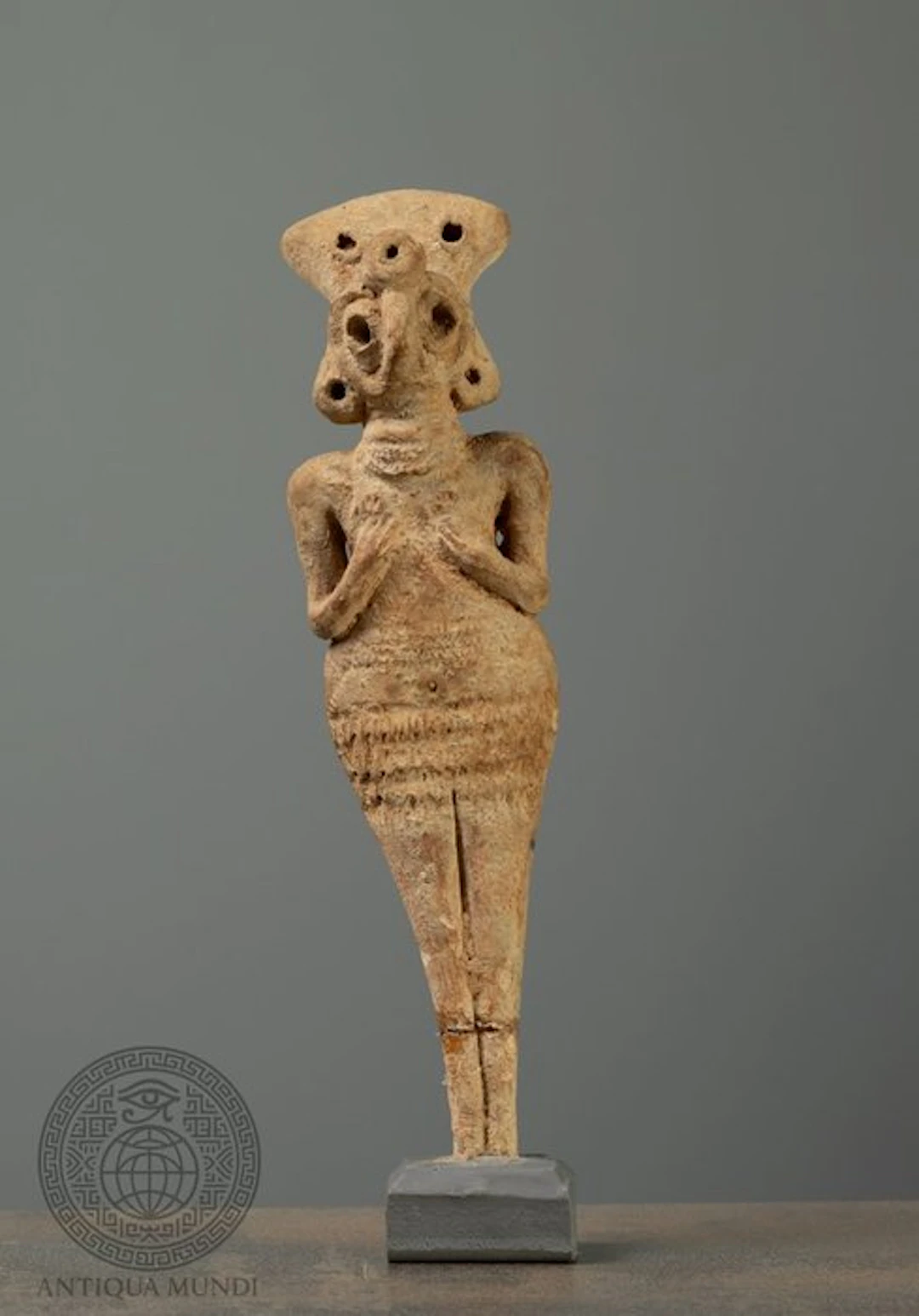
An unusual hand-modelled terracotta figure representing a highly stylised female figure, belonging to the Bronze Age coroplastic tradition of the Levant and the wider Ancient Near East. The figure has a strikingly elongated and slender body, with a narrow waist and broadened hip area. The legs are held closely together and are separated only by a deeply incised vertical line. The bent arms are brought forward across the upper body, with the hands meeting immediately in front of the chest, creating a rigidly frontal pose characteristic of a number of ancient cult and votive figures. Particularly remarkable is the elaborate treatment of the head. The strongly stylised face is dominated by a long, projecting, almost beak-like nose. On either side are large modelled ring-shaped elements with deep central openings, which may represent exaggerated ears, earrings or other forms of personal adornment. Above the face rises a broad, approximately fan- or crescent-shaped headdress, pierced with several carefully positioned holes. Additional perforations occur within the large lateral head ornaments. These perforations are among the most distinctive features of the figure. On related Bronze Age terracottas, such openings have been associated with elaborate headdresses and personal ornaments and may in some cases have accommodated additional decorative elements. The precise original arrangement of such elements on the present figure, however, can no longer be established. The neck is articulated by several horizontal modelled or incised bands, probably representing a multi-strand necklace or neck ornament. The abdomen, hips and upper legs are particularly richly decorated. Several horizontal registers consist of short incised strokes, notches and impressed dots, forming a broad ornamental band across the lower body. This decoration probably represents stylised clothing, a belt, jewellery or a combination of these elements. Additional individual impressions further embellish the body. The reverse is considerably more simply treated than the front. A long vertical incised line divides the lower body and continues towards the legs. Several smaller impressions or perforations are also visible on the reverse. The figure belongs to the broader tradition of Bronze Age anthropomorphic terracotta sculpture from the Levant and Ancient Near East. Characteristic features include the highly abstracted human form, disproportionately emphasised head, elaborate head and ear ornaments, arms positioned in front of the torso, and the combination of three-dimensional modelling with geometric incised and impressed decoration. Female figures of related types have frequently been discussed in connection with concepts of fertility, protection, motherhood and domestic or cultic ritual practices. Related female terracotta figures have traditionally often been described as “Astarte figures” or “Astarte-type figures.” This terminology should be understood as a conventional typological or iconographic designation. In the absence of a documented archaeological find context or identifying inscription, it cannot be established with certainty that the figure actually represents the goddess Astarte. The combination of the pierced headdress, large ring-shaped lateral ornaments and geometrically decorated body is consistent with terracotta traditions of the Levantine and wider Near Eastern cultural sphere during the early 2nd millennium BC, with related types known from the Middle Bronze Age. Archaeological condition consistent with age, with surface wear, discolouration, minor chips and earthy and mineral deposits. The modelled facial features, large ring-shaped head ornaments, perforations and incised and impressed body decoration remain clearly visible. There is a circumferential break across the lower part of the legs; the figure has been reassembled and glued at this point. Mounted on a modern grey display stand, allowing the figure to be presented safely in an upright position. Provenance: Formerly in the Madeleine & Erich Dammann Collection, Germany. Acquired during the owners' extensive travels between 1950 and 1970. The collection has been documented in Germany since 1970 and remained in continuous family ownership thereafter. As was customary for private purchases made in local markets during the 1950s–1970s, purchase receipts or invoices were generally neither issued nor requested. The provenance is documented through continuous family ownership, historical photographs, and supporting biographical records.
Estimación:€600
Ir a la subastaVer todos los artículos deCatawikioArte Antiguo
Estimación:
€600
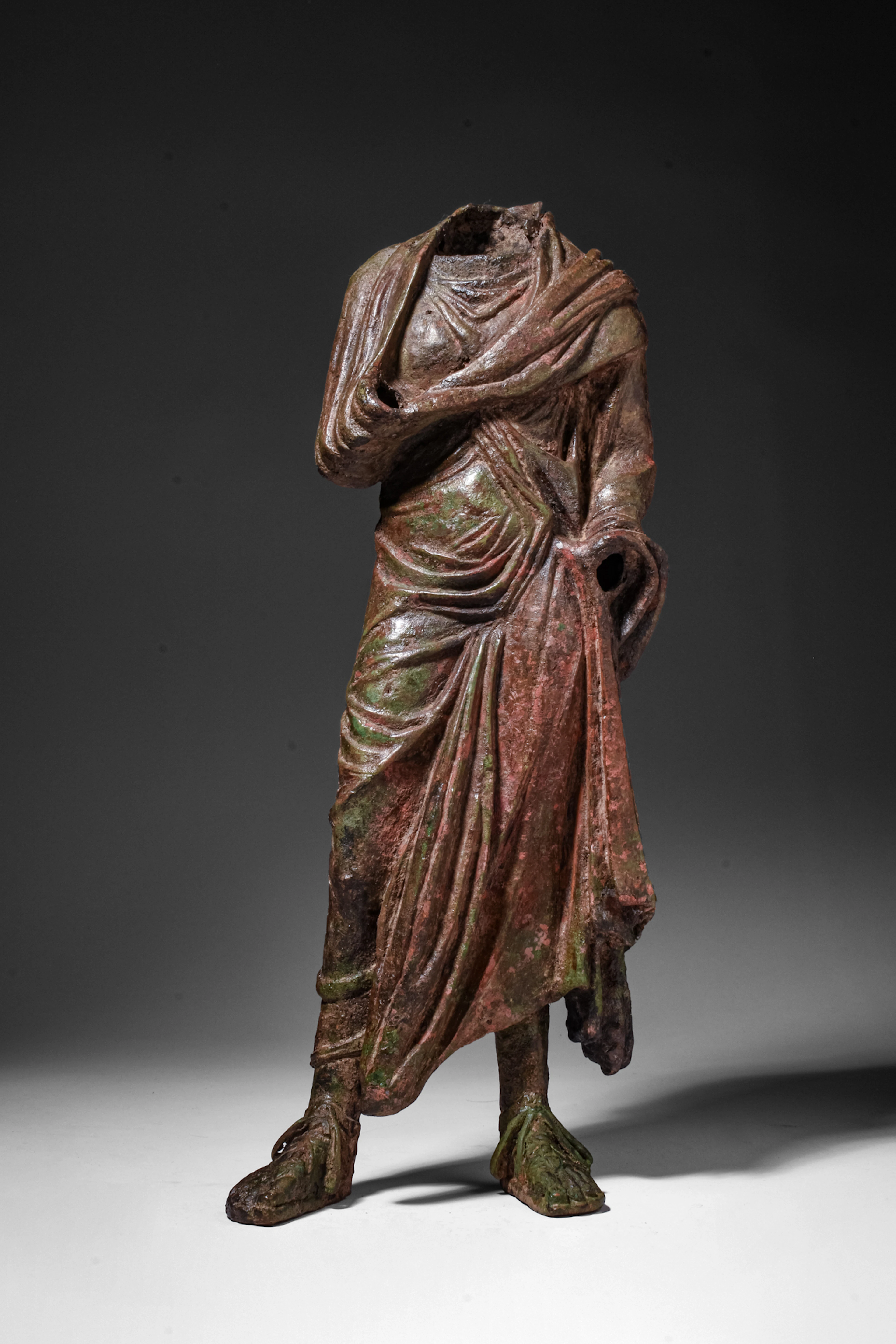
LARGE HELLENISTIC BRONZE STATUETTE OF A DRAPED MALE FIGURE
06/21/2026

€11,593.82
Est.: €11,540.27
OCT 8 | 3:00 PM
¡Lleva tu subasta a coleccionistas de todo el mundo!
Publica ahora