



Todas las subastas / Arte Antiguo / KUNIYOSHI - 100 Hundred Poems by One Hundred Poets - c

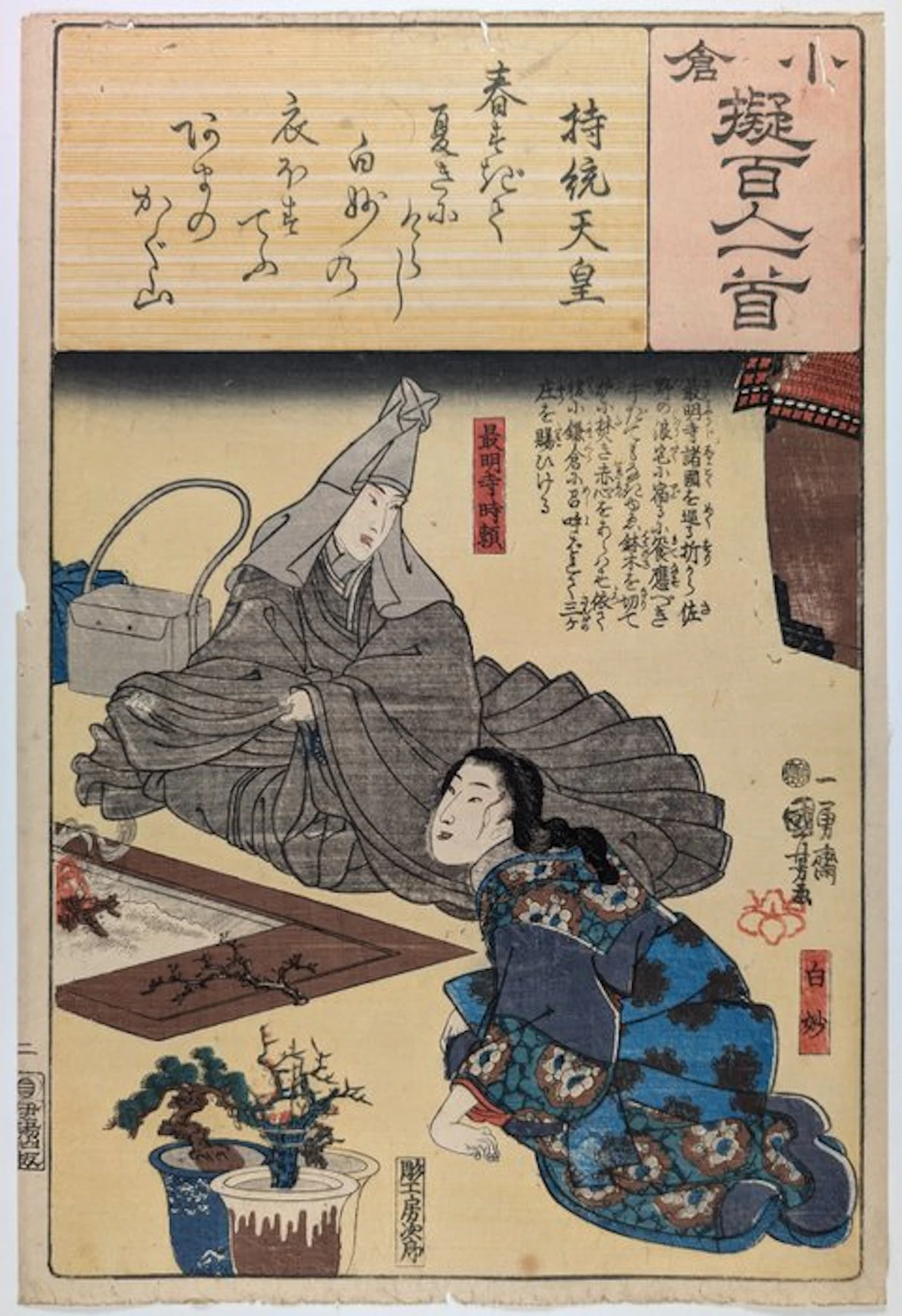
** Hachi no ki: the regent Hōjō Tokiyori in disguise at the house of Sano Tsuneyo, with Tsuneyo's wife Shirotae. Poem No. 2 of Kuniyoshi's Hundred Poets series ** Artist: Utagawa Kuniyoshi (1797–1861), signed Ichiyūsai Kuniyoshi ga (一勇斎国芳画) Title: Poem by Jitō Tennō: Shirotae and Saimyōji Tokiyori (持統天皇 最明寺時頼 白妙) Series: Ogura nazorae hyakunin isshu (小倉擬百人一首), The Hundred Poets Compared Date: Japan, c. 1845–48 (late Edo period) Publisher: Ibaya Senzaburō (Dansendō) Carver: Hori Fusajirō (彫工房次郎) Text: Ryūkatei Tanekazu (柳下亭種員) Format: Ōban, approx. 36 × 24 cm CONDITION Good impression with colors well perserved across the sheet. There are some minor wormholes on the margins and some minor trimming outside the image area. Good overall! Please check the images! THE SCENE Poem 2 of the anthology is attributed to Empress Jitō (645–703), and it is one of the best-known poems in the collection: Spring has passed, and summer seems to have come. On heavenly Mount Kagu, they say, robes of pure white are spread out to dry. Kuniyoshi links the poem to the picture through one word. Shirotae (白妙), "pure white cloth" in the poem, is also the name of the woman in the print. She is the wife of Sano Genzaemon Tsuneyo, the hero of the Hachi no ki ("The Potted Trees") legend, which is best known from the Noh play of that name. The story concerns Hōjō Tokiyori (1227–1263), regent of the Kamakura shogunate. After he retired he became a lay monk at Saimyōji, and from then on he was known as Saimyōji Tokiyori. Legend says he then travelled the provinces in disguise to see how his people lived. One snowy night he asked for shelter at the poor house of Tsuneyo in Sano. Tsuneyo was a samurai who had lost his lands, and he had nothing to offer his guest. To keep him warm, he cut up his three treasured potted trees, a plum, a pine and a cherry, and burned them in the hearth. He also told the monk that, poor as he was, he would still ride to Kamakura the moment the shogunate called. When the call came, Tsuneyo arrived in worn armour, and the "monk" revealed himself as the regent. Tokiyori rewarded him with three estates. The text on the sheet tells the same story in short form. While Saimyōji was touring the provinces, he lodged at Sano's humble house. Having no other way to entertain him, Sano cut his potted trees and burned them, which showed his true heart. Tokiyori later summoned him to Kamakura and granted him three estates. The story became a model of samurai loyalty in reduced circumstances, and of a ruler's gratitude for it. About the Series: The Ogura nazorae hyakunin isshu is one of the few series in which the three leading masters of the 1840s worked side by side: Kuniyoshi designed 51 sheets, Hiroshige 35 and Kunisada 14. Instead of portraying the classical poets themselves, each print pairs one of the hundred poems with a scene from history, legend or kabuki, and the viewer is invited to work out the connection, almost like a riddle. A short narrative text on each sheet tells the story behind the picture. Kuniyoshi's contributions are known for their strong figure compositions and storytelling, and each sheet joins a classical poem to a dramatic tale.
Estimación:€150
Ir a la subastaVer todos los artículos deCatawikioArte Antiguo
Estimación:
€150
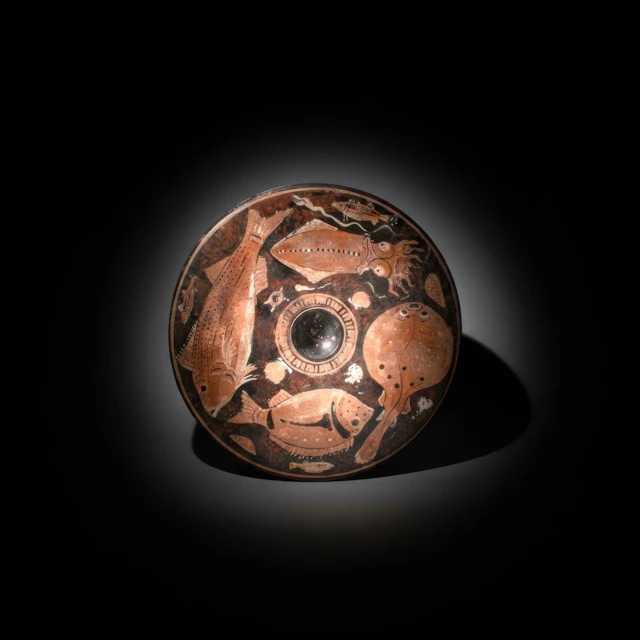
VERY RARE APULIAN RED-FIGURE FISH PLATE WITH 15 SEA CREATURES
06/21/2026

€23,187.64
Est.: €11,540.27


OCT 27 | 4:00 PM
¡Lleva tu subasta a coleccionistas de todo el mundo!
Publica ahoraAl suscribirte, aceptas la política de privacidad. Cancela tu suscripción en cualquier momento.
Barnebys HQ
Brahegatan 10
BOX 5038
114 37 Stockholm
