
Todas las subastas / Libros, mapas, papel & manuscritos / Jean Froissart / Philippe de Commines / Johannes...

Jean Froissart / Philippe de Commines / Johannes...
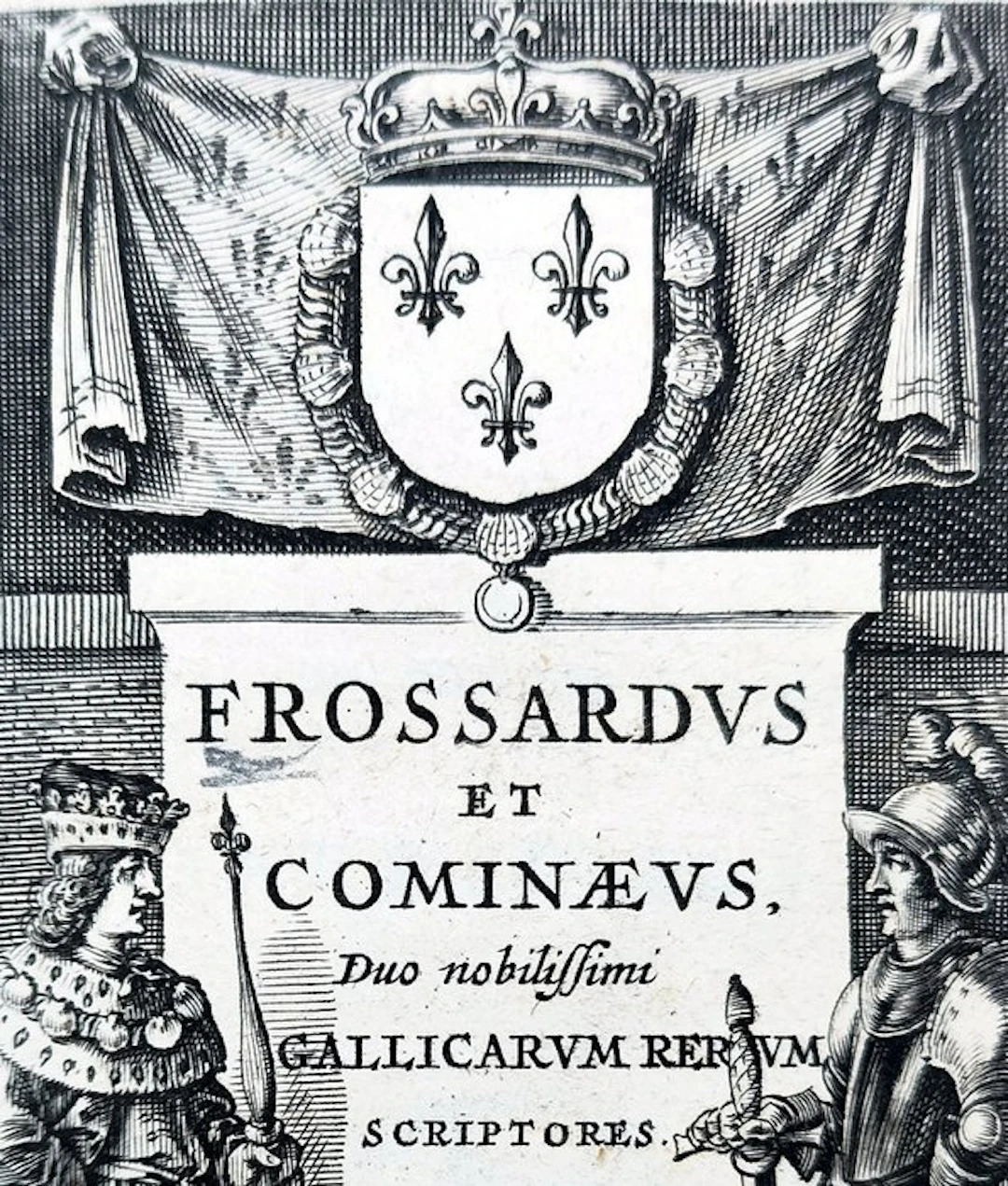
1656 EDITION ON HISTORY OF EUROPE, MIDDLE AGES, FEUDAL CHIVALRY, FRANCE, LOW COUNTRIES, DUCHY OF BURGUNDY, ENGLAND, ITALY, GERMANY, AUSTRIA, SPAIN, SWITZERLAND, IRELAND, BALKANS, WAR HISTORY, MONARCHY, RELIGION by Jean Froissart (c. 1337–1405) and Philippe de Commines (1447–1511), two authors/books in a single volume, translated from Old French into Latin, and edited and annotated by Johannes Sleidanus (1506–1556), a Luxembourgish historian, diplomatic and annalist of the Reformation. This volume is a edition of two cornerstone accounts of late-medieval French history, translated and printed in Amsterdam by the renowned cartographer and printer Joan Blaeu. During the 16th and 17th centuries, this compilation served as the standard European textbook on French politics and warfare for scholars, statesmen, and diplomats who did not read vernacular Middle French. The translator Johannes Sleidanus—remembered today primarily for his seminal history of the Protestant Reformation (De statu religionis et reipublicae)—produced elegant, concise Latin translations of the works of Commynes and Froissart. Sleidanus eliminated redundant passages, smoothed the narrative flow, and rendered the French vernacular into clear, modern Latin suited to academic and diplomatic circles. Original contemporary binding in excellent condition, virtually intact. COMPLETE JOAN BLAEU EDITION. The volume opens with an elegant title page designed by Joan Blaeu, encapsulating the decisive conflict between the French Crown and the Duchy of Burgundy. On the left stands King Louis XI of France, depicted in his official capacity with all the symbols of statecraft, royal legitimacy, and political calculation. To the right is Charles the Bold, Duke of Burgundy, dressed fully for war in plate armor and a plumed helmet, his right hand resting on the hilt of a massive sword. Charles embodies feudal chivalry and martial ambition, representing the bygone world described by Jean Froissart—an era where disputes were settled by the sword and individual valor—which ultimately led to Charles's ruin and death at the Battle of Nancy (1477). Engraved in the center of the lower pedestal is an armillary sphere, the distinctive astronomical emblem of the Blaeu printing dynasty. Suspended above the monument is an imperial canopy with drapery framing three fleurs-de-lis and a crown, symbols of the French monarchy. The image visually summarizes the historical transition recorded in this volume: the collapse of feudal, chivalric independence and the triumph of the centralized French monarchy. TWO WORKS IN ONE VOLUME: JEAN FROISSART AND PHILIPPE DE COMMINES TOGETHER OFFER AN UNBROKEN CHRONICLE THAT BRIDGES THE GAP BETWEEN FEUDAL CHIVALRY AND MODERN STATECRAFT. FIRST BOOK. JEAN FROISSART (CHRONIQUES). Period Covered: Mid-14th century through roughly 1400. Subject: The first half of the Hundred Years' War between England and France, including the battles of Crécy and Poitiers, the English Peasants' Revolt of 1381, and the Jacquerie. Style & Perspective: Aristocratic, chivalric, and episodic. Froissart focuses on heraldry, knightly honor, individual martial valor, and courtly pageantry. SECOND BOOK. PHILIPPE DE COMMYNES (MÉMOIRES) Period Covered: Circa 1464 to 1498. Subject: The rivalry between King Louis XI of France and Charles the Bold, Duke of Burgundy, followed by Charles VIII’s Italian campaign. Style & Perspective: Pragmatic, analytical, and disillusioned. Probably the "first modern political philosopher of France" (a Machiavelli of the North), Commynes disregards knightly romanticism to dissect political psychology, deception, diplomacy, and the mechanics of state power. TITLE: Frossardus et Cominaeus, duo nobilissimi Gallicarum rerum scriptores. (Froissart and Commines, two most distinguished chroniclers of French history). AUTHORS: Jean Froissart (c. 1337–1405) and Philippe de Commines (1447–1511), and translated from vernacular Middle French into Latin and commented upon by Johannes Sleidanus (1506–1556) PUBLISHER: Joan Blaeu or Ioannes Blaeu DATE: MDCLVI (1656), printed in Amsterdam, text in Latin DESCRIPTION: 1 volume in 12°, size height 140 x width 88 mm or 5.5 by 3.5 inches. 664 numbered pages, [46] index leaves, two works/books in one volume, complete edition. Original contemporary binding in vellum and in excellent condition, virtually intact, rare defects, the binding is solid and fully functional, free of tears, losses, cracks, or structural damage, as shown in the photos. Good quality printing and paper, text printed in italics, woodcut head- and tail-pieces, decorated initials. A fine illustrated title page at the beginning, plus a title with the date for each work; the page numbering is progressive and continuous. The text is clean, virtually intact, rare small stains or defects all in very good condition as per photo. COMPLETE FIRST EDITION. REFERENCES: WORLD CAT n°1335794762; USTC n°1830852 (Only 6 copies); Short Title Catalogue Netherlands n°852003587; London, United Kingdom, British Library Shelfmark: 1193.c.2; Amsterdam, Netherlands, Elsevier Heritage Collection Shelfmark: 12.1656.Fro.00. SHIPPING: via UPS, DHL, FEDEX, National Postal Services, protected, INSURED and fully tracked package. Estimated time for Europe 3-5 working days. Shipping within one working day, you can combine shipping if you purchases several items from us, saving money and time.
Estimación:€650
Ir a la subastaVer todos los artículos deCatawikioLibros, mapas, papel & manuscritos
Estimación:
€650
Artículos similares






Resultados de subastas para artículos similares


¡Lleva tu subasta a coleccionistas de todo el mundo!
Publica ahora