Henry Eldridge Watercolor of Sir John Thomas Coghill
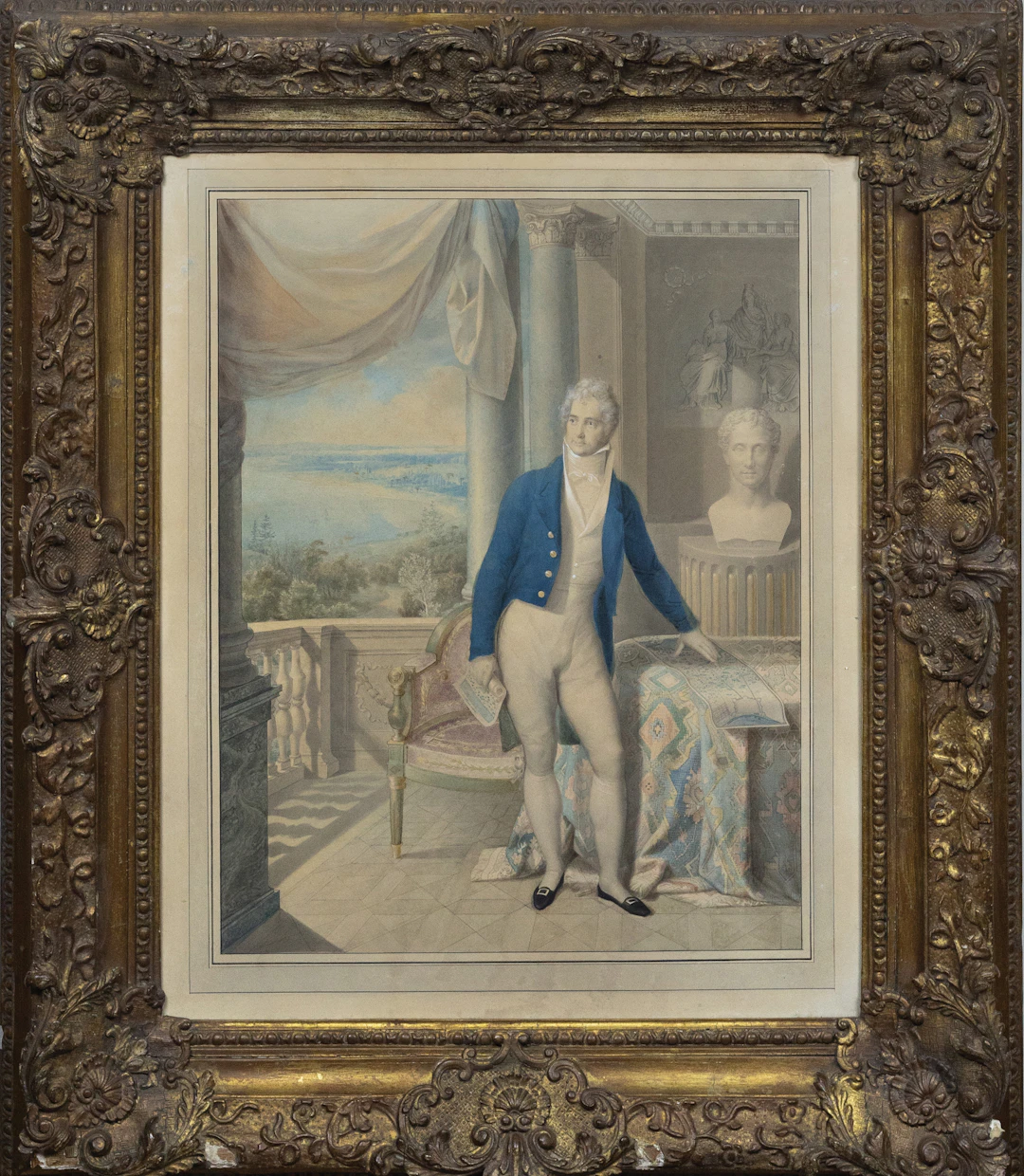
ELDRIDGE, Henry (1769 - 1821), Attributed to. Sir John Thomas Coghill, Second Baronet (1766-1817). Watercolor, unsigned. c. 1812-1821. 23 1/2" x 18" framed. An early 19th century portrait of Sir John Thomas Coghill, 2nd baronet, standing before the Louisiana land he purchased from the great Marquis de Lafayette. This handsome full-length watercolor portrait shows the baronet Sir John Thomas Coghill in a classical setting, his left hand resting on a map of his vast Louisiana property which sprawls across the vista behind him. The portrait is a magnificent coming together of various socio-cultural threads: the baronet himself speaks to the significance of art and travel during the Regency period while the map, and the land, point to a critical moment in American history. Following the Louisiana Purchase of 1803, a grateful U.S. Congress had authorized a grant of over 11,000 acres to the French and American hero Marie-Joseph Paul Yves Roch Gilbert du Motier, Marquis de Lafayette, for his contributions to the American Revolution. Most of this land was situated at Pointe Coupée on the Mississippi River, with a small tract near New Orleans. By 1810 Lafayette began trying to sell of these lands to pay off his debts; half was bought by Englishmen Henry Seymour and Sir John Thomas Coghill, and Coghill also entered into a partnership arrangement with Lafayette over the New Orleans section. (Abbey) The Louisiana Purchase was the monumentally significant agreement by which the United States bought from France that part of France's North American empire roughly defined by the Missouri and Mississippi River watersheds. The "deal doubled the size of the nation, creating what Thomas Jefferson termed an "empire for liberty." French control of the region dated from 1682, when the explorer René-Robert Cavelier, Sieur de La Salle, claimed on behalf of King Louis IX a vaguely defined area he named "Louisiana." Rather than lose the colony to Britain as a result of its defeat in the Seven Years' War, France ceded Louisiana to Spain in 1763. Rising tensions between the United States and Spain led to Pinckney's Treaty (1795), which guaranteed American navigation rights on the Mississippi River and the right to deposit goods for export at New Orleans, through which most of the trade of the western states passed. "In 1801, rumors that Spain had transferred Louisiana back to France alarmed many Americans. Fearing that access to the Gulf of Mexico might be interrupted, some Americans, mostly from the West, called for the territory to be taken by force. To head off this sentiment, President Thomas Jefferson dispatched Robert Livingston of New York and, later, James Monroe to Paris to negotiate the purchase from France of New Orleans and the province of Florida west of the Perdido River. "Meanwhile, Emperor Napoleon Bonaparte, faced with defeat in the French sugar colony of Santo Domingo, decided to sell all of Louisiana in order to consolidate his forces in Europe. Although their instructions empowered them only to acquire New Orleans and West Florida, Livingston and Monroe jumped at the French offer. Understanding the territorial ambitions of many Americans, they recognized this acquisition as a unique opportunity. On 30 April 1803, American and French negotiators initialed agreements transferring the Louisiana territory to the United States in exchange for $11,250,000.” (William Earl Weeks for ANB). In March 1812, for 60 francs (roughly $12) per acre, Lafayette sold the Louisiana land patents for 2,000 and 4,000 acres, respectively, to Seymour and Coghill, as explained by John Thomas’s nephew James Henry Coghill in the latter’s account of the Coghill family: My uncle, while detained in France during the war with the first Napoleon, became acquainted with Lafayette, and through him was induced to purchase a large amount of land at New Orleans. I believe a large part of that city is now built over this very land, and had my father kept possession of it, I have no doubt that it would now be of immense value, and have added largely to our estate; but he did not foresee what was to happen, and sold it in the full belief that his brother had been very well swindled by Lafayette, as in taking possession it was found that at a few spades' depth there was nothing but water. (Coghill) As Coghill’s nephew recounts, by the time Louisiana was admitted to the union as the 18th state in 1812 (its western boundary with Spanish Texas would remain in dispute until the Adams-Onís Treaty of 1819, which was formally ratified in 1821), the value of the land was still somewhat in question, although the fortunes were soon to change. Indeed, Vice-Admiral Sir Josiah Coghill’s selling of his brother’s land coincides with the rising importance of New Orleans as a site for trade and wealth building. With the growth of settlement in the Midwest (formerly the Northwest Territory) and Deep South during the early decades of the 19th century, trade and shipping increased markedly in New Orleans. Produce and products moved out of the Midwest down the Mississippi River for shipment overseas, and international ships docked at New Orleans with imports to send into the interior. The port was crowded with steamboats, flatboats, and sailing ships, and workers speaking languages from many nations as New Orleans became the major port for the export of cotton and sugar. More than the rest of the Deep South, it attracted immigrants for the many jobs in the city; as its population grew rapidly the region became quite wealthy, with the richest citizens also importing fine goods of wine, furnishings, and fabrics. Importantly, Coghill’s nephew also recounts his uncle’s passion for art. A great traveler, Sir John Thomas Coghill spent much of his time abroad and particularly in Naples, where he amassed a significant collection that included a number of Greek and Etruscan vases. In fact, his collection was so impressive that in 1817 52 engravings of his finest vases were published in Rome by James Millingen of the Society of Antiquaries of London and the Academy of Archeology of Rome as "Peintures Antiques des Vases Grecs de la Collection de Sir John Coghill", Bart, and the collection was thereafter mostly (if not entirely) sold to the British Museum. The classical setting of this portrait, with its Corinthian columns, marble bust, and Roman fresco, thus speaks not only to the taste for antiquities at this time, but also Coghill’s personal role in the propagation of this fashion through his remarkable acquisitions. Indeed, the baronet’s sophisticated eye is highlighted in this splendid full-length portrait. Dressed in the height of Regency fashion with tight white breeches, a short coat with tails, and a high-collared shirt, Coghill is presented as distinguished and refined through the careful brushwork of celebrated portraitist Henry Eldridge (1768-1821). Apprenticed to the mezzotint engraver William Pether, Edridge acquired an eye for detail in this meticulous work; he also studied his master's other work as a miniaturist. He attended the Royal Academy Schools from 1784 where Sir Joshua Reynolds much admired Edridge's copies of his works. Edridge set up his own portraiture business in 1789 and became well known for a style of portraiture that combined the delicacy of miniature painting with breadth of draughtsmanship. As well as painting in oils, he made a large number of watercolor portraits like this one here, often drawing his subjects in soft lead pencil before applying watercolor with the stippling technique and using washes of color to enrich drapery. This careful attention to technique is particularly evident in the splendid richness of the sumptuously patterned cloth, billowing sateen drapery, and brilliant blue tailcoat, and Eldridge likewise employs his meticulous attention to detail in capturing the essence of this important swath of land at a critical turning point in America’s development. References: Abbey, Kathryn T. “The Land Ventures of General Lafayette in the Territory of Orleans and State of Louisiana.” Louisiana Historical Quarterly?XVI Johns Hopkins Studies in International Thought (Baltimore, 1929): 318-46. Coghill, James Henry. "The Family of" Coghill, 1377 to 1879: With Some Sketches of Their Maternal Ancestors, the Slingsbys, of Scriven Hall. 1135 to 1879. Riveside Press, 1879. Lutz, Paul V. “Lafayette’s Louisiana Estate: The Unusual Dealings between the Marquis and Three Wealthy Englishmen.” Louisiana Studies 4 (1967): 333-60.
Estimación:€26,352.03
Ir a la subastaVer todos los artículos deArader GalleriesoArte, Pintura & obra gráfica