


Todas las subastas / Arte Antiguo / Fukurokuju, Sesson Shukei - Paper - Japan - Early Edo period

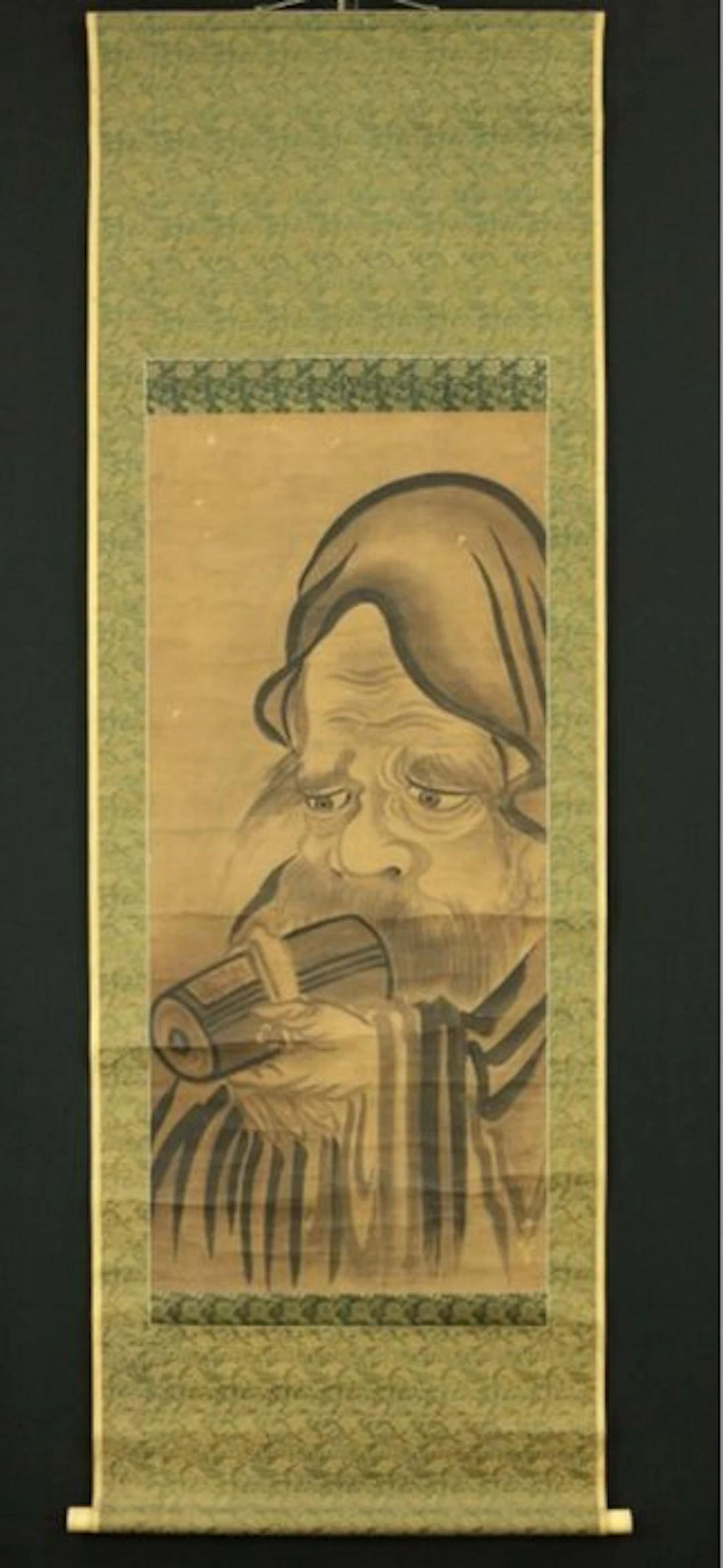
Sesson Shukei (1504–1589) signed Sesson Shukei with a seal. Japan. Finely drawn ink on paper. With a silk damask frame and mounted as a hanging scroll depicting the god of fortune Fukurokuju, a small scroll rests on his head, his mouth hidden, but the eyes at least seem to betray an unusual truth with a serious expression. His hood and wide sleeves are rendered with bold, dynamic brushstrokes; the eyebrows and beard are densely painted brushwork, his nostrils marked with short lines and the contours and folds of his face with energetic brush strokes. Dating very difficult. 16th–17th century. SIZE 110 x 50 cm (image) and 190 x 70 cm (overall). Condition: Good condition with signs of old wear, small color losses, creases. Rolled ends: bone. Provenance: German private collection. Sesson Shukei (1504–1589) was a Japanese Zen monk and painter of the Muromachi period; he was born as a member of the Satake clan, but left it after being disinherited by his father, and was taken in as a monk into a Shosho-ji temple by Satake Bodaji. Sesson was a master of ink painting, comparable to Sesshu Toyo, one of the greatest painters in Japanese history, and he worked in a dramatic style. He generally emphasized individuality, humor, and exaggeration in his handling of subjects, whether figural or landscape. He homage Sesshū in name, but painted his own quirky, often almost baroque ink - far from Kanō school painting and later Nanga. His Zen attitude is not courtly-slick, but eccentric, “kisō” (奇想). In China Fu, Lu, and Shou (福禄寿, Sānxīng) are three separate star gods. In Japan they were often fused into one figure: Fukurokuju. He thus does not stand for luck alone but for the full bourgeois ideal of the Edo period: fortune + means + old age. The elongated forehead comes from the Chinese Shouxing (寿星), the Old Man of the Southern Pole (Canopus / 南極老人). The head is considered the seat of wisdom and years of life — the higher the forehead, the more life-time and scholarly learning. MUSEUM COMPARISON Compare with a related painting of Jurojin by Sesson Shukei, 136.5 x 70.6 cm, in the Freer Gallery of Art collection at the National Museum of Asian Art, Smithsonian Institution, accession number F2015.6a-d. Also compare a closely related painting of Daruma, School of Sesson Shukei, dated to the 17th–18th century, in the British Museum, accession number 1913.0501.009.
Estimación:€1,200
Ir a la subastaVer todos los artículos deCatawikioArte Antiguo
Estimación:
€1,200
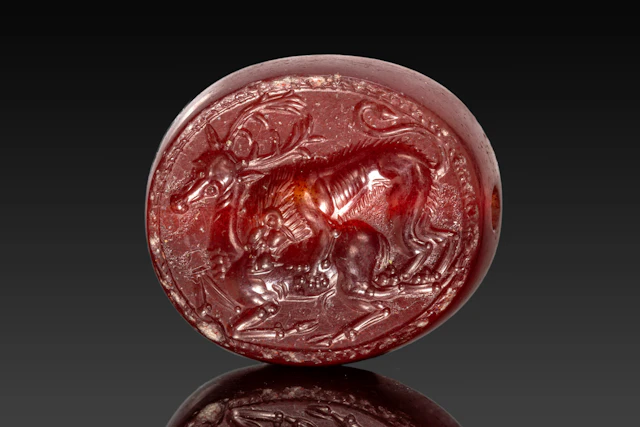
ETRUSCAN CARNELIAN STAMP SEAL WITH A LION ATTACKING A STAG
06/21/2026

€5,796.91
Est.: €5,773.91
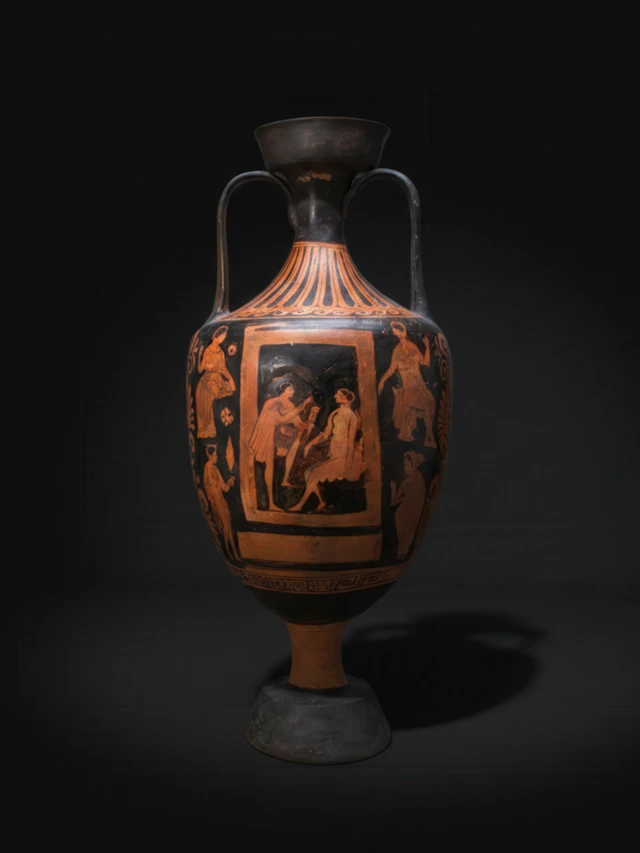
LARGE APULIAN RED-FIGURE AMPHORA WITH NAISKOS SCENE AND ALTAR
06/21/2026
€6,376.6
Est.: €5,773.91

OCT 27 | 4:00 PM
¡Lleva tu subasta a coleccionistas de todo el mundo!
Publica ahoraAl suscribirte, aceptas la política de privacidad. Cancela tu suscripción en cualquier momento.
Barnebys HQ
Brahegatan 10
BOX 5038
114 37 Stockholm
