






Todas las subastas / Libros, mapas, papel & manuscritos / Francesco Petrarca; Alessandro Vellutello - Il Petrarcha - 1538

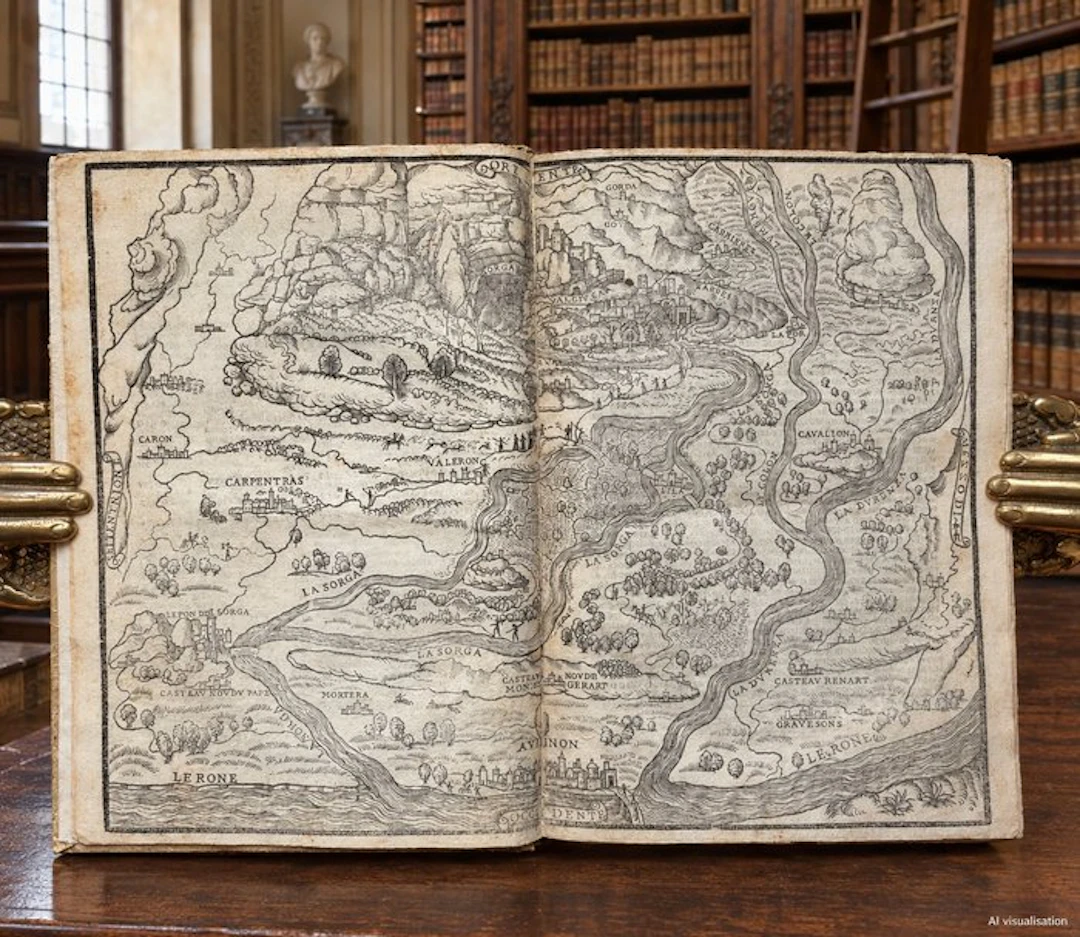
Francesco Petrarca The Petrarch, with the exposition by Alessandro Vellutello Venice, 1538 — Historical-literary, artistic, and bibliographical presentation The copy presented here belongs to the Venetian edition of 1538 of The Petrarch with the exposition of Alessandro Vellutello and with more useful things added in various places, one of the most significant testimonies of Francesco Petrarca’s editorial reception in Renaissance Italy. The correct bibliographic identification places the print in Venice, at Bartolomeo Zanetti Casterzagense, for the initiative of Alessandro Vellutello and Giovanni Giolito da Trino. The date 1538, given in the edition, is fundamental to distinguish it from earlier prints of the work and from later sixteenth-century editions. Specialized bibliography identifies this publication as the first Giolito edition of Vellutello’s commentary on Petrarch’s vernacular works. The volume brings together Petrarchan vernacular poetry, with particular reference to the Canzoniere and the Trionfi, accompanied by Vellutello’s interpretive exposition. Its importance is not exhausted by the literary value of the texts: the work also documents the vitality of Venetian publishing, the development of humanist studies, and the Renaissance’s growing attention to the critical understanding of the great authors of the Italian tradition. The present treatise considers the author, the commentator, the printer, the illustrative apparatus, the content and meaning of the work, its historical fortune, and the bibliographical characteristics of the 1538 edition. 1. Francesco Petrarca: the figure and literary heritage Francesco Petrarca (1304–1374) holds a prominent position in the history of Italian and European literature. Poet, humanist, and student of classical culture, he was one of the figures who decisively contributed to the formation of Renaissance sensibility. His intellectual experience occurs in a period of deep transformation of European society. Medieval culture, with its religious, philosophical, and symbolic structures, still exerted a strong influence, but there was a growing emphasis on the individual, memory, human dignity, and the rediscovery of Ancient texts. Petrarca was one of the protagonists of this transformation. His interest in Latin authors, his search for ancient manuscripts, and his conception of literature as an exercise in inward knowledge anticipated some essential features of Humanism. His greatness, however, lies not only in erudite activity. It is especially in vernacular poetry that Petrarca achieved a depth of expressiveness destined to exert extraordinary influence in the following centuries. The poet transformed personal experience into material for universal reflection. Love, desire, remorse, memory, the search for glory, the fear of death, and the instability of human aspirations become elements of continuous meditation on the condition of man. His poetry does not offer a simplistic representation of feelings, but probes their contradictions. The poetic subject is constantly divided between spiritual aspirations and earthly desires, between the need to attain inner peace and the difficulty of escaping passions. This tension gives Petrarch’s work a profoundly modern dimension. The poet does not merely celebrate the beloved or describe an experience: he observes himself, reconstructs his past, and seeks to understand the meaning of his choices. The 1538 book belongs to the long history of this fortune. More than a century after the author’s death, Petrarch was already recognized as one of the greatest models of European poetry and a fundamental reference for literary formation, writing practice, and the study of vernacular language. 2. The Canzoniere: love, memory, and the restlessness of the human soul The best-known core of Petrarch’s work is the Rerum vulgarium fragmenta, known as the Canzoniere. The collection comprises 366 compositions, mostly sonnets, organized in a poetic and inner journey of great complexity. At the center of many texts is Laura, a figure tradition identifies with the poet’s beloved woman. Her presence constitutes the starting point of a reflection that progressively goes beyond mere amorous celebration. Laura becomes the fulcrum around which desire, memory, remorse, jealousy, the aspiration to glory, and the confrontation with life’s fragility develop. Petrarchan love is characterized by continuous oscillation. The poet desires what disturbs him, regrets what he has desired, and seeks to understand the conflict between his spiritual aspiration and the power of passions. This condition is expressed in an extraordinarily precise language, where the verse’s musicality accompanies the complexity of thought. The structure of the sonnet becomes a privileged tool to organize the movements of consciousness, transforming personal experience into a rigorous and universally recognizable poetic form. The theme of time is also essential. Memory allows preserving what has been, but cannot prevent change or erase loss. Poetry attempts to oppose oblivion, while recognizing that every human experience is destined to transform. Thus the collection becomes a meditation on the distance between past and present, between ideal and reality, between the desire for permanence and the inevitability of change. The Canzoniere’s influence was enormous. Petrarchan imitation spread in Italy and Europe, offering generations of authors a model of amorous lexicon, lyric construction, and inner analysis. Its influence reached courtly poetry, Renaissance literature, and later European lyrical traditions. In the 1538 edition, the presence of Vellutello’s commentary allows the reader to approach these texts not only as autonomous pieces but as parts of an overall itinerary that the commentator tries to reconstruct through a precise interpretation of the author’s life and poetics. 3. The Trionfi: the transience of earthbound conquests Alongside the Canzoniere, the edition includes the Trionfi, an allegorical poem in which Petrarch faces the fate of man through a sequence of symbolic visions. The work takes up the classical tradition of the triumphal pageant and transforms it into a representation of the forces that govern existence. The different powers succeed one another in a progression in which each is surpassed by a greater force. Love is conquered by Chastity, Chastity by Death, Death by Fame, Fame by Time, and Time by Eternity. This structure expresses a conception of life based on the awareness of the precariousness of human conquests. Beauty is destined to vanish, glory is not eternal, memory can be erased, and time ends up consuming what humans consider stable. The Trionfi’s perspective broadens that of the Canzoniere. If the lyric collection mainly explores the contradictions of individual consciousness, the allegorical poem represents the moral and universal forces to which every human being is subjected. The presence of both works in the Venetian volume thus allows observing two complementary dimensions of Petrarchan poetics: intimate meditation on feelings and broader reflection on destiny, fame, and the relationship between time and eternity. The sixteenth-century reader could thus encounter, in a single book, both the poet of love and memory and the author capable of transforming great moral themes into a wide-ranging allegorical construction. 4. Alessandro Vellutello: the commentator and the new interpretation of Petrarch Alessandro Vellutello, humanist and active interpreter in the first half of the sixteenth century, is the second intellectual protagonist of the edition. The formula with the exposition by Alessandro Vellutello, stated in the title, clarifies the nature of the editorial project: the poetic text is accompanied by an explanatory apparatus intended to guide the reader in understanding the compositions and biographical, geographical, and literary references. Vellutello belongs to a tradition of scholars who considered the great authors not only as models to imitate, but as works to be analyzed and interpreted through philological and historical-literary tools. His most characteristic contribution concerns the attempt to reconstruct the ordering of the Canzoniere’s poems. He attached particular importance to the sequence of the compositions and to the possibility of reading them as testimonies of different moments in the poet’s life. This approach appears in the introductory treatise dedicated to the division of the sonnets and sonnet-canzoni into three parts. Vellutello sought to organize the collection in an interpretive structure that would make the relationships between the poems, the amorous events, and Laura’s figure more intelligible. The project reflects a Renaissance conception of reading: to understand an author means to reconstruct his thinking, clarify the meaning of words, identify relationships between texts, and place the work within a biographical and cultural context. Vellutello’s proposal does not necessarily coincide with the ordering accepted by today’s Petrarchan studies. His historical interest lies precisely in having offered an organic reading of the work, participating in a debate involving philologists, editors, and literati of the sixteenth century. The introductory apparatus and Petrarchan geography The commentary is not limited to explaining the verses. The 1538 edition includes materials designed to direct consultation and reconstruct the work’s context: indexes, biographical information, discussions on the arrangement of the compositions, and references to places tied to Petrarch’s poetic life. A particular point of interest is the Valchiusa map, a Provençal locality associated with the poet’s life and imagination. Geography in this context assumes an interpretive function. The landscape is not merely a physical space but becomes part of the literary memory, helping to connect the poetry to recognizable places and to reconstruct the author’s biographical story. Hence the apparatus makes the book a structured study tool, in which text, commentary, and visual materials collaborate in understanding the poetry. 5. Bartolomeo Zanetti: the printer and Renaissance Venice The 1538 edition was printed in Venice by Bartolomeo Zanetti Casterzagense, on the initiative of Alessandro Vellutello and Giovanni Giolito da Trino. The colophon identifies the workshop and the promoters of the enterprise, providing a fundamental datum for the material history of the volume. The specialized bibliographic description confirms the editorial formula and identifies the print as the first Giolito edition of the work commented by Vellutello. Bartolomeo Zanetti operated in a city that in the sixteenth century represented one of Europe’s major centers of publishing. Venice had a vast commercial network, specialized typography skills, and an audience of scholars, literati, professionals, and readers interested in humanistic culture. Book production in Venice was characterized by strong dynamism. The workshops published classical works, religious texts, scientific treatises, vernacular literature, and commentaries for study. The book had become not only a cultural object but also the result of a complex economic organization in which authors, commentators, printers, financiers, and distributors collaborated. In this framework, the 1538 Petrarch edition represents a particularly significant example of the collaboration between intellectual activity and editorial initiative. Vellutello provided the exegetical project; Zanetti oversaw the typographic production; Giovanni Giolito da Trino participated in the editorial and commercial venture. The volume thus arose from the meeting of literary expertise, technical capability, and interest in disseminating a canonized author through traditional channels. The page layout responded to concrete reading needs. The poetic compositions were organized in distinct blocks, while the commentary was arranged around the text or in separate columns, according to the structure of the different sections. This solution allowed readers to compare verses with explanations, following the commentary without losing reference to the original text. The layout thus became an integral part of the study method. The meaning of the printing privilege The title page mentions a privilege granted by the Most Serene Republic of Venice, which forbade unauthorized reprinting and sale within the Republic for a period of five years. The privilege did not correspond to modern copyright law, but represented a form of temporary protection for the editorial venture. Producing a large volume, accompanied by commentaries, indexes, and illustrations, required considerable investment in paper, type, labor, and organization. The protection granted by Venetian authorities aimed to protect that investment and to limit unauthorized competition. This element adds another historical dimension to the book: the edition documents not only the diffusion of literature but also the legal and economic system through which printed culture was produced and distributed in the Renaissance. 6. The frontispiece, the woodcut portrait, and the Valchiusa map The frontispiece of the edition is one of the most significant elements of the exemplar. It features the title in distinct type, accompanied by a portrait of Petrarch enclosed in an oval frame. The poet is shown in profile, with his head covered and wearing an laurel crown, an attribute traditionally associated with poetic glory. The figure is immediately recognizable as part of Petrarchan iconography, where the portrait contributes to confer authority and identity to the text. The image serves a precise cultural function. It is not a mere decorative ornament, but a sign of recognition that links the volume to the poet and his consecration in literary memory. The technique is consistent with woodcut (xilografia), a method that allowed images incised on wooden blocks to be printed together with typographic pages. This technique played a fundamental role in Renaissance book production, as it enabled reproducing portraits, maps, decorative borders, and other images at costs compatible with commercial diffusion of books. However, it is necessary to distinguish the technique from the artistic attribution: based on the sole visible features of the frontispiece, it is not possible to identify with certainty the engraver or illustrator responsible for the portrait. A second notable figurative element is the Valchiusa map, described in catalogues as a two-page woodcut. Its presence confirms the edition’s attention to the geographical dimension of Petrarch’s biography. The map offers readers a visual representation of the territory associated with the poet’s life and imagination. The Provençal landscape thus becomes an integral part of the reading experience. The combination of portrait, cartography, and commentary shows how Humanist publishing used multiple tools to make the literary text comprehensible and authoritative. The poetic word was accompanied by visual elements capable of strengthening the memory of the author and guiding interpretation. 7. The historical and cultural context of the 1538 edition The volume’s publication falls within a phase of full maturity of the Italian Renaissance. Movable type printing, introduced in Europe in the late fifteenth century, had profoundly changed the circulation of knowledge. Texts could be reproduced in a number of copies exceeding that possible with manuscript tradition, reaching geographically wider audiences and promoting the spread of different interpretations of the same work. Venice played a decisive role in this process thanks to its commercial position, the presence of specialized printers, and the ability to connect markets and cultural traditions. Petrarch was particularly well suited to this publishing system. His poetry enjoyed consolidated prestige, and his language provided an essential model for those seeking refined literary training. The 1538 commented edition thus responded to a precise cultural need: to make a canonical author available in a form that combined the poetic text with the tools necessary to study it. The presence of Vellutello’s commentary also shows that the fortune of the classics depended not only on reproducing the texts, but also on comparison of interpretations, philological research, and the will to organize knowledge in systematic forms. The volume was born in the years after the Protestant Reformation and at a time when European authorities attributed growing importance to controlling the press. It is not necessary to assign a specific confessional meaning to this publication: its significance is primarily literary, editorial, and humanistic. Nevertheless, it is significant that the work presents a printing privilege, an element that documents the interweaving of cultural production, institutional regulation, and economic interest in sixteenth-century Venice. 8. Editorial fortune and the work’s impact The 1538 edition is of particular interest because it marks a significant step in the editorial history of Vellutello’s commentary. Its importance does not lie in introducing Petrarch to the public for the first time, since the poet was already widely known and published, but in having participated in the diffusion of a specific interpretation of his work. Vellutello’s project contributed to the sixteenth-century debate on the Canzoniere’s arrangement and the relationship between the poems and the author’s biography. The reading proposed by the commentator offered a structure through which to understand the poems as parts of a journey, rather than as a simple sequence of texts. The 1538 publication is also distinguished by Giovanni Giolito da Trino’s involvement in the editorial venture. The Giolito name is closely linked to the history of Venetian publishing and to the diffusion of vernacular literature in the sixteenth century. Bibliography records further editions of the work in subsequent years, including the 1544 printing at the Giolito press. This continuity testifies to the persistence of interest in Petrarch and in Vellutello’s commentary. It is useful not to confuse this editorial continuity with a quantitative proof of the single edition’s sales. Rather, it shows that the text and its interpretive apparatus continued to be deemed worthy of new publications. The historical success of a commented edition depends on many factors: the poet’s authority, the quality of interpretation, the usefulness of consultation tools, the efficacy of layout, and the editor’s ability to reach a interested audience. The Venetian edition of 1538 gathers these characteristics and thus constitutes an important testament to Renaissance book culture. 9. Bibliographic curiosities and edition peculiarities The 1538 edition presents characteristics that make it particularly interesting from the history of early printing. The first Giolito-edition. The print produced by Bartolomeo Zanetti for Vellutello and Giovanni Giolito da Trino is identified by antiquarian bibliography as the first Giolito-edition of the work. This label concerns the edition’s publishing history and allows distinguishing it from earlier commentary editions and later reissues. The Venetian privilege. The title page bears the grant of temporary protection against unauthorized reprinting and selling. This is a significant document in the economic history of printing, showing how book production was already regulated through forms of protection of the editorial investment. The author’s portrait. Petrarch’s likeness, enclosed in an oval, constitutes a hallmark of the book’s visual identity. Its presence strengthens the link between the printed work and the author’s figure, following a tradition in which the poet’s portrait became part of the book’s cultural presentation. The Valchiusa map. The two-page woodcut map links reading to the geography of Petrarch’s biography. Its presence shows how the edition sought to accompany the literary commentary with visual orienting and contextualizing tools. Editorial collaboration. The volume documents the collaboration among commentator, printer, and editorial promoter. It is a concrete testimony of how, in the Renaissance, publishing a complex work required a convergence of intellectual, technical, and economic competencies. Annotations and copy history. Any glosses, stamps, ownership notes, and signs of reading present in the exemplar can provide information about its later circulation. Such elements must be examined directly: provenance or collection history cannot be attributed on the basis of the frontispiece alone. These aspects show that the historical value of an old book does not lie solely in its content. Its structure, the image system, typographic indications, and traces of transmission constitute autonomous testimonies of the culture that produced and preserved it. Collation and preservation status: In quarto; [8], 160, [44] leaves. With its splendid two-page plate, the volume is in excellent condition with very light marginal foxing, but pages are fresh, clean, and very beautiful in excellent preservation, a high-level collectible copy. Shipping: Express delivery in just 24 working hours for EU countries; for non-EU countries it will take 48 working hours.
Estimación:€1,600
Ir a la subastaVer todos los artículos deCatawikioLibros, mapas, papel & manuscritos
Estimación:
€1,600
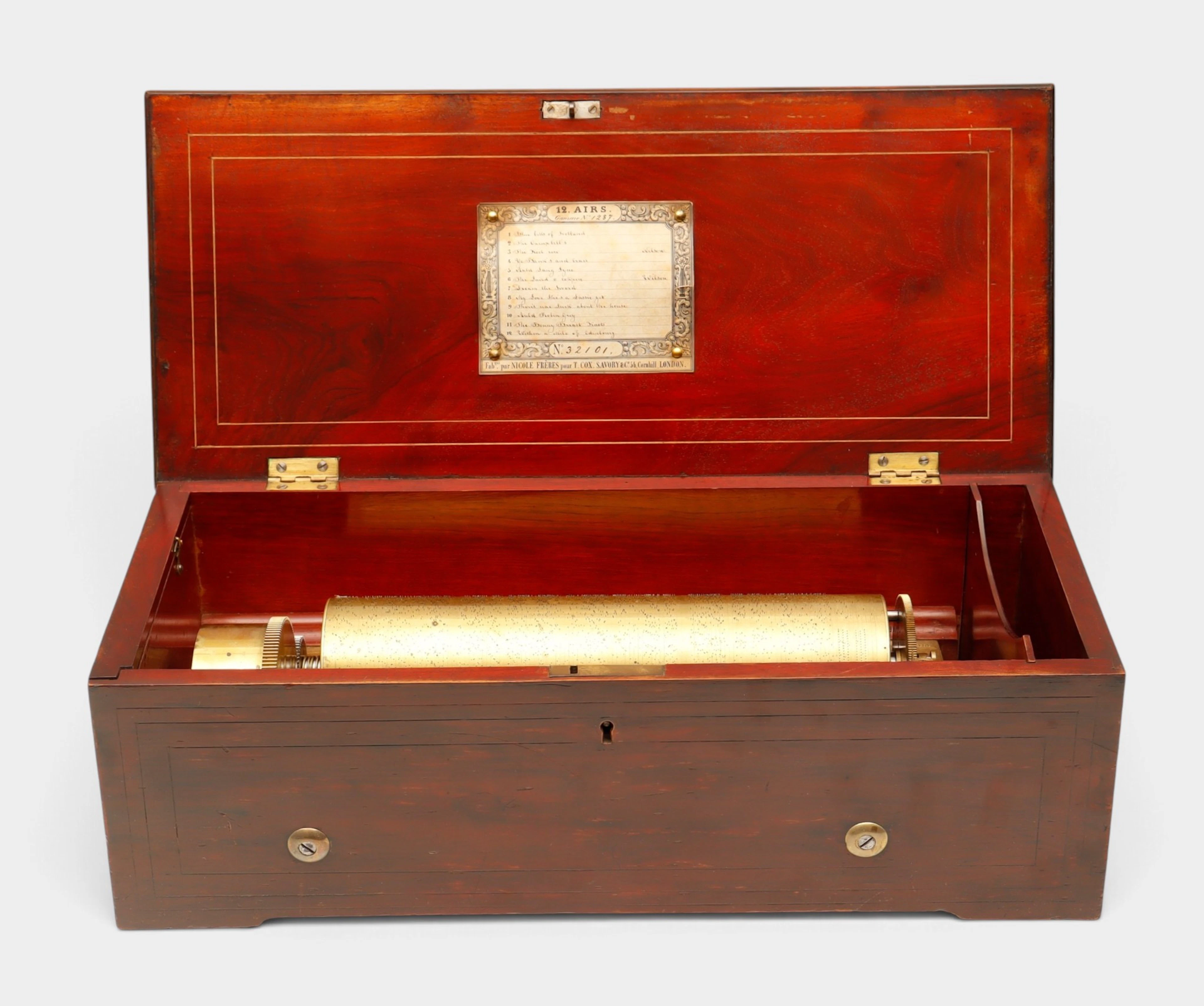
Caja de música suiza de doce canciones de Nicole Frères, hacia 1848-1852.
10/22/2026
€1,350
Est.: €1,300
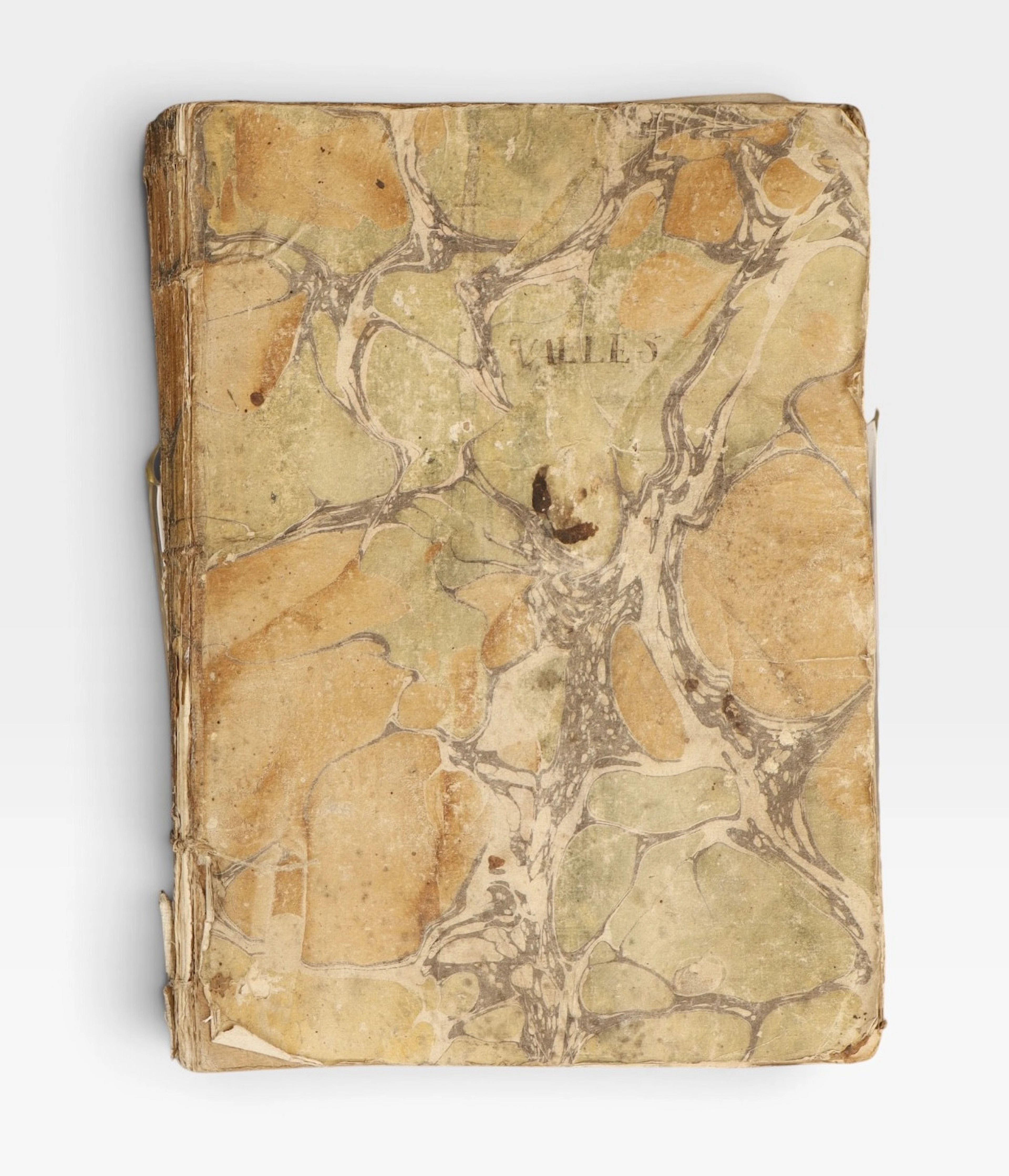
Guerra de la Independencia, Cataluña, 1808-1809.
10/22/2026
€130
Est.: €140


OCT 27 | 4:00 PM
¡Lleva tu subasta a coleccionistas de todo el mundo!
Publica ahoraAl suscribirte, aceptas la política de privacidad. Cancela tu suscripción en cualquier momento.
Barnebys HQ
Brahegatan 10
BOX 5038
114 37 Stockholm
