European school, late 18th century - The Children’s Wedding
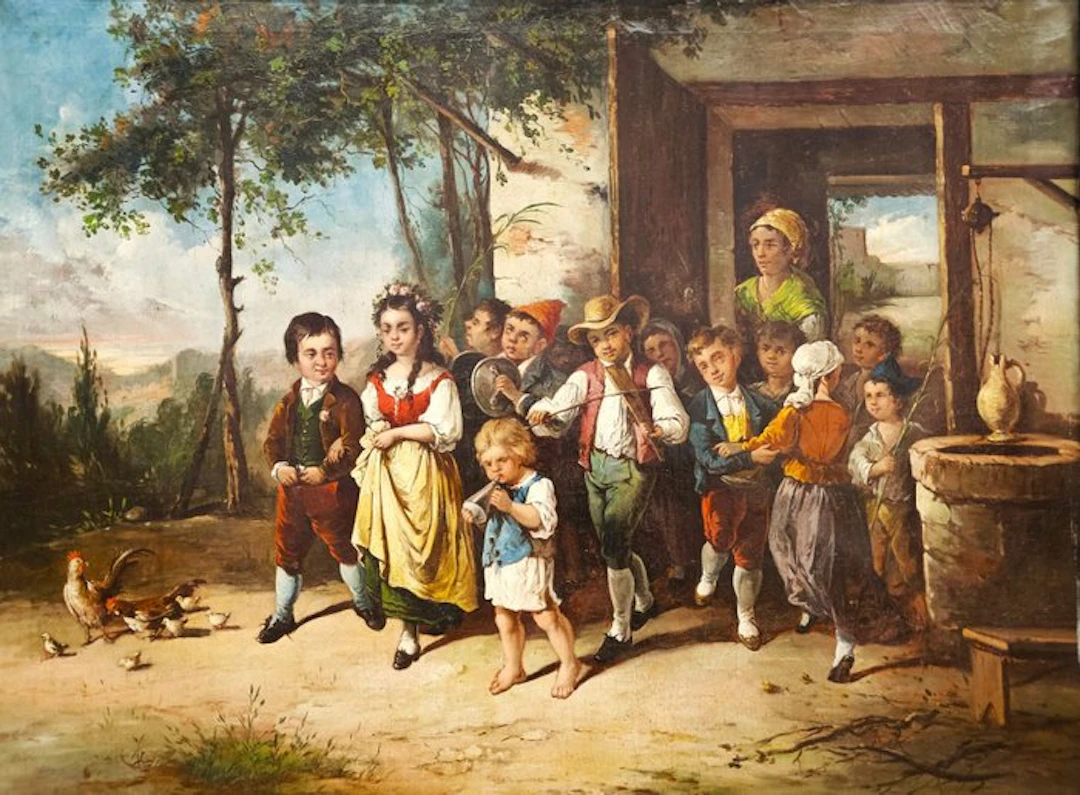
Technical data -Title: The Child Wedding - Children Playing at Being Adults :) -Author: Anonymous -School: European School -Chronology: Late 18th century, circa 1780–1800 -Technique: Oil on canvas -Genre: Genre painting / scene of daily life -Thematic: Procession or child wedding ceremony -Dimensions of the work: 83.5 × 111.5 cm -Overall dimensions with frame: 104 × 131 cm -Format: Horizontal -Signature: No visible signature -Origin: European private collection -Frame: Prominent old ebony wooden frame, dating close to the work -Support: Canvas mounted on wooden stretcher -Condition: Condition consistent with its age, with widespread craquelure and signs of the passage of time -Attribution: Work conservatively kept as anonymous, subject to deeper historical-artistic study -Pictorial affinities: Shows interesting parallels with European genre and sentimental painting of the last quarter of the 18th century, especially with environments close to Jean-Baptiste Greuze, Michel Garnier and, in the Spanish context, José del Castillo, Ramón Bayeu and Francisco de Goya. -Note: These references are indicated only as stylistic and historical-artistic comparisons and do not constitute a direct attribution Description Extraordinarily suggestive oil on canvas from the late 18th century, featuring a large group of children who, far from simply playing, seem to organize before our eyes a true small popular court. A girl crowned with flowers occupies the ceremonial heart of the scene. Beside her, a well-dressed boy adopts a restrained, almost solemn pose. Behind them unfolds a cheerful procession of musicians, attendants, and onlookers, while a child in the foreground blows with absolute concentration a small wind instrument. Hence the title we propose: The Child Wedding. The painting possesses something particularly beautiful: the children seem to have borrowed, for a few hours, the rituals of adults. Procession, music, gallantry, festive attire, and ceremony become play; and the painter observes this small human theater with a mixture of tenderness, irony, and extraordinary sensitivity. It is precisely this interest in childhood as a mirror of the adult world that becomes especially relevant in late 18th-century European painting. Goya explicitly addressed this idea in Muchachos jugando a soldados (1779), where children represent characters and behaviors typical of adults. The Prado Museum also preserves various compositions by José del Castillo, made around 1780, dedicated to children's games and pedagogical ideas related to the Enlightenment, as well as the monumental Niños jugando al toro by Ramón Bayeu. Our painting belongs intellectually to that same universe. Pictorial quality Beyond its charming iconography, the work deserves attention for its execution quality. The artist demonstrates notable ability to organize a composition with many figures without losing legibility. The succession of heads and bodies generates an ascending movement that leads from the little musician in the foreground to the cortege behind the main couple. Especially delicate is the treatment of the faces. We do not find mechanically repeated types: the painter tries to give each child a true psychological identity. Side glances, barely hinted smiles, expressions of curiosity or concentration, and small gestures build an extraordinarily lively scene. The young protagonist stands out in particular. Her oval face, luminous flesh tones, softly pink cheeks, precise drawing of the eyes, and floral crown reveal a sensitivity that finds interesting parallels in French sentimental painting of the second half of the 18th century. Here the reference to Jean-Baptiste Greuze (1725–1805), one of the great European masters of sentimental painting, inevitably appears. His famous L’Accordée de village —presented at the Salon of 1761 and now in the Louvre— also constructs a narrative around a wedding ceremony and the affectionate relationships between youth, children, and adults. The comparison should be understood exclusively in terms of iconography, culture, and style: there is currently no element that would allow attributing this work to Greuze or his workshop. But it is a reference worth considering in future research. Pictorial affinities and possible lines of investigation The absence of a visible signature obliges keeping the work prudently within the realm of anonymous painting. However, its quality allows proposing several families of comparative artists. Jean-Baptiste Greuze and the French sentimental school We find affinity in the psychological individualization of the youths, the delicate treatment of certain flesh tones, and, above all, in turning a small everyday event into a scene filled with sentiment. Greuze built much of his prestige around this narrative and sentimental painting. His L’Accordée de village, of 1761, represents men, women, and children gathered around an engaged couple. We do not propose an attribution to Greuze; we do consider it legitimate to study the work within that French painting climate. Francisco de Goya and the court cartonists of Spain There is another particularly fascinating avenue. Between the 1770s and 1790s, Goya, José del Castillo, Ramón Bayeu, and other artists linked to the Real Fábrica de Tapices developed a vast repertoire of popular scenes: festivals, games, processions, gallantries, and children depicting adult behaviors. Goya painted Muchachos jugando a soldados in 1779; José del Castillo produced around 1780 various childhood scenes for El Pardo; and Ramón Bayeu tackled in the 18th century several children playing the bull. There is also an especially interesting fact: some scenes by José del Castillo were conceived precisely in relation to the Enlightenment pedagogical ideas, showing childhood, games, and education as true pictorial concerns. It is probably here that The Child Court gains its full dimension. The little characters do not seem merely portrayed. They play a role. Iconography: children imitating adult society This may be one of the loveliest aspects of the painting. The composition seems to represent a kind of child wedding, ceremonial procession, or festive performance starring children. The flower-crowned girl would assume the role of young bride or central figure of the celebration; the boy beside her would be the companion or fiancé; and the characters that follow the couple form a true small court of musicians and attendants. It would not be strange if this were a childish staging of a ceremony observed previously in the adult world. This kind of inversion has enormous strength within illustrated culture: the child ceases to be merely a secondary figure and begins to be observed as an individual, a protagonist, and a symbol of a life stage. In Muchachos jugando a soldados, for example, Goya depicts several children literally reproducing the martial behavior of adults. Our scene seems to develop a much gentler variant: the adults have their courts, their marriages, and their ceremonies; the children build theirs. Technique and pictorial matter The work is executed with a very attractive combination of controlled drawing and visible brushwork. The most important areas —faces, hands, and the outfits of the main figures— receive a considerably more meticulous treatment, while the landscape, architecture, and vegetation are resolved with progressively freer brushwork. The whites have numerous warm modulations; the reds, ochres, greens, and yellows function as chromatic accents intended to individualize the figures. The musician child’s face and, especially, the flesh tones of the main couple show a painting capability clearly superior to purely decorative production. The author knew the craft. And probably knew it well. Authorship The work has no visible signature that would allow establishing a secure attribution, and we currently lack documentation that would connect it to a specific painter. Therefore it should be properly offered as: Anonymous – European School, late 18th century However, from a historical-artistic point of view, we believe there are sufficient reasons to recommend that future research compare the French sentimental painting associated with Jean-Baptiste Greuze’s circle, as well as the wide circle of Spanish painters connected with genre painting and the cartoons for tapestries of the second half of the 18th century, especially José del Castillo, Ramón Bayeu, and the young Francisco de Goya. These mentions are merely comparative references and lines of investigation, and not attributions to the named artists or workshops. That is precisely where part of the charm of The Child Court lies: we know we are facing an ambitious painting of considerable format and notable quality; what remains unknown is the name of the painter who gave it life. And that question remains open for its next owner. Condition The surface shows an old craquelure consistent with an historical painting, clearly visible in some light areas and flesh tones. There are normal signs of aging and possible old conservation interventions. The work should be valued primarily through the detailed photographs provided, which form an integral part of the lot description. The frame shows wear, small losses, and signs of its age. Presentation A painting of this kind gathers several elements especially attractive for collectors: - large format, complex composition, numerous figures, unusual iconography, quality in the depiction of faces, and above all, an authorship that remains open to future research. The Child Court is not merely a genre scene. It is a painting about childhood, imitation, ceremony, and that marvelous moment when children turn the serious world of adults into a game. Shipping and conditions Shipping will be carried out by a professional specialized company, using a custom-made box and adequate foam protections for the piece. We ship worldwide. Due to the dimensions of the work, any potential extra charge related to large-format shipments, island destinations, special continental destinations or outside the EU will be charged to the buyer. The frame is included as a gift, and thus will not be the subject of claims for possible damage during transport.
Estimación:€3,600
Ir a la subastaVer todos los artículos deCatawikioVarios