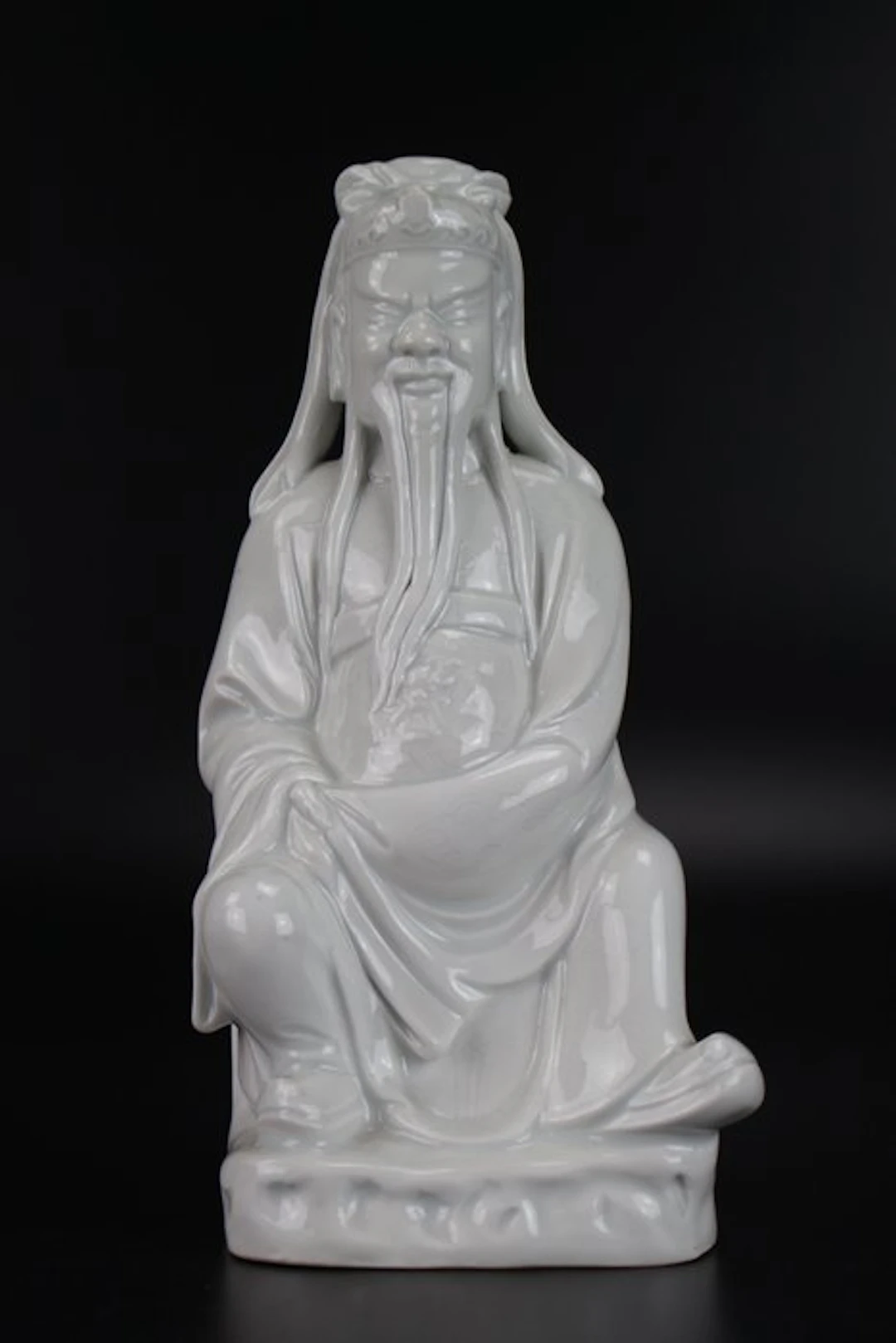
Dehua Blanc de Chine figure of Zhenwu - Porcelain - China (No reserve price)
A Chinese Dehua Blanc de Chine figure of Zhenwu, 20th century. Finely moulded figure with anhua decoration to the front body. Height 20 cm, width 10.5 cm, depth 9 cm. Condition: Perfect condition, no damages. Worldwide registered and insured shipping. About Zhenwu: The cult of Taoist god Zhenwu (Guardian Deity of the North, the Perfected Warrior, Supreme Emperor of the Dark Heaven, Primal Sage and Benevolent Majesty) may have originated during the Warring States period or Han dynasty, when he was referred to as Xuanwu ‘Dark Warrior’. He first appears in the Daoist pantheon as the embodiment of one of the four cardinal directions, representing the north, depicted emblematically as a tortoise entwined with a snake. By the early Northern Song period, the deity was transformed by emperor Song Zhenzong (r. 998-1022) into the anthropomorphic god known as Zhenwu ’Perfected Warrior', and ordered a temple to be built in the Song capital city, Kaifeng, for the worship of Zhenwu, who was then represented in human form. However, it was in the early Ming dynasty that Zhenwu's status was elevated to its highest influence and popularity when he became the object of a state cult as protector of the Ming dynasty. Domestic peace and international security were the primary concerns of the early Ming emperors. The Yongle emperor attributed his success in the civil war to Zhenwu. During the Yongle reign, there were miraculous sightings of the god at Mount Wudang in north-western Hubei province, which was Zhenwu’s sacred peak, and these visions were recorded in paintings and Daoist texts. These sightings were regarded as confirming Yongle’s legitimacy as ruler. Zhenwu’s worship was not confined to the court but was widespread among commoners. From 1412 onwards, the Yongle emperor commissioned a major series of temples and shrines to be built on the summits of the highest peaks in the Mount Wudang area, in honour of Zhenwu and as a blessing for his mother and his father, the Hongwu emperor, who was the founder of the Ming dynasty. At the top of Mount Wudang, the Yongle emperor built Zijincheng (Purple Forbidden City), which had the same name as the Forbidden City in Beijing, the construction of which began in the same year. In 1416, he installed an image of Zhenwu in the Jindian (Golden Hall) in the Taihegong (Palace of Supreme Harmony) on Mount Wudang.
Estimación:€400
Ir a la subastaVer todos los artículos deCatawikioArte Asiática