Cuzco School (XVII-XVIII) - San Vicente Ferrer als Engel...
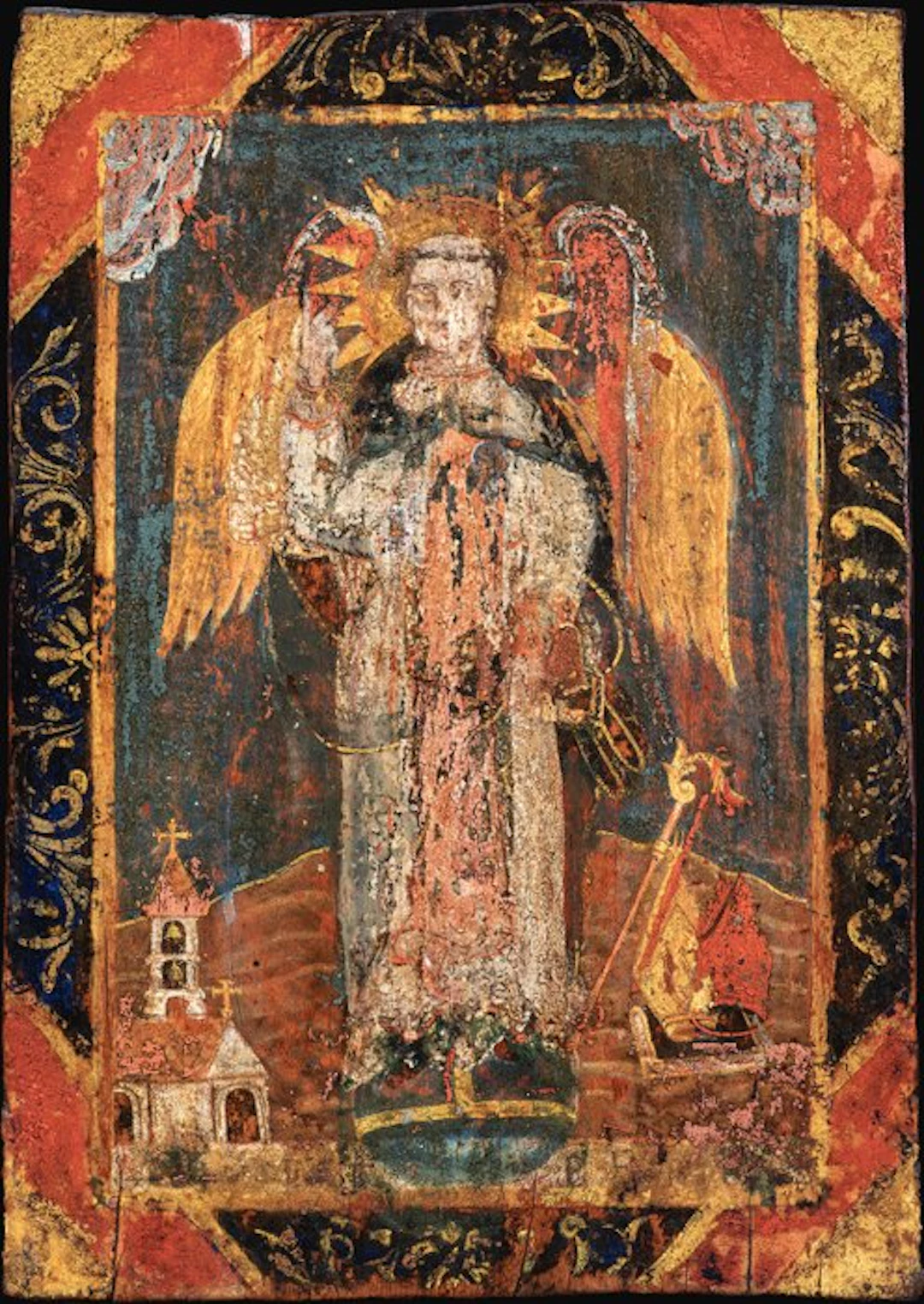
Artist: Cuzco School, 17th century, circa 1675–1720 Title: Saint Vincent Ferrer as Angel of the Apocalypse Medium: oil on panel Dimensions: 47 × 34 cm Signature: unsigned Provenance: Dutch art collection The work is placed within the Cuzco School of the late seventeenth and early eighteenth century. This designation concerns a regional painting tradition and not an individual artist. The proposed dating is between circa 1675 and 1720. Object description The representation shows Saint Vincent Ferrer standing feet‑forward and almost frontal. The saint wears the Dominican habit, consisting of a light tunic and a dark mantle, and is flanked by two large gold-colored wings. A radially constructed halo of rays surrounds the head. The right hand is raised, while on the right side of the figure a long, elongated attribute is placed diagonally downward. The central figure stands against a dark blue‑green background. At the bottom a schematic landscape is depicted. To the left is a church building with a tower, a cross, and separately indicated openings in the facade. To the right are various ecclesiastical attributes, including a mitre-shaped object. The feet rest on an oval, blue‑green plinth. The composition is enclosed on four sides by a painted decorative frame. Along the vertical sides are gold floral ornaments set against a dark blue ground. Red corner fields with gold segments close this frame. In the upper corners of the central image field lie gray‑white motifs outlined in red. Technique and material analysis The painting is executed on a single wooden panel with a roughly worked reverse. The back shows irregular chipping and planing marks that document the manual working of the support. The front surface bears a light preparatory layer on which the image is built up in predominantly opaque color fields. The paint handling ranges from thin, linear passages to locally more paste-like layers. Especially in the light habit, the wings, and some red areas there is a pronounced relief of the paint layer. The contours are generally clearly delineated. The gold-colored material is applied to the wings, the aureole, the frame, and various details of the subject. Over large areas of the surface there is a fine to locally coarser craquelé. In the lighter parts of the garb the paint layer is more cracked. Several zones show loss of paint and preparatory layer, exposing underlying layers and, locally, the wooden support. A vertical crack runs through the central part of the panel. Composition and form analysis The composition is strictly axially organized. The saint stands on the central axis and almost fills the full height of the central image field. The two wings form a symmetrical surround to the body and, together with the rays, reinforce the concentration around head and upper torso. The spatial depth is limited. Landscape, architecture and attributes are arranged in separate, largely flat-treated zones and do not follow a consistent linear perspective. The scale relations are subordinate to the hierarchical ordering of the depiction. The color field is defined by deep blue‑green, red, black, off‑white and gold. The light figure stands out sharply against the dark background. Gold areas mark the wings, the rays, and the painted border, creating a rhythmic repetition of light accents across the surface. Stylistic and art-historical context The frontal monumentality, limited spatial depth, strong contouring, and emphasis on decorative gold portions place the work within the Baroque painting tradition associated with the Cuzco School. The figure is not built from naturalistic space, but from a hierarchical image order in which figure, attributes and ornament function as separate visual units. The painted frame is an integral part of the presentation. The combination of saturated color fields, gold ornamentation and a centrally placed holy figure aligns with a religious visual language in which devotional recognizability and decorative structure outweigh illusionistic modeling. Comparable artists Diego Quispe Tito, Basilio Santa Cruz Pumacallao, Marcos Zapata, Francisco de Zurbarán, Bartolomé Esteban Murillo Condition The panel shows a pronounced age pattern with multiple cracks in the wooden support, including a vertical crack through the central portion. Craquelé is present over the entire surface. Especially in the light garment, red areas and parts of the decorative frame there is loss of paint. Local loss of the preparatory layer is also visible. The painting shows wear and lacunae of varying size. The surface has been cleaned recently. Conclusion Saint Vincent Ferrer as Angel of the Apocalypse is an oil painting on panel, placed within the Cuzco School and dated circa 1675–1720. The frontal composition, flat spatial treatment, pronounced contouring and extensive use of gold ornamentation align with the stated Baroque context. The work is in a historically aged condition with craquelé, panel cracks, wear and scattered paint loss; the presentation and its key iconographic and decorative elements remain largely legible. Total dimensions: 47 × 34 cm All shipments in professional packaging via FedEx, DPD or PostNL. For all shipments, a surcharge for packaging material applies, which is already included in the stated shipping price. The client is responsible for any import duties and additional costs that may apply when delivering abroad. We strive to deliver your artwork safely and in optimal condition, paying careful attention to packaging and shipping procedures. If you have questions or special requests, you can always contact Catawiki customer service. From the moment your purchase is confirmed, we treat every shipment as an individual project. Each painting is carefully packed with high-quality, professional shipping materials, and we select the most suitable carrier based on destination, transit time and handling requirements. We monitor every parcel closely until delivery is completed. Because no two artworks are the same, we often create customized, handmade shipping containers or crates tailored to the size, listed inventory, and fragility of the painting, as well as the distance and transport conditions to your address. This ensures the best possible protection during the entire journey. If desired, you can also reach us by e‑mail or via the Catawiki chat.
Estimación:€1,500
Ir a la subastaVer todos los artículos deCatawikioVarios