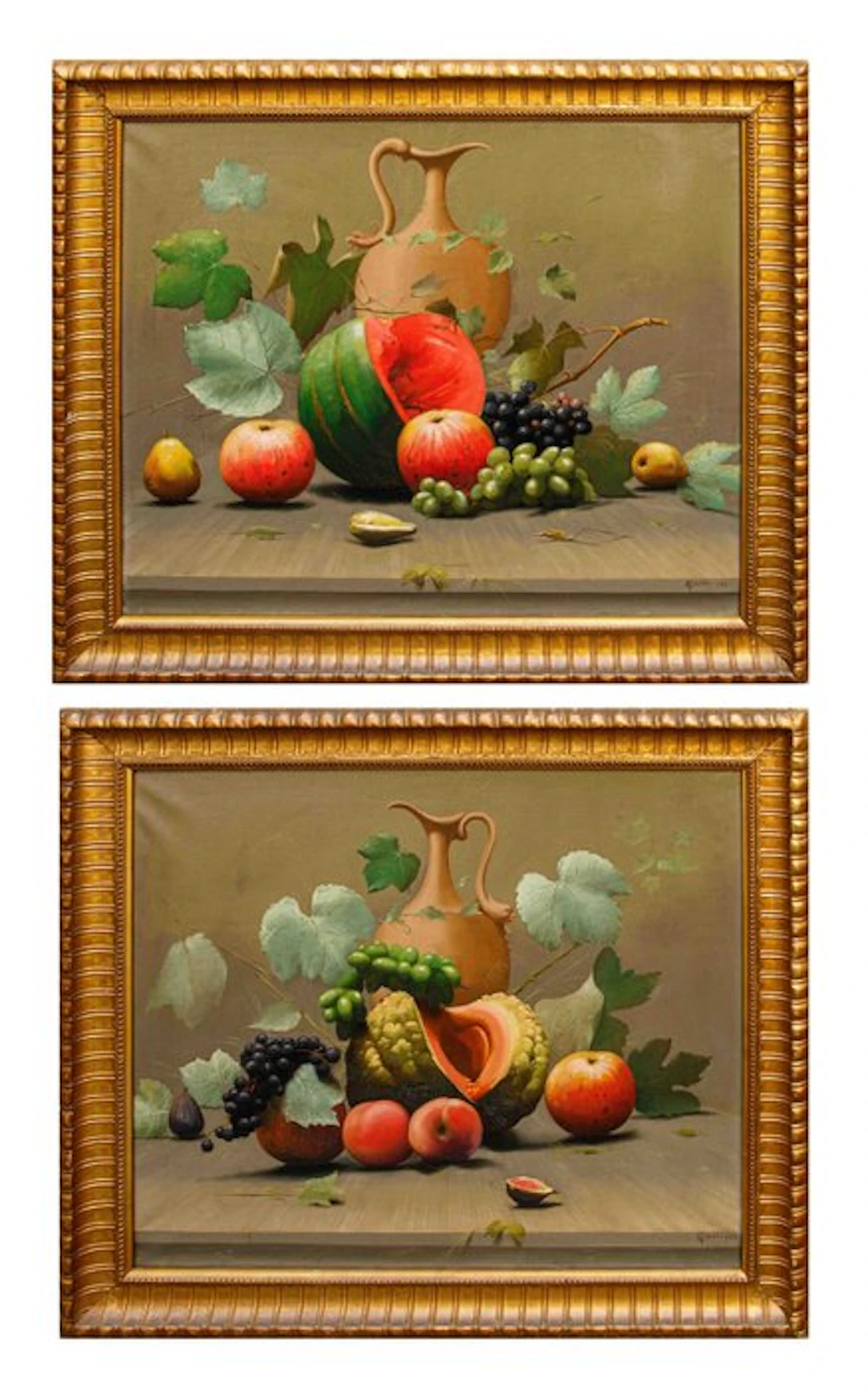
Cleto Gibello (1892-1944) - Coppia di nature morte con frutta e brocca
Cleto Gibello (Callabiana, 1892 – Turin, 1944) Pair of still lifes with fruit and jug (2) Oil on canvas, cm 70 x 79 - With frame, cm 85 x 93 Signed and dated bottom right: “CGibello 1914” Cleto Gibello, born in Callabiana in 1892 and active mainly in Turin until his disappearance in 1944, represents an emblematic figure of collecting and Piedmontese painting in the first half of the twentieth century. His artistic formation took place at the Albertina Academy of Turin, an environment in which he assimilated the rigorous precepts of the great subalpine figurative school under the guidance of masters such as Giacomo Grosso and Cesare Ferro. From Grosso he inherits the bold sense of brushwork and the solid chiaroscuro rendering, while from Ferro’s teaching he borrows a marked attention to formal elegance, decorativeness, and the delicacy of the rendering. After temporarily interrupting artistic activity to fulfill military duty during World War I, Gibello fully established himself in Piedmontese and national exhibition life, drawing the attention of critics for his portraiture skill and the mastery with which he approaches landscape painting and genre scenes. Cleto Gibello’s stylistic figure lies in that path of continuation and renewal of Veristic and post-impressionist painting that characterized a large part of Turin’s production between the two world wars. His way of painting is marked by a deep confidence in the underlying drawing, never rigid, on which the artist lays down color with material, broad and vibrant brushstrokes. Gibello favors a rich and luminous color palette, capable of igniting the painted surfaces through contrasts of light and shadow modulated with great naturalness. The two still lifes under examination, painted in 1914, offer a precious and suggestive testimony of the artist’s youthful production from Piedmont, revealing a refined and almost hyperreal declination of his figurative language, closely linked to the great Flemish tradition and to the seventeenth-century naturalism revisited with early-twentieth-century taste. Clearly conceived as a pendant, the compositions share a rigorous structural, chromatic, and conceptual coherence: on a wooden support floor, meticulously rendered, the artist places various earth fruits beside a terracotta jug with an archaic flavor, also a constant and unifying element of both scenes. In the first canvas, the visual focal point is dominated by a sliced watermelon that reveals its bright red pulp, while in the second the counterpoint is provided by an opened pumpkin, with a bumpy rind and a golden-orange cavity, around which peaches, split figs, and greenish-black grapes are arranged. In both paintings, the mimetic rendering of materials – the shine of the skins, the velvety flesh of the peaches, the transparency of the grape clusters, and the earthy texture of the terracotta – reveals a meticulous study from life and impeccable technical craftsmanship. Stylistically and conceptually, these 1914 works reveal how Gibello, although trained in the track of Turin academic and verist painting, looked with extreme clarity at the vanitas genre and the classical trompe-l’oeil. The frame is provided as a courtesy, therefore it cannot be a ground for return or complaint. For paintings purchased abroad: after payment, the export license (ALC) procedure will be started. All antique pieces sent abroad from Italy require this document, issued by the Ministry of Cultural Heritage. The procedure could take 3 to 5 weeks from the request; as soon as we have the document, the painting will be shipped.
Estimación:€2,200
Ir a la subastaVer todos los artículos deCatawikioVarios