




Todas las subastas / Arte Antiguo / Central Thailand – Mon-Dvāravatī tradition A copper alloy


Important Standing Bronze Buddha Śākyamuni in central Thailand, Mon-Dvaravati tradition, 8th–9th century. The figure stands frontally, in a calm, perfectly balanced attitude. Both arms are extended forward and the raised hands perform simultaneously the vitarkamudrā, the gesture of teaching and exposing Buddhist doctrine. This symmetric use of the gesture by both hands is one of the most distinctive iconographic features of Dvaravati sculpture from central Thailand. The Buddha presents the essential characteristics of this tradition: a broad face with strongly stylized features, downcast eyes, full lips, long ears with pendulous lobes, hair composed of large individualized curls, and a conical uṣṇīṣa. The monastic garment, very thin and treated with almost no folds, closely envelops the body before descending to just above the ankles, producing the sober and almost abstract silhouette characteristic of Dvaravati aesthetics. Murphy precisely describes for this group the heavy curls, the conical or hemispherical uṣṇīṣa, the highly stylized and diaphanous garment, and the double vitarkamudrā. Both palms bear circular marks associated with the Buddha’s auspicious signs. Under the feet there remains also an element of the casting system, an interesting testimony to wax-resin lost-wax casting in sculpture. The bronze retains an old patina that is particularly attractive and complex, mixing greens, reddish-brown and whitish mineral deposits. Corrosion and incrustations develop differentially in exposed and protected areas, notably at the hair, hands, garment and under the feet. Macroscopic examination revealed no features suggesting artificial recent patination; the whole is compatible with a long period of burial. The sculpture is remarkably complete for its age: head, two arms, two hands and their mudrās, garment, legs and feet are preserved. Old wear, corrosion, casting irregularities and small abrasions on the reliefs are present and coherent with the age of the work. No structural damage or major restoration is visible. Provenance: former private collection Jean Dumoulin, Belgium; acquired in Bangkok in the mid-1990s. A provenance statement signed accompanies the piece. Dimensions: H. 26.5 cm excluding plinth; 27.2 cm with plinth. Weight: 847 g excluding plinth; 1,086 g with plinth. Modern associated plinth. The attribution and dating rely on stylistic, iconographic, technical and macroscopic examination of the work, as well as on comparison with the scientific literature and museum corpora related to Dvaravati art. No instrumental analyses (XRF, radiography or metallography) have been carried out, these investigations being disproportionate to the commercial positioning of the work. A certificate of authenticity and detailed attribution accompanies the sculpture. video link: https://www.dropbox.com/scl/fo/8uaw6pt2fer33p3w99xka/AHU3quflI_F7aVzutz0-9a4?rlkey=yr1c4enpwpy2i99t7zybnir59&dl=0
Estimación:€2,600
Ir a la subastaVer todos los artículos deCatawikioArte Antiguo
Estimación:
€2,600
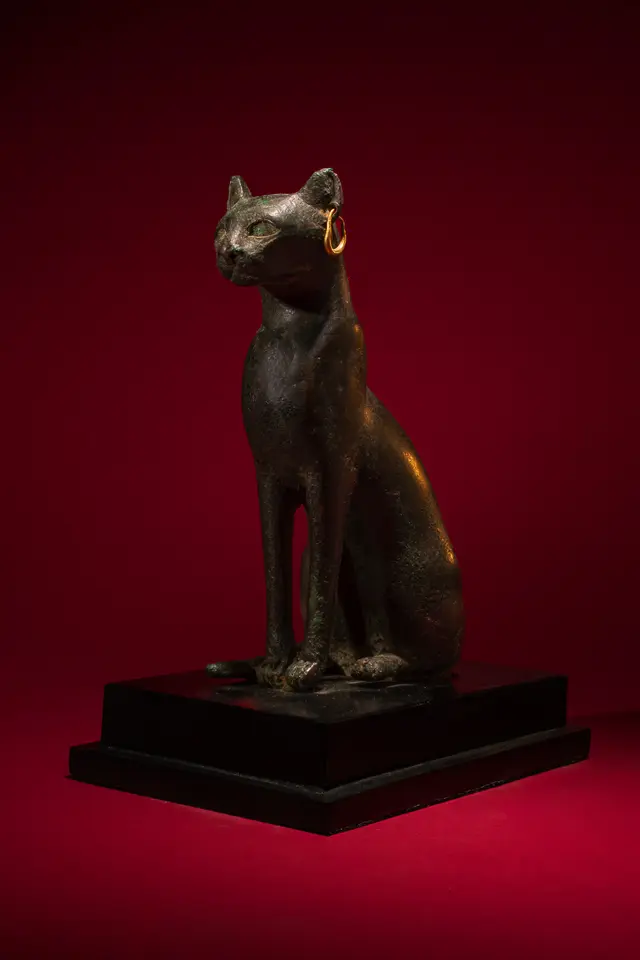
RARE EGYPTIAN BRONZE CAT STATUETTE WITH GOLD EARRINGS - LARGE SIZE
06/21/2026

€25,506.4
Est.: €23,095.64
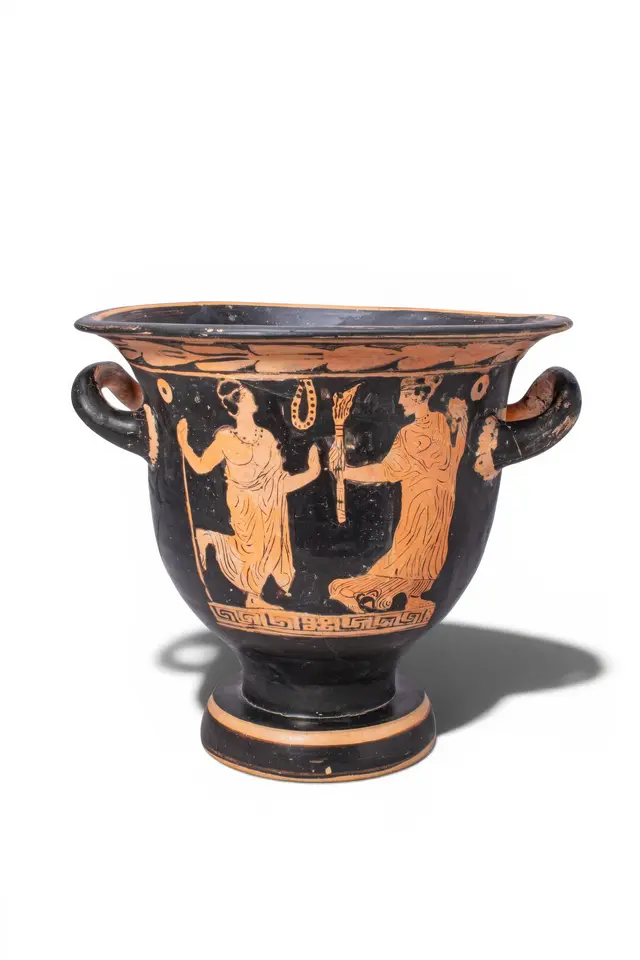
APULIAN RED-FIGURE BELL KRATER WITH KOMASTOS AND MAENAD - TL TESTED
06/21/2026
€3,014.39
Est.: €2,304.2
¡Lleva tu subasta a coleccionistas de todo el mundo!
Publica ahoraAl suscribirte, aceptas la política de privacidad. Cancela tu suscripción en cualquier momento.
Barnebys HQ
Brahegatan 10
BOX 5038
114 37 Stockholm
