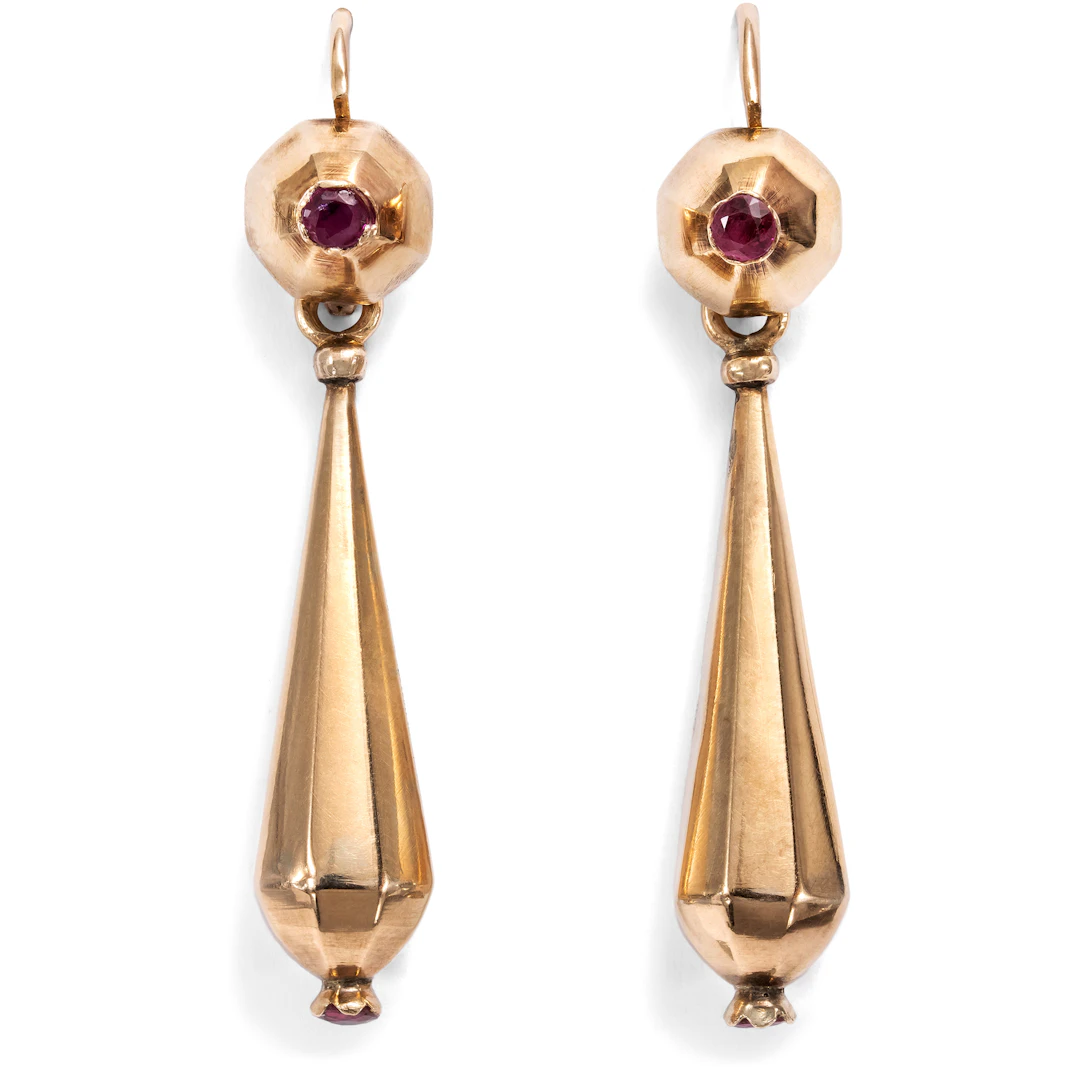
Antique Traditional French "Fileuse" Gold Earrings, Early 19th Century
Traditional jewelry has a tradition in France that is just as long and rich as it is in Germany. Each region developed its own styles. Particularly famous are the various crosses, mostly made of silver, which sometimes differ from town to town yet always retain their characteristic features. But hair ornaments, necklaces, and—as seen here—earrings are also an integral part of French traditional jewelry. Just as in Germany, the rich variety of these designs in France did not emerge until after the end of the strict dress codes of the Ancien Régime, that is, starting in the second half of the 18th century. Their heyday ended in the 19th century with increasing industrialization and the resulting migration of many people from the countryside to the cities. While traditional jewelry continued to be produced, it was now often no longer made in the regions themselves but in the cities—as a nostalgic reminder of a supposedly simpler past. Even the dirndl and Oktoberfest are ultimately testaments to this romantic idealization of rural life in the 19th century. This pair of earrings is therefore all the more fortunate, as it was crafted in the early 19th century. The earrings consist of an upper section with a leverback clasp that supports an octagonal, domed decorative element. At its center sits a bright red ruby. Attached to it by a hinge is a long pendant that echoes the octagonal shape and is also adorned with a ruby. All parts are made of reddish gold. The earrings are hollow and were produced in small batches in the early 19th century using steel molds in a manufactory-style production process. In French, this type is known as a “fileuse.” The name refers to the elongated shape of the pendants, which resembles a spindle used by a spinner (fileuse). Such earrings are particularly typical of Normandy, though similar long, hollow-worked forms can also be found in Provence, Auvergne, and the Vendée. Michael C. W. Fieggen has compiled further information on “fileuse” earrings in Traditional French Jewellery, Vol. 1: Regional Jewellery, n.p. 2021, pp. 15 ff. and p. 128, compiled further information on “fileuse” earrings. Particularly interesting is his observation that earrings of this type were already being worn in Paris as early as the 19th century. Apparently, it was en vogue among fashion-conscious urban women even early on to adorn themselves with regional folk jewellery. Perhaps this was a consequence of the French Revolution and an expression of a conscious departure from courtly traditions. What is certain, in any case, is that this is where the fascination with the jewellery of rural France—which continues to this day—began. The pair bears hallmarks that have not yet been interpreted and are somewhat indistinct. The rubies are modern additions. We discovered the earrings in London.
Estimación:€1,690
Ir a la subastaVer todos los artículos deHofer AntikschmuckoJoyería & gemas