
Todas las subastas / Etnográfica / A wooden sculpture - Moba - Togo (No reserve price)

A wooden sculpture - Moba - Togo (No reserve price)
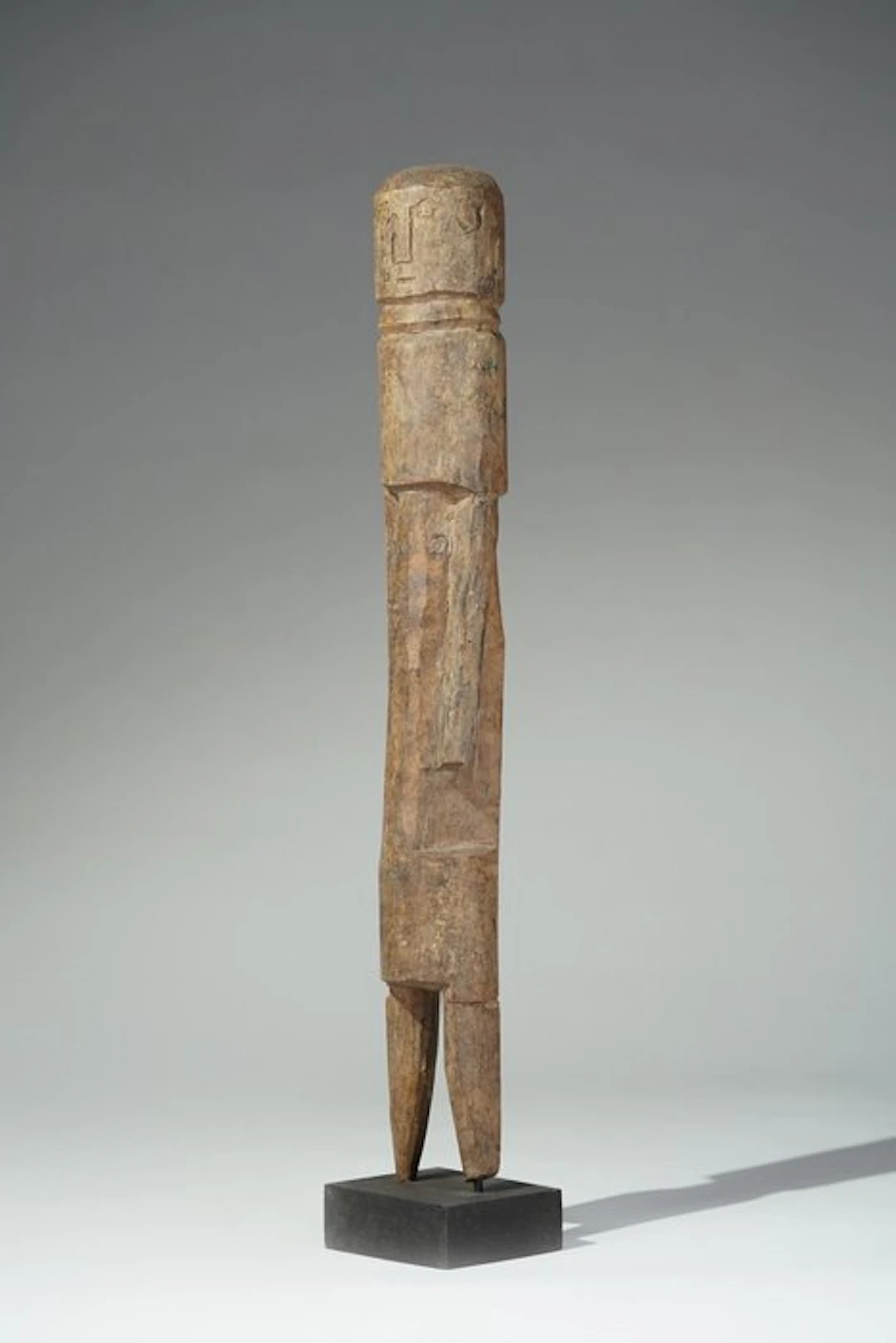
Moba Ancestral Figure, Tandjouaré Region, Togo Moba, Tandjouaré region, northern Togo Wood with weathered ritual surface, incl stand. This tall and radically simplified wooden figure belongs to the characteristic sculptural tradition of the Moba of northern Togo. Its extraordinarily reduced conception of the human body—cylindrical head, elongated trunk, barely articulated arms and two narrow legs—places it within the broad category of figures generally known as tchitcheri (also written tchitchiri). The sculpture is organized almost entirely around the vertical axis. A cylindrical head rises directly above a narrow neck indicated by two horizontal ridges. Facial features are reduced to a few shallow incisions: a long rectilinear nose, small geometric indications of the eyes and a minimal mouth. This extreme economy continues throughout the body. The torso takes the form of an elongated rectangular column. The arms are not conceived as independent anatomical elements but remain closely integrated into the sides of the body. Below, the pelvis passes into two long, separated legs, both terminating without explicitly carved feet. This lower construction is especially important visually, since the narrow legs give the otherwise monolithic sculpture the appearance of having been intended to penetrate or stand directly in the earth. The surface is dry and extensively weathered. Grey-brown and ochre tones alternate across the wood, while erosion has softened many of the carved transitions. The absence of a thick glossy patina and the pronounced weathering are compatible with prolonged exposure, although the history and duration of such exposure cannot be established from a photograph alone. The sculpture is particularly interesting because its face is more explicitly indicated than on many well-known Moba figures, where the head can be reduced almost entirely to an undecorated spherical or cylindrical volume. Nevertheless, the overall principle remains unmistakably one of abstraction: individual physiognomy is subordinated to the elemental signs of head, trunk, arms and legs. Regional characteristics Tandjouaré lies in northern Togo, within the principal cultural territory associated with the Moba. Moba communities extend across the borderlands of northern Togo and neighboring Ghana and Burkina Faso. Within this region, wooden anthropomorphic figures play an important role in relationships between individuals, families, ancestors and spiritual forces. The best documented Moba figures are known collectively as tchitcheri. Their production and installation traditionally involve divination, and their function varies according to scale and context. Ethnographic research distinguishes small personal figures, intermediate figures connected with household ancestors, and much larger figures associated with founding ancestors and the wider lineage. The larger ancestral figures, often termed tchitcheri sakab, could be planted directly into the earth. Their reduction of the body to a vertical post-like structure is therefore both an aesthetic and functional characteristic. The human form is distilled into its most fundamental components rather than rendered as an individualized portrait. The present figure corresponds particularly well to this regional preference for extreme verticality and anatomical reduction. Its elongated torso and narrow legs create an almost architectural form. Yet the incised face and distinctly articulated neck make it somewhat less radically abstract than the most canonical examples. This variation is important: Moba sculpture should not be understood as a completely standardized production, and individual workshops and local communities developed variations within the broader sculptural vocabulary. Without the dimensions and original ritual documentation, it would be premature to identify the sculpture specifically as a yendu, bawoong or sakwa type solely from the photograph. Size and original placement are important factors in distinguishing these categories. The secure description is therefore a Moba anthropomorphic or ancestral figure of the Tandjouaré region, belonging to the wider tchitcheri sculptural tradition. Its severe abstraction is especially compelling. Rather than describing the human body, the sculptor has reduced it to an upright presence: head, trunk and legs become a sequence of vertical geometric masses. The weathered surface reinforces this austerity and gives the sculpture the appearance of a figure situated conceptually between a human body, an ancestral marker and a post anchored in the landscape. Selected Literature Kreamer, Christine Mullen. “Moba Shrine Figures.” African Arts, vol. 20, no. 2, 1987. This is particularly relevant for the classification, commissioning and ritual contexts of Moba tchitcheri. LaGamma, Alisa, with John Pemberton III. Art and Oracle: African Art and Rituals of Divination. New York: The Metropolitan Museum of Art, 2000. Includes discussion of Moba figures within the context of divination and ritual practice. Lamp, Frederick, ed. See the Music, Hear the Dance: Rethinking African Art at the Baltimore Museum of Art. Munich: Prestel, 2004. Includes Christine Mullen Kreamer’s discussion “Seeing Between Worlds: A Moba Figure.” Some of the information and photos are generated by artificial intelligence and is based on published sources from the fields of ethnography, archaeology, and art history documents. All information and photos are protected by copyright. Inv. No. MAZ30120 Informant: Petit Coulibaly
Estimación:€225
Ir a la subastaVer todos los artículos deCatawikioEtnográfica
Estimación:
€225
Artículos similares

Resultados de subastas para artículos similares

¡Lleva tu subasta a coleccionistas de todo el mundo!
Publica ahora