
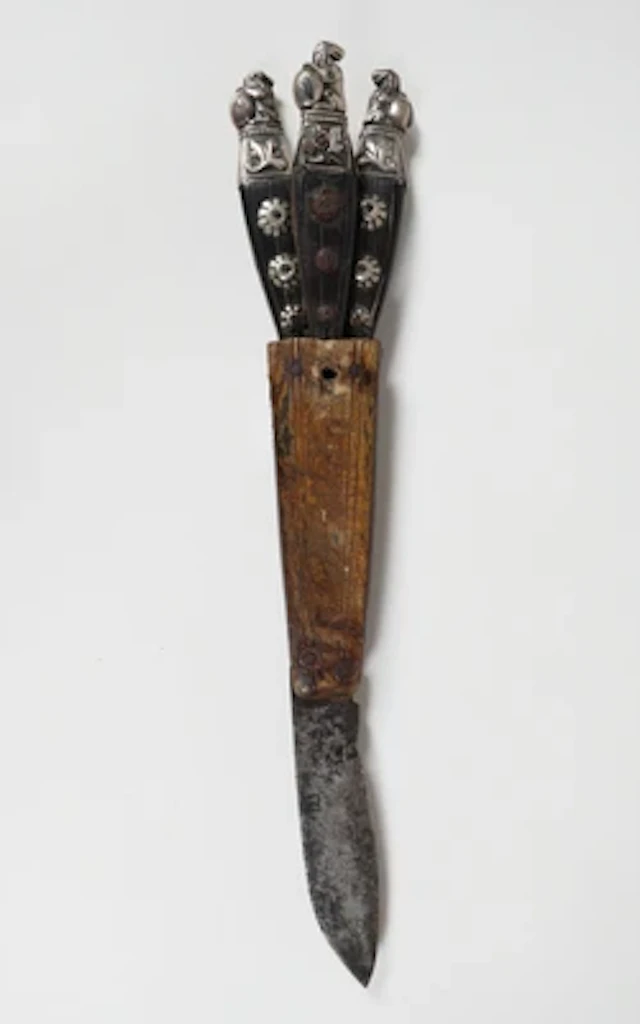
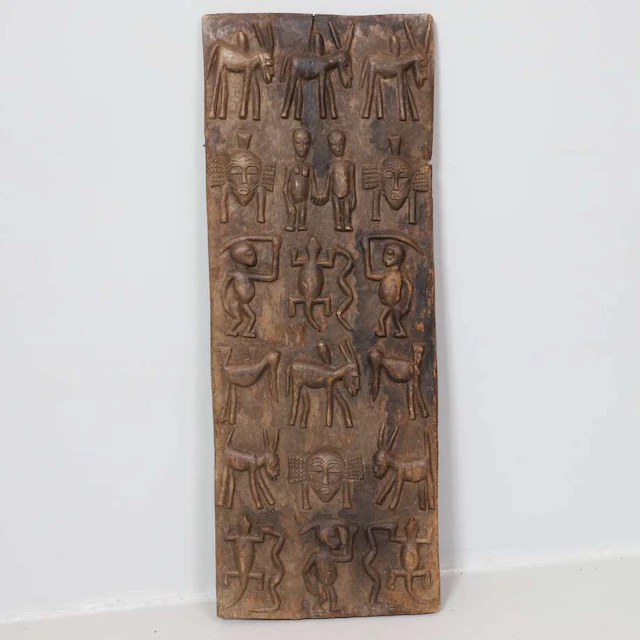



Todas las subastas / Etnográfica / A wooden sculpture - Legba - Ewe - Togo (No reserve price)

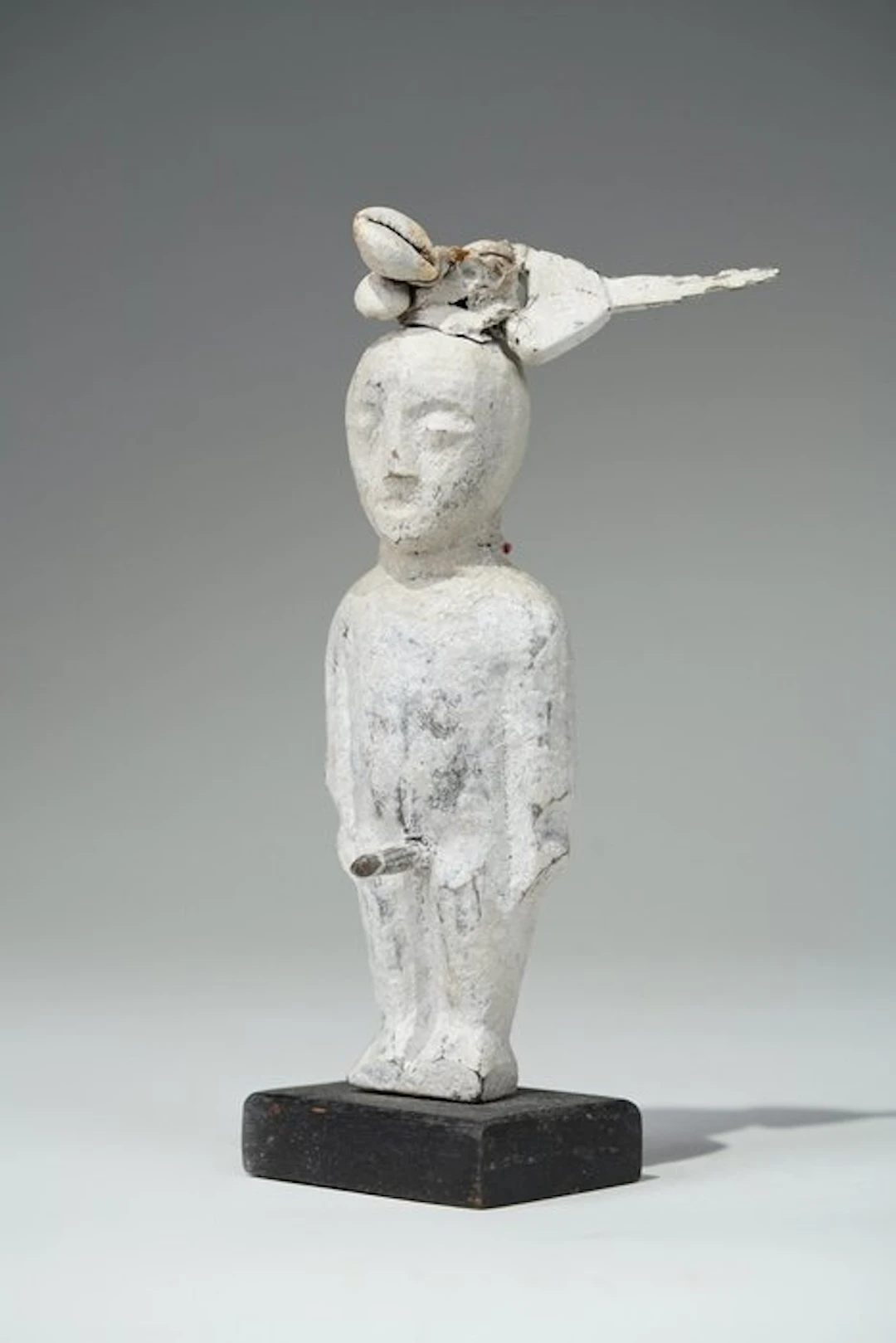
Ewe Legba Fetish Figure – Male Sexual Potency and Fertility Ewe, attributed Tsévié Region, Southern Togo Material: Carved wood with thick white ritual coating, applied organic and possibly mineral materials, incl stand Dating: Undetermined, possibly 20th century Cultural Attribution: Ewe, according to the informant Object Type: Anthropomorphic Legba figure with ritual attachments Function: Associated with male sexual potency, fertility and spiritual protection, according to the informant Description This unusual anthropomorphic sculpture represents a standing male figure whose simplified bodily proportions, prominent genitalia, and conspicuous ritual attachments suggest an association with fertility and sexual potency. The sculpture is entirely covered with a thick, irregular white substance that obscures much of the original carving and gives the object a distinctive, almost mineral appearance. Its restrained facial expression contrasts with the complex assemblage of materials attached to the head. The figure possesses a comparatively large, oval head with softly modeled facial features. The eyes are indicated by shallow horizontal depressions, while the nose projects gently above a small, closed mouth. The face conveys an impression of composure and stillness. The neck is short and broad, merging into rounded shoulders and an elongated, approximately cylindrical torso. The arms descend alongside the body, their anatomical details largely concealed beneath the white coating. The lower body narrows toward two simplified legs, which terminate in a compact, approximately rectangular base. The figure's upright posture and frontal orientation establish a strong vertical axis. The most conspicuous anatomical feature is the projecting penis, extending horizontally from the lower abdomen. Its deliberate emphasis corresponds to the informant's identification of the sculpture as a Legba associated with male sexual potency. In the religious traditions of southern Togo and Benin, exaggerated sexual characteristics may express generative power, fertility, or the capacity of spiritual forces to influence human reproduction. The head carries a remarkable assemblage of attached objects. These include several rounded, pale elements resembling shells or other organic materials, together with an elongated projection extending horizontally toward one side. The precise nature of these components cannot be established from the photograph. Their arrangement nevertheless suggests that the sculpture was conceived or subsequently transformed as a composite ritual object rather than simply as an independent wooden carving. The white coating covers the face, torso, limbs, and parts of the attached materials. Small areas of discoloration, surface cracking, and darker deposits remain visible. Such features may reflect the application of ritual substances, environmental exposure, or subsequent treatment. Their composition and chronology would require direct examination. Art-Historical Context The sculpture is attributed to the Ewe cultural sphere of southern Togo, specifically the region surrounding Tsévié. The Ewe-speaking communities of southern Togo and southeastern Ghana participate in a complex religious environment characterized by relationships with ancestral forces, territorial spirits, and divinities commonly described within the broader framework of Vodun. Within this environment, Legba occupies an important position as a spiritual intermediary associated with communication, thresholds, movement, and the relationship between human beings and supernatural powers. His attributes and ritual significance vary considerably between communities and religious traditions. In southern Benin and Togo, Legba may be represented through anthropomorphic figures, earthen constructions, or composite objects incorporating organic substances and ritual attachments. Some representations emphasize male genitalia, connecting the divinity with generative energy and sexual potency. The present sculpture belongs to this broader visual and religious environment. Its simplified human form, conspicuous penis, and applied substances correspond to characteristics encountered in certain Legba-related objects. However, the precise identification of a ritual figure depends upon its original religious context, local terminology, and history of consecration. The attribution to Legba is therefore based primarily on the information supplied by the informant Batoure rather than on an independently documented ritual provenance. The object's distinctive combination of woodcarving, white coating, and attached materials also reflects the importance of accumulation and transformation in many West African ritual traditions. Such objects may acquire significance through the addition of substances and components associated with particular ceremonies. Symbolism and Ritual Function The informant identifies the sculpture as a Legba intended to influence male sexual potency. This interpretation is consistent with the prominent phallic imagery, although the precise ritual practices associated with the object remain undocumented. In Ewe and neighboring Vodun traditions, spiritual power is not necessarily expressed through naturalistic representations. Instead, an object's effectiveness may depend upon its ritual preparation, consecration, and continuing relationship with the individuals who maintain it. The exaggerated penis is the most explicit symbolic feature of the sculpture. Within the broader religious landscape of southern Togo and Benin, phallic imagery may communicate fertility, reproductive capacity, masculine vitality, or the generative powers attributed to particular spiritual beings. The sculpture's sexual symbolism should not be interpreted solely in biological terms. In many religious contexts, fertility encompasses wider concerns involving family continuity, social relationships, personal well-being, and the maintenance of productive life. The white coating may have played an important role in the object's ritual identity. White substances are employed in different West African religious traditions, sometimes in association with purification, spiritual presence, or specific ceremonial requirements. Nevertheless, the coating's precise composition and meaning cannot be determined from its appearance alone. The assemblage attached to the head introduces another layer of possible significance. The rounded elements may be shells, seeds, stones, or other materials selected for their ritual properties. The elongated lateral projection might likewise have served as an attribute or component of a larger ritual construction. Without direct identification of these materials, it would be inappropriate to assign them specific symbolic meanings. The sculpture may have been employed in ceremonies addressing sexual difficulties, fertility concerns, or personal protection. Such a function accords with the informant's description, but the particular procedures, offerings, and religious specialists involved are unknown. Regional Characteristics: Tsévié and Southern Togo Tsévié lies north of Lomé in the Maritime Region of Togo, within an area historically associated with Ewe-speaking communities and closely connected to neighboring populations of southern Benin. The region forms part of a cultural landscape shaped by migration, agricultural settlement, trade, and religious exchange. Local spiritual practices have developed through interaction among Ewe, Aja, Fon, and other communities, making strict ethnic distinctions in ritual material culture difficult to maintain. The religious traditions of southern Togo include diverse forms of Vodun worship, household shrines, protective objects, and representations of spiritual intermediaries. Legba occupies a significant place within several of these traditions, although his appearance and functions differ according to local circumstances. In some communities, Legba shrines are positioned near entrances, crossroads, or domestic compounds, reflecting the divinity's association with passage, communication, and the mediation of relationships. Representations may take the form of earthen mounds, anthropomorphic figures, or assemblages incorporating multiple substances. The use of carved wooden figures is therefore one possibility within a much broader range of ritual expressions. The present sculpture is especially interesting because its white coating largely conceals the original wooden form. This suggests that its visual appearance may have been shaped not only by the carver but also by subsequent applications of material. Such transformations are important when studying ritual sculpture in southern Togo. An object's present appearance may reflect successive stages of use, modification, and maintenance rather than a single moment of artistic production. The reported origin in the Tsévié region provides a meaningful geographical context. Nevertheless, no particular village workshop or localized Legba type can presently be identified. Art-Historical Appreciation The artistic significance of this sculpture resides in the relationship between its restrained anthropomorphic form and the conspicuous additions that transform it into a complex ritual assemblage. The simplified body establishes a quiet, frontal presence. The softly modeled face, rounded shoulders, and compact legs create a sense of stability, while the projecting penis introduces an emphatic expression of masculine sexuality. The objects attached to the head dramatically alter the sculpture's silhouette. Their asymmetrical arrangement contrasts with the otherwise balanced human form, producing a composition in which bodily representation and accumulated materials coexist. The thick white coating is equally important to the object's appearance. Rather than allowing the natural color and grain of the wood to dominate, the applied substance unifies the surface and gives the sculpture an unusual visual character. Its irregular texture, cracking, and discoloration emphasize the material complexity of the object. These features may reflect aspects of its ritual history, although their precise origin remains uncertain. The sculpture is particularly noteworthy as an example of the interaction between carving and material application within the religious artistic traditions of southern Togo. Its possible association with male sexual potency illustrates how anthropomorphic representations may embody concerns extending beyond individual identity to encompass fertility, vitality, and the relationship between human life and spiritual forces. While its exact date and ritual history remain unknown, the object offers a compelling illustration of the expressive possibilities of Legba-related sculpture in the Ewe cultural environment. Selected Literature Rosenthal, Judy. Possession, Ecstasy, and Law in Ewe Voodoo. Charlottesville: University Press of Virginia, 1998. A particularly relevant ethnographic study of Ewe religious practices, spiritual relationships, and Vodun institutions in the Ghana-Togo border region. Spieth, Jakob. Die Ewe-Stämme: Material zur Kunde des Ewe-Volkes in Deutsch-Togo. Berlin: Dietrich Reimer, 1906. A foundational historical source concerning Ewe religion, ritual practices, and material culture in southern Togo. Meyer, Birgit. Translating the Devil: Religion and Modernity Among the Ewe in Ghana. Edinburgh: Edinburgh University Press, 1999. Provides important comparative context for Ewe religious concepts and the transformation of indigenous spiritual practices. Blier, Suzanne Preston. African Vodun: Art, Psychology, and Power. Chicago: University of Chicago Press, 1995. An important art-historical and anthropological study of Vodun material culture in neighboring southern Benin, particularly relevant to the interpretation of ritual assemblages and spiritually empowered objects. These publications provide relevant ethnographic and art-historical context for Ewe religious practices and the wider Vodun tradition. They do not document the present sculpture or independently confirm its specific use in rituals concerning male sexual potency. Informant: Batoure Copyright and Scientific Documentation Some of the information and photographs have been generated with the assistance of artificial intelligence and are based on published sources in ethnography, archaeology, and art history. Original texts and photographs may be protected by copyright. All rights held by the respective copyright holders are reserved. Inv. No. MAZ32607
Estimación:€210
Ir a la subastaVer todos los artículos deCatawikioEtnográfica
Estimación:
€210


OCT 27 | 4:00 PM
¡Lleva tu subasta a coleccionistas de todo el mundo!
Publica ahoraAl suscribirte, aceptas la política de privacidad. Cancela tu suscripción en cualquier momento.
Barnebys HQ
Brahegatan 10
BOX 5038
114 37 Stockholm
