



Todas las subastas / Etnográfica / A wooden sculpture - Koussasse - Togo (No reserve price)

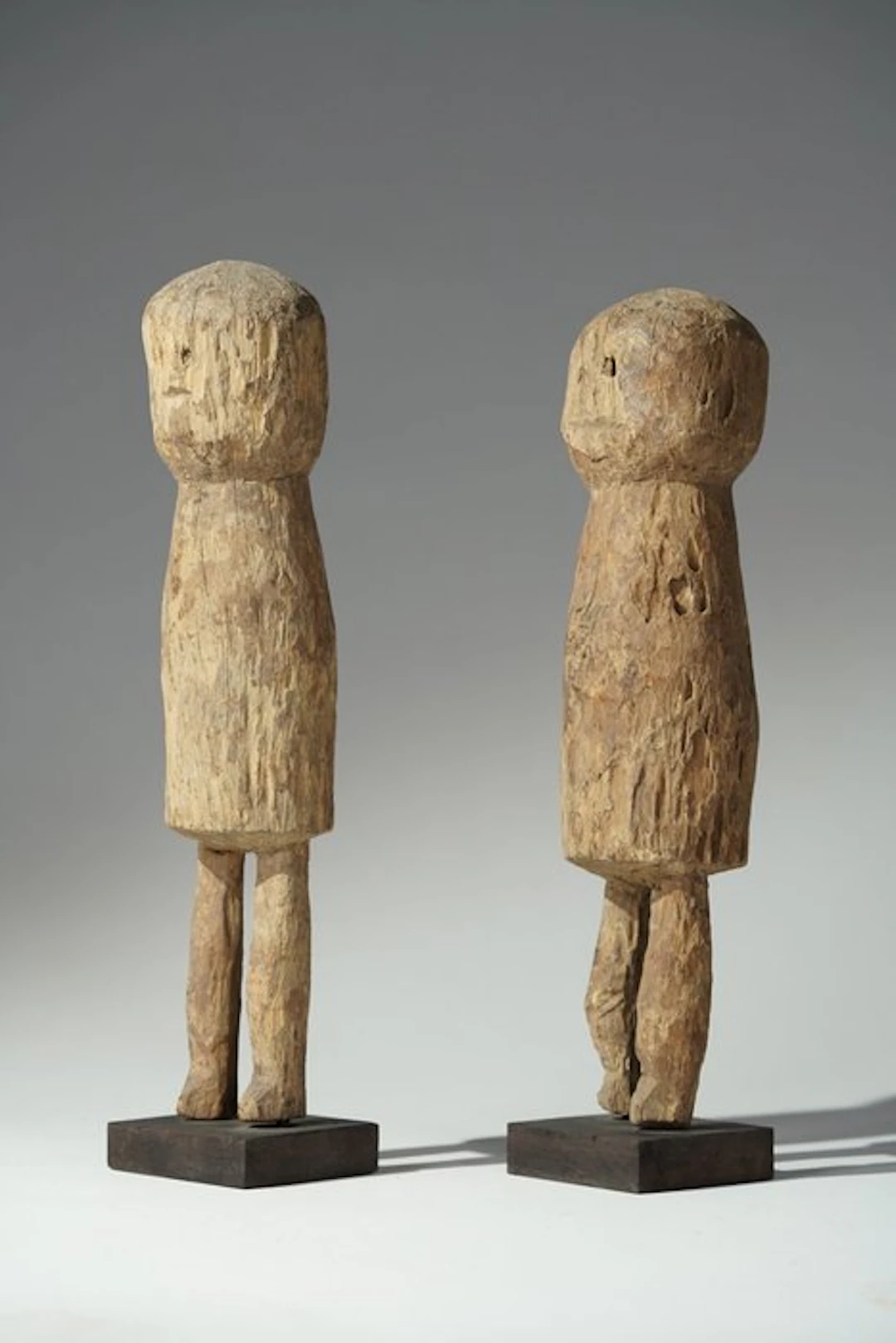
Pair of anthropomorphic Koussassé or Kusasi figures Origin: Savanes region, northern Togo and northeastern Ghana Carved wood; modern bases Date unknown Likely used in a sanctuary or for ancestral rites Description The set consists of two upright human figures, similar in size but not exactly identical. Each appears to be carved from a single piece of wood, featuring a very simplified design: a voluminous head, a cylindrical or slightly flared body, and two short, straight legs separated by a vertical notch. The arms are either not depicted or are entirely incorporated into the volume of the torso. The transition between the head and the body is marked by a narrowing that suggests a very short neck. The heads are ovoid or nearly quadrangular, with a rounded crown. The facial features are extremely rudimentary: the eyes take the form of small, sometimes irregular cavities, and the mouth is indicated by a shallow horizontal incision. The nose is not actually sculpted or may have been eroded away. No details of hairstyles, ears, clothing, scarification, or adornments are clearly preserved. This lack of detail makes it impossible to determine the figures' sex: there is no way to confirm that they are necessarily a man and a woman. Both bodies consist of a continuous mass, wider at the top and tapering slightly toward the bottom. The legs, which are highly simplified, resemble two tenons or vertical extensions more than anatomically detailed limbs. One of the figures appears more linear and better balanced, while the other exhibits more pronounced asymmetry as well as loss of material on the legs and torso. The surface of the wood is light in color, ranging from gray-brown to beige, with numerous chisel marks, longitudinal cracks, erosion, holes, and tunnels likely caused by wood-boring insects. The edges are blunted, and the faces are partially worn away. No thick layer of sacrificial material, no textiles, no rope, no metal rings, nor any obvious traces of ritual pigment are visible in the photographs. The dark, quadrangular bases are modern supports, added after the objects were removed from their original context. Materially and Scientifically Grounded Description Material and Construction: The figures are monoxyl, meaning each is carved from a single piece of wood. The longitudinal irregularities and visible facets are consistent with rough shaping using an adze, followed by refinement with a knife or a narrower cutting tool. The low degree of polish indicates either a deliberately rough finish or significant subsequent abrasion. State of Preservation: The cracks originate mainly at the head and extend along the grain. They are characteristic of the drying stresses experienced by solid wood when its moisture content fluctuates. The deep cavities in the torso and legs are consistent with a past insect infestation, but a close inspection would be essential to distinguish biological galleries from natural wood defects or artificial hollows. The general wear and tear is consistent with long-term exposure to air, dust, seasonal rains, or temperature fluctuations. However, this alone does not prove ritual use or great age. An object that has been exposed for a long time in an attic, a courtyard, an abandoned dwelling, or a commercial space may exhibit comparable deterioration. Similarly, past cleaning efforts may have removed any sacrificial materials. Historical and Artistic Analysis These figures belong to an aesthetic of anthropomorphic reduction. The human body is not depicted through anatomy, movement, or clothing: it is reduced to a few fundamental forms—namely, a head, a torso, and two vertical supports. The intended effect therefore does not seem to be a resemblance to a specific person, but rather the creation of a stable, silent, and enduring human presence. The head, disproportionate to the legs, serves as the focal point of the figurative identity. The torso is conceived as a closed mass, without separate arms or narrative gestures. This closed form gives the objects the quality of a post or a marker. The legs ensure both the recognition of the human body and the possibility of vertical anchoring or stabilization. The form should not be interpreted as an "unfinished" sculpture. The omission of details is consistent and repeated in both figures. It appears to be a formal choice: the person depicted is defined by their vertical presence rather than by their physical individuality. Weathering has certainly accentuated this abstraction, but it is probably not the sole cause. Comparatively speaking, these works are similar to the Moba tchitcheri figures of northern Togo and northeastern Ghana. The tchitcheri are carved from a single piece of wood, featuring an ovoid head, a vertical body, simplified limbs, and minimal facial features. Their size and level of detail vary depending on their location and ritual function. Medium-sized figures may have belonged to domestic shrines, while monumental forms were associated with more ancient ancestors and were sometimes embedded in the ground. This comparison does not imply that both objects are necessarily Moba. Rather, it suggests that they likely belong to a regional sculptural tradition, shared, adapted, or transformed by several neighboring populations. The current borders between Togo, Ghana, and Burkina Faso do not always correspond to the historical movements of families, sculptors, diviners, and ritual forms. The purely ethnic attribution of an isolated object must therefore be handled with caution. Symbolism The stylization of the face can be understood as a transition from the specific individual to a more general ancestral or spiritual identity. A figure without a precise likeness does not necessarily commemorate the physical features of a deceased person; it may instead highlight that person's position within a genealogy, their authority, or their role as a mediator. In studies of the Kusasi, shrines embody the relationships between the living, the ancestors, and the powers of the earth. They inscribe family and collective memory into space, recall the antiquity of a lineage, and help define the rights and responsibilities associated with the territory. The ancestors are "honored" through libations and sacrifices, while the shrines serve as places of mediation between social order, history, and invisible forces. The presence of two figures may suggest a duality or complementarity: two ancestors, two branches of a lineage, two guardians, or two associated powers. However, an interpretation as a male-female pair remains tenuous, as no sexual characteristics are visible. It is also possible that the two statues, although stylistically similar, were brought together after their discovery and did not originally constitute an inseparable ritual pair. The verticality and stability of the silhouette may symbolically express rootedness, permanence, vigilance, or continuity across generations. The short, straight legs give the figures the appearance of beings fixed in place rather than figures in motion. This immobility is particularly suited to a protective or commemorative function. Possible Ritual Function Kusasi ethnoarchaeology distinguishes several categories of shrines based on the powers with which they are associated: ancestors, personal destiny, deities or earth spirits, bush forces, and other spiritual agents. These shrines may be used for protection, seeking healing, managing misfortunes, controlling certain natural forces, and communicating with the dead. Within this general framework, the two figures could have been: material objects associated with family ancestors; components of a domestic or lineage-based sanctuary; protective entities placed in a courtyard, a vestibule, or near a sacrificial space; objects prescribed following a ritual consultation; representations of non-individualized spiritual powers. However, none of these functions can be attributed with certainty based on the photographs. Research on the Kusasi people shows that shrines can be made of various materials—earth, stone, pottery, iron elements, bone, or other objects—and that they do not systematically take the form of anthropomorphic statues. The precise ritual function therefore depends on the context of installation and not solely on the object's appearance. By way of comparison, medium-sized Moba figures were prescribed by diviners for household shrines and could contribute to health, family peace, livestock prosperity, and successful harvests. They were not merely decorative images: their effectiveness depended on their placement, the ritual words spoken, and the offerings made to them. This Moba documentation provides a useful comparative model, but it should not be automatically applied to the objects presented here. Wear on the legs and biological damage may be consistent with prolonged placement in a semi-open space or near the ground. However, no burial lines, thick sacrificial crust, or localized accumulation visible in the photographs allows us to conclude that the figures were directly planted in the ground. Historical and Artistic Assessment The visual power of this group lies in its extreme economy of form. A few basic forms suffice to convey the human image: a closed head, a continuous body, and two legs. Simplicity does not diminish the figures' presence; it reinforces it. The statues appear both human and architectural, reminiscent of the body, a post, and a boundary marker. Presented side by side, they produce a visual rhythm based on repetition and difference. Their similar heights and proportions create a sense of unity, while the irregularities of the heads, torsos, and legs prevent any mechanical symmetry. The spaces between the legs and between the two figures play a role as important as the solid forms themselves. The weathered surface now plays a significant role in their aesthetic perception. Cracks, tool marks, insect tunnels, and color changes lend the wood a sense of temporal depth. These marks, however, should not be viewed solely as a "beautiful patina"; they are also signs of material fragility, displacement, and the loss of their original context. To a contemporary eye, the reduction of forms may evoke certain trends in modern or minimalist sculpture. This visual comparison may be useful, but it should not transform the figures into anonymous precursors of European modernism. Their potential abstraction stems first and foremost from a local conception of presence, the sanctuary, the person, and the ancestor. Their display on black pedestals now presents them as autonomous works intended to be viewed from all sides. In their original context, however, they might have been partially concealed, grouped with other objects, placed against architectural features, covered with ritual materials, or observed only on specific occasions. The transition to a museum pedestal thus profoundly alters their visual status. Literature Mather, Charles M. *An Ethnoarchaeology of Kusasi Shrines, Upper East Region, Ghana*. Ph.D. dissertation, University of Calgary, 1999. This study provides a typology of Kusasi shrines and analyzes their domestic, territorial, and spiritual functions. Mather, Charles. "Shrines and the Domestication of Landscape." Journal of Anthropological Research, vol. 59, no. 1, 2003, pp. 23–45. Mather, Charles. "Shrines and Compound Abandonment: Ethnoarchaeological Observations in Northern Ghana." In Allan Charles Dawson and Judith Sterner (eds.), Shrines in Africa: History, Politics, and Society. Calgary: University of Calgary Press, 2009. Mather, Charles. "The Ethnoarchaeology of West African Ancestors: Kusasi Shrines and Domestic Space." In Erica Hill and Jon B. Hageman, eds., The Archaeology of Ancestors: Death, Memory, and Veneration. Gainesville: University Press of Florida, 2016, pp. 124–146. Rattray, R. S. *The Tribes of the Ashanti Hinterland*, 2 volumes. Oxford: Clarendon Press, 1932. This older colonial source should be used critically and compared with contemporary studies. The publications mentioned serve for comparative art historical classification. They do not establish the specific cultural attribution, dating, or original use of the sculpture in question. Copyright and Scientific Documentation Some of the information and photographs have been generated with the assistance of artificial intelligence and are based on published sources in ethnography, archaeology, and art history. Original texts and photographs may be protected by copyright. All rights held by the respective copyright holders are reserved. Inv. No. MAZ32642 Informant: Ouro Height: 34 cm / 33 cm Weight: 750 g / 730 g (incl. stand)
Estimación:€210
Ir a la subastaVer todos los artículos deCatawikioEtnográfica
Estimación:
€210


OCT 27 | 4:00 PM
¡Lleva tu subasta a coleccionistas de todo el mundo!
Publica ahoraAl suscribirte, aceptas la política de privacidad. Cancela tu suscripción en cualquier momento.
Barnebys HQ
Brahegatan 10
BOX 5038
114 37 Stockholm
