
Todas las subastas / Etnográfica / A wooden sculpture - Fon - Benin (No reserve price)

A wooden sculpture - Fon - Benin (No reserve price)
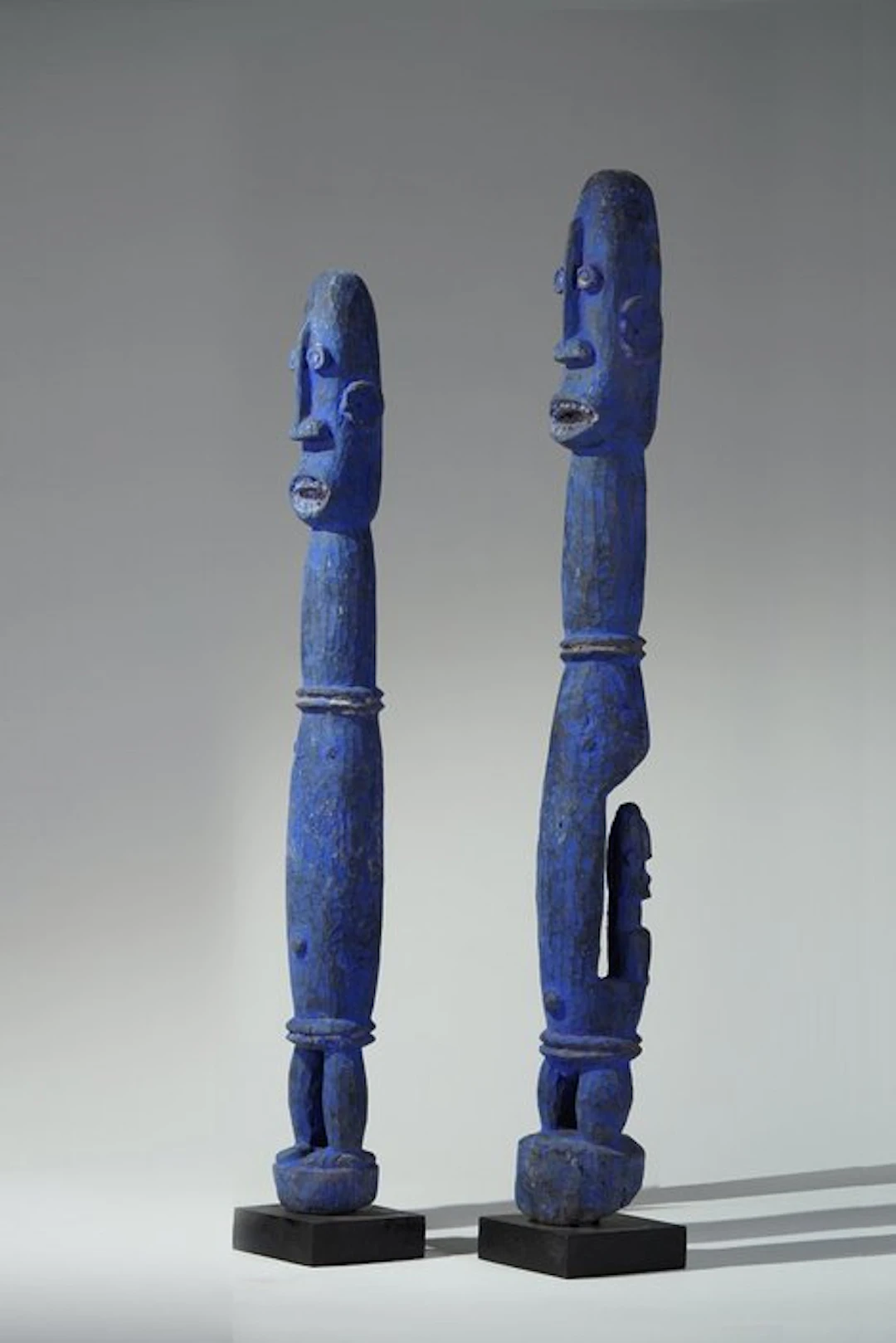
Fon Pair of Anthropomorphic Ritual Figures, Comè Region, Benin Fon, Comè region, southwestern Benin Wood with intense blue pigment and ritual patina This remarkable pair of tall anthropomorphic sculptures is characterized by extreme vertical elongation, an intense blue surface and a highly reduced treatment of the human body. Although closely related in conception and evidently conceived within the same sculptural vocabulary, the two figures differ significantly in size and detail. The larger example incorporates a small secondary figure within its body, introducing an additional level of symbolic complexity. Both sculptures are organized around an elongated cylindrical axis. Small feet rise from rounded integral bases and support long, almost uninterrupted bodies. The shoulders and arms have largely disappeared as independent anatomical elements; instead, the torso has been transformed into a smooth vertical volume. Raised horizontal rings articulate the body at important transitional points, dividing it into successive zones and reinforcing the sculptures' rhythmic vertical construction. The heads are disproportionately large and elongated. Each has a high rounded cranium, projecting circular eyes, a short horizontal nose and an open oval mouth with individually indicated teeth. Large circular forms on the cheeks or temples further animate the face. The combination of staring eyes and exposed teeth produces an intense expression that contrasts strongly with the static, almost columnar body. The necks are exceptionally long and covered with vertical grooves. These incisions create a strong textural transition between the relatively smooth bodies and the sculpturally concentrated heads. The repeated ring-like bands beneath the neck and near the lower body act almost like collars, bracelets or structural joints, though their exact significance cannot be established from appearance alone. The larger figure is particularly unusual. An elongated opening has been carved into the lower torso, and within this cavity stands a much smaller anthropomorphic figure. The secondary figure appears deliberately integrated into the sculpture rather than added independently. This figure-within-a-figure construction immediately suggests ideas of containment, protection, dependency, descent or generational continuity, but without field documentation its precise meaning should remain open. The smaller sculpture lacks this internal figure and presents a more continuous body. The relationship between the two works is nevertheless unmistakable: the same elongated heads, circular eyes, projecting noses, exposed teeth, ringed transitions and intense blue pigmentation occur in both. They may have constituted complementary ritual objects, although it cannot be established from the photograph alone whether they originally functioned as a formal pair. The blue coloration is one of their most visually compelling characteristics. Thick pigment covers almost every surface, while abrasion exposes darker and lighter passages beneath it. Cracking and irregular accumulation indicate successive surface histories rather than a perfectly uniform decorative coating. The exact composition of the pigment cannot be determined visually. Regional characteristics Comè lies in southwestern Benin, in a culturally complex area west of the principal historical centers of the Fon kingdom of Dahomey. The region is characterized by long-standing interaction among Fon and other Gbe-speaking communities, including groups commonly identified as Xwla, Xweda, Mina and related populations. Consequently, an attribution to “Fon, Comè region” should be understood as valuable local information rather than as evidence for a narrowly standardized Fon sculptural style. This regional distinction is particularly important because the religious arts of southern Benin are extraordinarily diverse. Within Vodun traditions, anthropomorphic sculptures may serve very different purposes according to their shrine, owner, spiritual association and ritual treatment. Some become receptacles or material supports for spiritual forces; others relate to protection, divination, healing, fertility or ancestral relationships. Physical appearance alone is rarely sufficient to determine the exact category. The intense blue pigment deserves similar caution. Color can be highly significant within the visual and ritual systems of southern Benin, but its meaning is contextual. It would therefore be inappropriate to identify these figures automatically with a particular Vodun solely because of their blue surface. The smaller figure enclosed within the body of the larger sculpture is potentially more informative. Images incorporating secondary human figures can articulate relationships between different beings rather than simply depicting an isolated individual. In the present case, the enclosed figure may evoke offspring, an ancestor-descendant relationship, spiritual protection or the containment of another presence. The conspicuous cavity makes this relationship central to the sculpture's conception. Nevertheless, identifying it specifically as a maternity image would go beyond what can securely be established. The pair also illustrates an important characteristic of the ritual arts of the Fon cultural sphere: sculptural power does not necessarily depend upon anatomical naturalism. Here the human body has been transformed almost into a ritual column. Facial features are concentrated at the summit, while the remainder of the figure becomes an elongated container-like form. The larger sculpture makes this concept of the body as container especially explicit through its open cavity and internal figure. Their extraordinary proportions give the sculptures considerable monumentality. The narrow silhouettes direct the eye upward from the rounded bases through the long bodies and ringed necks toward the intensely expressive faces. Repetition strengthens their presence: viewed together, the two figures establish a visual dialogue of similarity and difference, with the larger work expanding the basic form through the incorporation of the miniature figure. Within the broader artistic landscape of southwestern Benin, these works are therefore best understood as highly individualized ritual sculptures whose specific identity depends upon the supplied Fon and Comè attribution. More precise identification with a particular Vodun, shrine or ritual function would require additional information from the circumstances in which they were collected and used. Selected Literature Blier, Suzanne Preston. African Vodun: Art, Psychology, and Power. Chicago and London: University of Chicago Press, 1995. Herskovits, Melville J. Dahomey: An Ancient West African Kingdom. New York: J. J. Augustin, 1938. Bay, Edna G. Wives of the Leopard: Gender, Politics, and Culture in the Kingdom of Dahomey. Charlottesville: University Press of Virginia, 1998. Preston Blier, Suzanne. “Vodun: West African Roots of Vodou.” In Sacred Arts of Haitian Vodou, edited by Donald J. Cosentino. Los Angeles: UCLA Fowler Museum of Cultural History, 1995. Some of the information and photos are generated by artificial intelligence and is based on published sources from the fields of ethnography, archaeology, and art history documents. All information and photos are protected by copyright. Inv. No. MAZ30766 Informant: Wassiu. Height: 83 cm / 92 cm Weight: 2,8 kg / 3,5 kg (incl. stand)
Estimación:€275
Ir a la subastaVer todos los artículos deCatawikioEtnográfica
Estimación:
€275
Artículos similares

Resultados de subastas para artículos similares

¡Lleva tu subasta a coleccionistas de todo el mundo!
Publica ahora