



Todas las subastas / Etnográfica / A iron sculpture - Mumuye - Nigeria (No reserve price)

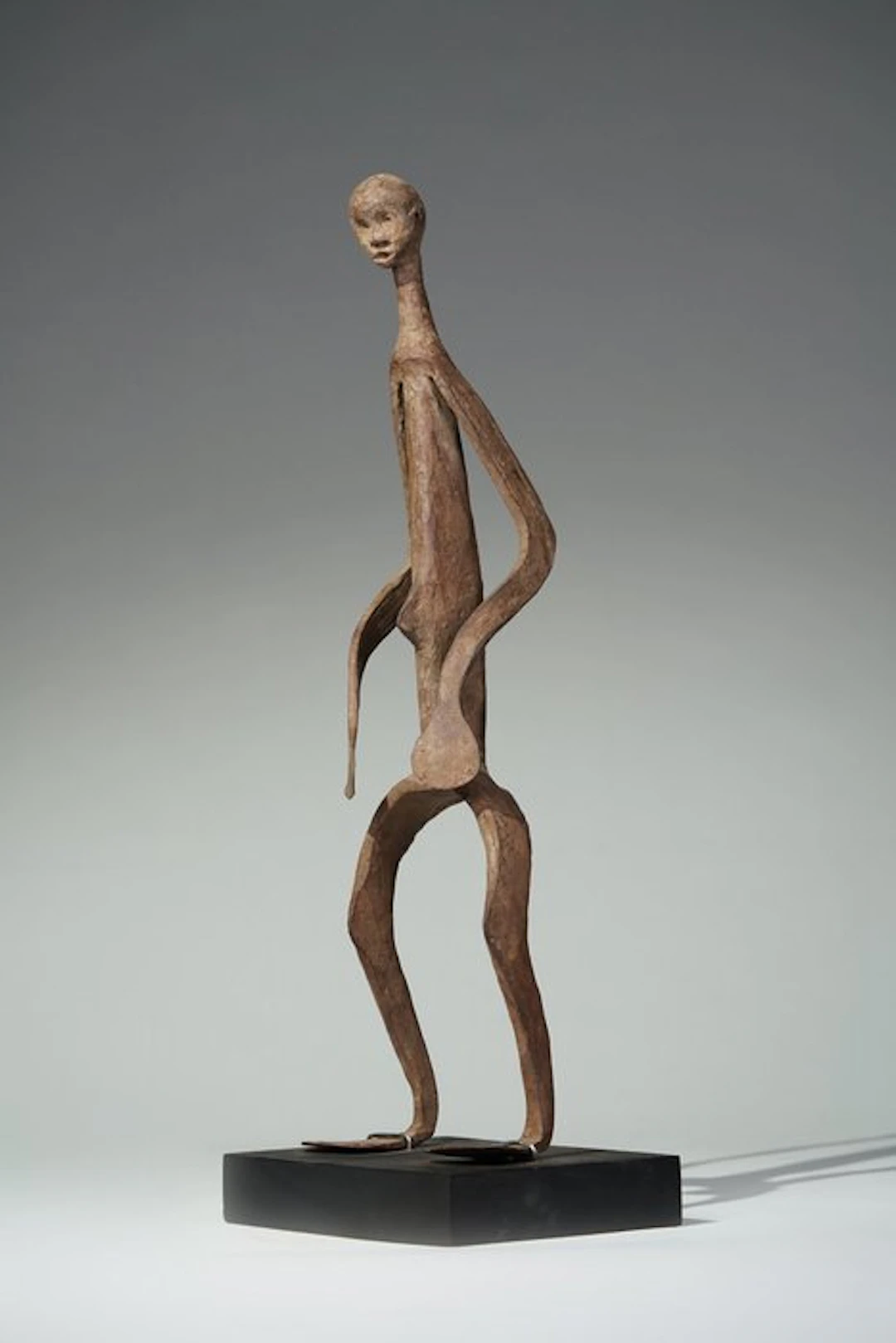
Anthropomorphic Iron Sculpture of the Mumuye People – Standing Figure with Elongated Limbs Origin: Jalingo (Janligo) Region, Taraba State, Northeast Nigeria Cultural Attribution: Mumuye, attributed Material: Iron, presumably forged and joined, reddish-brown to dark brown oxidation patina, incl stand. Dating: Not certain Provenance: Jalingo Region, Nigeria, according to the known provenance Description This exceptionally slender iron sculpture depicts an upright anthropomorphic figure characterized by extreme elongation of body proportions and a dynamic, almost dance-like posture. The figure has a narrow, elongated torso that extends upwards into a strikingly thin neck. This supports a small, nearly spherical head with simplified, yet clearly recognizable facial features. The eyes appear as small, indented forms, while a narrow nose and a prominent mouth lend the face a calm, focused expression. The head is slightly tilted to the side and appears to turn towards the viewer. Particularly characteristic are the long, slender arms, which extend asymmetrically to the sides of the body. The right arm forms a wide arc, its lower section ending in a flattened, disc-like hand. The opposite arm initially falls diagonally downwards and transitions into a narrow, pointed extension. The legs are greatly elongated and slightly angled, creating an open, rhythmically articulated silhouette. Their ends form flat, forward-pointing feet. The body appears almost linear overall, with individual sections accentuated by slight thickenings and irregular transitions. The surface possesses a warm, reddish-brown oxidation patina with darker depressions and, in places, rough, irregular textures. The object is mounted on a modern black display base. Art Historical Analysis The Mumuye belong to the ethnic groups of the Upper Benue region in present-day northeastern Nigeria. Their historical settlement areas extend particularly across parts of Taraba State, including the landscapes around Jalingo, Zing, and adjacent regions. The artistic traditions of the Mumuye people became internationally known primarily through their anthropomorphic wooden sculptures, which are among the most distinctive figurative expressions of Central Nigeria. These figures are often characterized by elongated bodies, abstracted facial features, and a dynamic articulation of the limbs. Known by various local names, these sculptures could play a significant role within social and religious contexts. The present object, with its pronounced verticality, simplified anatomy, and dynamic arm posture, shares formal similarities with this artistic tradition. However, it differs significantly from the well-known carved wooden figures in its material and construction. The use of iron allows for a much greater resolution of the body into narrow, spatially expansive lines. While wooden sculptures develop their form from a closed volume of material, the present form arises from the connection of elongated metal sections, the spaces between which contribute significantly to the composition. A definitive classification within a documented Mumuye tradition of figurative iron sculpture is not possible based on the photograph alone. The cultural attribution should therefore be considered provisional. It also remains unclear whether the sculpture originated from an older local workshop tradition or represents a later artistic interpretation of regional formal concepts. Symbolism and Iconography The iconographic effect of the sculpture is largely determined by the unusual posture of the human body. The small, slightly tilted head, the outstretched arms, and the bent legs create the impression of a figure in a moment of concentrated movement. This posture could be interpreted as a depiction of a dance, a ceremonial gesture, or some other physical action. However, a definitive interpretation is not possible. In various African pictorial traditions, certain body postures can possess social, religious, or symbolic meanings. The position of the arms, in particular, can indicate action, communication, or a special relationship to the surrounding world. However, for the figure in question, there is a lack of reliable ethnographic information that would allow for a concrete interpretation. The striking elongation of the neck and limbs could be understood as a deliberate departure from naturalistic body proportions. The human body does not appear as an anatomically closed unit, but rather as a system of interconnected lines and directions of movement. The asymmetrical design reinforces this impression. While one arm swings far outwards, the other follows a more vertical movement. The legs form an open, seemingly unstable stance, which is balanced by the broad feet. This formal tension lends the figure a special expressiveness, without necessarily implying a specific spiritual or social meaning. Ritual Function and Cultural Context Within the traditional societies of the upper Benue region, anthropomorphic sculptures could fulfill various functions. For certain Mumuye wooden figures, connections to protective beliefs, healing practices, and the social authority of specialized individuals are documented. Such objects could hold special significance within communal or individual religious contexts. Whether comparable concepts were also relevant to the present iron sculpture cannot be proven. The unusual posture could suggest a ceremonial representation, but a direct comparison with documented Mumuye wooden figures would be methodologically problematic. The object could also have been created as an independent figurative work whose primary significance lay in its sculptural form. The elongated legs and flat feet suggest that the figure could originally be displayed freestanding or mounted on a base. Whether the current display pedestal reflects an original display situation remains unclear. The visible oxidation documents changes to the metal surface but does not allow for a reliable age determination. Nor can any particular ritual treatment be inferred from it. Further functional analysis would require information about the object's production, original use, and collection history. Art Historical Assessment The unique aesthetic quality of this iron sculpture lies in its extraordinary combination of figurative recognizability and radical formal reduction. The human body is reduced to a few elongated, interconnected elements, the arrangement of which creates a dynamic spatial composition. The figure possesses a pronounced verticality, emphasized by the long neck and slender legs. At the same time, the outstretched arms disrupt this order, lending the form a lively, almost dance-like dynamism. The relationship between material weight and visual lightness is particularly remarkable. Although iron is a resistant and relatively heavy material, the sculpture appears almost weightless due to its open spaces and slender limbs. The irregularly oxidized surface reinforces the impression of a form developed directly from the material itself. The small, meticulously modeled head provides a serene counterpoint to the dynamic posture and imbues the figure with a concentrated human presence. Within the broader art historical context of the figurative traditions of the Benue region, and subject to its cultural attribution, the object can be considered a remarkable example of linear, spatially open metal sculpture. Its particular significance lies in the independent transformation of human anatomy into an abstract, movement-oriented formal language. The sculpture impressively demonstrates how few sculptural elements can suffice to create a human figure of great expressiveness and spatial presence. Literature Frank Herreman (ed.): Mumuye: Sculpture from Nigeria – The Human Figure Reinvented. Brussels: Mercatorfonds, 2016. Marla C. Berns, Richard Fardon, and Sidney Littlefield Kasfir (eds.): Central Nigeria Unmasked: Arts of the Benue River Valley. Los Angeles: Fowler Museum at UCLA, 2011. The publications mentioned above serve as a general art historical context for the figurative traditions of the Mumuye and the Benue region. A reliable literature reference directly related to this specific type of anthropomorphic iron sculpture is not currently available. Copyright and Scientific Documentation Some of the information and photographs have been generated with the assistance of artificial intelligence and are based on published sources in ethnography, archaeology, and art history. Original texts and photographs may be protected by copyright. All rights held by the respective copyright holders are reserved. Inv. No. MAZ32120 Informant: Amadou Dogo
Estimación:€275
Ir a la subastaVer todos los artículos deCatawikioEtnográfica
Estimación:
€275

OCT 27 | 4:00 PM
¡Lleva tu subasta a coleccionistas de todo el mundo!
Publica ahoraAl suscribirte, aceptas la política de privacidad. Cancela tu suscripción en cualquier momento.
Barnebys HQ
Brahegatan 10
BOX 5038
114 37 Stockholm
