







Todas las subastas / Alfombras & textiles / A gathering from an early codex of Thomas Bradwardine, De causa Dei

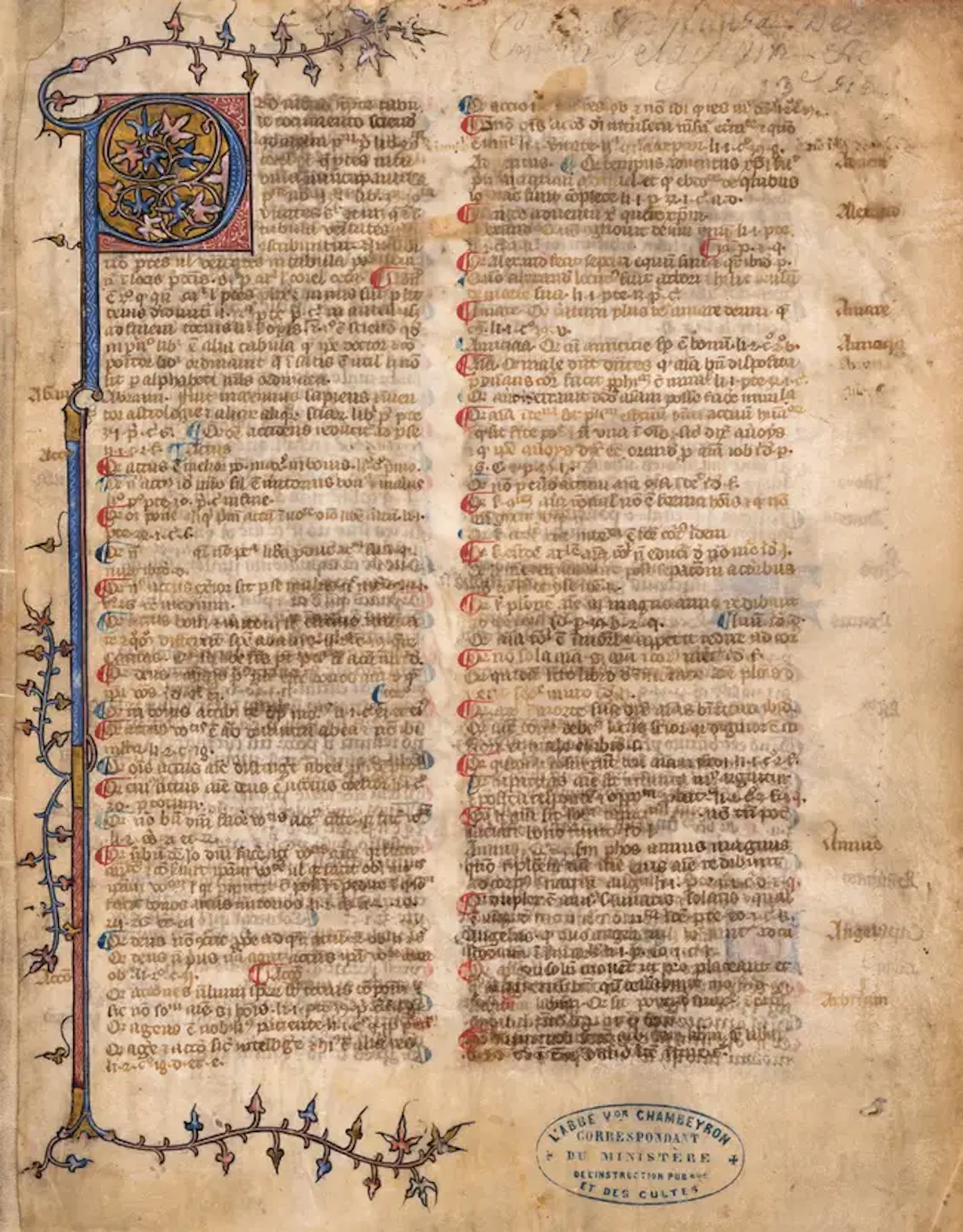
A gathering from an early codex of Thomas Bradwardine, De causa Dei contra Pelagium et de virtute causarum, in Latin, illuminated manuscript on vellum, [northern France (almost certainly Paris), second half of the fourteenth century], 6 leaves (with apparently continuous text) from the capitula list at the front of the work, text in double columns of 48 lines in a professional University bookhand, lemmata-terms set in margin in main hand, paraph marks in alternate blue and red, 2- to 4-line initials in gold on blue and dark pink grounds, frontispiece with one very large initial ‘P’ in blue with white brushstrokes overlaid, enclosing delicately scrolling coloured foliage with ivy-leaves on a wide burnished gold ground, the whole initial on dark pink grounds with white brushwork overlaid, the descender of the initial turning into a long text border that runs for the length of the inner vertical side of the entire text column in same colours as before and gold, with ivy-leaf tendrils sprouting from this and the initial to fill two borders, initial leaf with a few stains and scuffs, and vellum translucent in places making parts of the text hard to read, other small stains and slight cockling throughout, else in good condition, 293 x 225mm. *** Provenance: 1. From a once grand and opulent copy of this text, most probably produced in Paris for use by a master in the university there. 2. L'abbé Victor Chambeyron (1813-63), a priest who held offices in Lyon, then Belleville-sur-Saône, Saint-Étienne, Couzon-sur-Saône and Givors (all in Rhône), as well as an amateur historian and archaeologist of the Lyonnaise region. His oval inkstamp at foot of fol. 1r, with his honorific title: “correspondant du ministère de l'instruction pub[li]que et des cultes” (a title given by the French State to trusted antiquarians and local scholars whose role was to seek out locally important records). Text: The modern pencil scrawls at the head of fol. 1r (perhaps in the hand of Chambeyron) identify the text here, and while it exists in numerous variants, the readings here agree exactly for the copy of the work recorded for the manuscript in Klosterneuburg, Augustiner-Chorherrenstift, Cod. 317 (incipit: “Actus. Quod actus est melior potentia maxime in bonis li. 1. capitulo 1 ...”, and explicit: “Idolum. Contra colentes idola et ea fabricantes nota multa ibidem parte 31a corollarii primi capituli”; for these, see the ‘manuscripta.at’ database). Thomas Bradwardine (c. 1300-49) was an early English mathematician, physicist, scholastic philosopher and theologian, chaplain and confessor to Edward III, a luminary of the University of Oxford and very briefly the archbishop of Canterbury (the latter for only three months in 1349). Chaucer ranked him as a scholarly giant alongside Augustine and Boethius in his Nun's Priest’s Tale (“But I ne kan nat bulte it to the bren [‘But I cannot sift it to the bran’, meaning sift the fine flour through a bulting-cloth to remove the ‘bran’ or chaff, and here meaning analyse it thoroughly] / As kan the hooly doctour Augustyn / Or Boece, or the Bisshop Bradwardyn”). His major work was this text, a lengthy theological treatise on divine sovereignty, grace, and predestination, and was written against what Bradwardine saw as a resurgence of Pelagianism (the belief that human free will is capable of achieving salvation without special divine grace). A few manuscripts state that it was completed in London in 1344. The text has recently been the subject of a research project by Edit Anna Lukács (The Manuscript Tradition of Bradwardine´s `De causa Dei´; ended 2014) based in the University of Vienna, which found that it survives in 53 manuscripts from the fourteenth and fifteenth centuries, all apparently in European institutions (see the list published online by Lukács on the University of Vienna’s website, of the 30 manuscripts now available in reproductions in the University of Vienna, the remaining manuscripts those in institutions in Vienna or within easy reach of that city). The vast Schoenberg database records no manuscript as ever appearing in sale records, and the present example may well be the first.
Estimación:€3,581.7
Ir a la subastaVer todos los artículos deForum AuctionsoAlfombras & textiles
Estimación:
€3,581.7


OCT 27 | 4:00 PM
¡Lleva tu subasta a coleccionistas de todo el mundo!
Publica ahoraAl suscribirte, aceptas la política de privacidad. Cancela tu suscripción en cualquier momento.
Barnebys HQ
Brahegatan 10
BOX 5038
114 37 Stockholm
