



Todas las subastas / Etnográfica / A bronze sculpture - Ogoni - Nigeria (No reserve price)

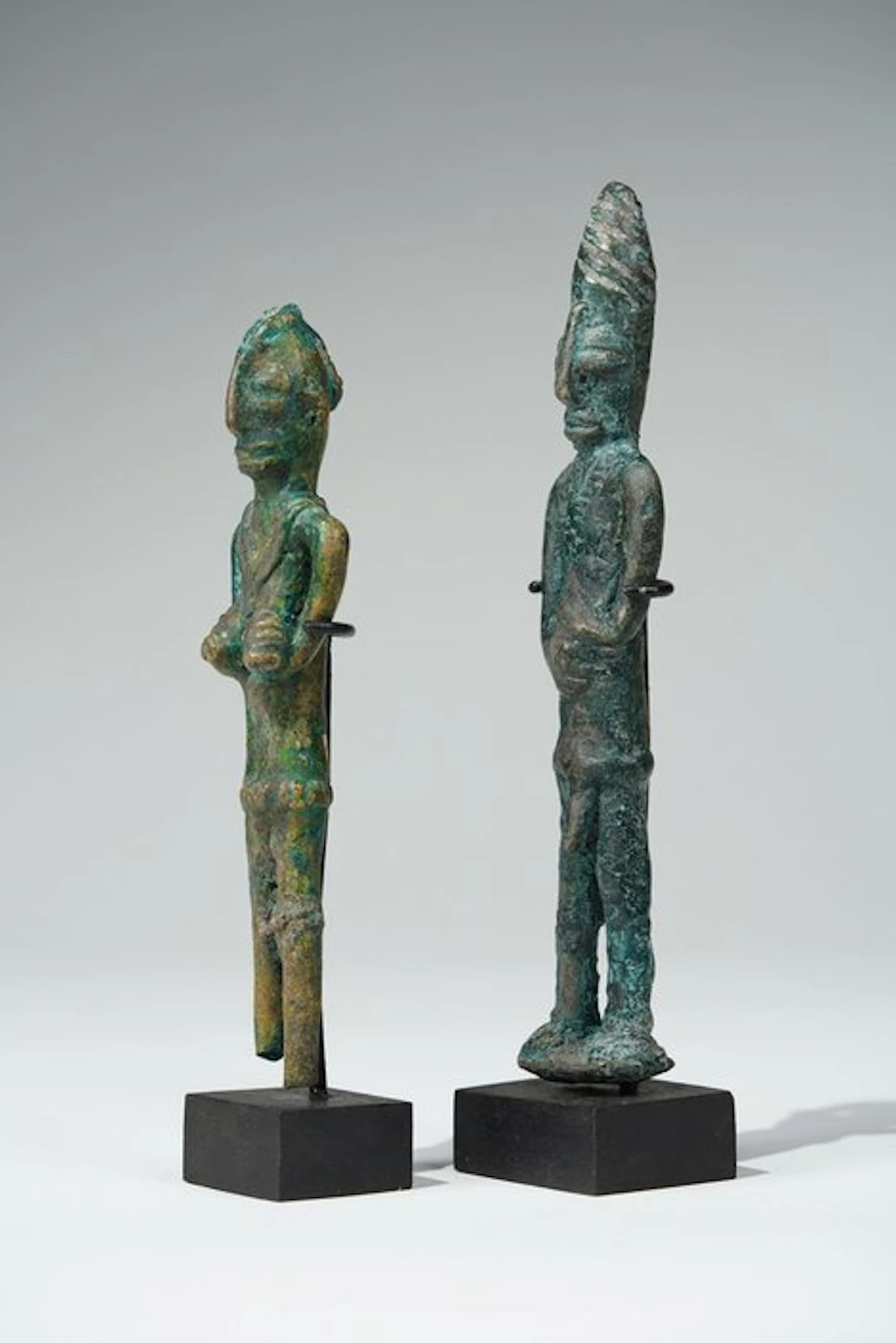
Pair of Bronze Anthropomorphic Figures – Ogoni Attribution Ogoni, attributed Abakaliki Region, Igoni Village, Southeastern Nigeria Material: Cast copper alloy (bronze), with green and brown oxidation Dating: Undetermined Cultural Attribution: Ogoni, according to the informant Function: Undetermined; possibly associated with commemorative or ritual practices Informant: Amadou Dogo Description This pair of bronze sculptures represents two standing anthropomorphic figures characterized by elongated bodies, carefully modeled facial features, and an expressive combination of geometric simplification and ornamental detail. Although the figures differ in height, proportions, and head decoration, they share a closely related sculptural vocabulary, suggesting that they may have been conceived as complementary representations. The smaller figure, positioned on the left, possesses an elongated oval head with a rounded upper section, prominent forehead, and simplified facial features. The eyes are relatively large and slightly projecting, while the nose and mouth are modeled in low relief. The ears extend along the sides of the head, and the upper portion appears to incorporate a modest coiffure or head ornament. The slender neck connects the head to a narrow torso, from which the arms extend forward and downward. Both hands are positioned close to the abdomen, forming a compact arrangement that may represent a gesture or the holding of an unidentified object. The lower body is remarkably elongated, with narrow, almost parallel legs and minimal articulation of the feet. A horizontal band around the hips separates the torso from the lower limbs and may indicate a belt, garment, or decorative element. The taller figure on the right is distinguished by an elaborate, vertically extended headdress with diagonal ridges. This towering structure gives the sculpture a strongly emphasized vertical orientation. The face is comparatively narrow, with projecting lips, a pronounced nose, and elongated ears. The upper body is compact, with arms bent toward the abdomen and hands brought together in front of the torso. The legs are long and straight, terminating in a slightly expanded, irregular base. Both sculptures exhibit substantial greenish-blue oxidation, interspersed with darker brown areas and localized surface deposits. These characteristics suggest prolonged exposure to environmental conditions but cannot independently establish their age or archaeological origin. The figures are displayed on modern black mounts, which are not original components of the sculptures. Art-Historical Context The sculptures are attributed to the Ogoni, a group of communities inhabiting the eastern Niger Delta, particularly the territory now forming part of Rivers State in southern Nigeria. Ogoni artistic traditions are especially well documented through wooden masks, puppets, and figurative sculptures associated with masquerades, ancestral remembrance, and communal institutions. Bronze sculpture, however, is considerably less securely documented as a characteristic medium of Ogoni artistic production. The present figures therefore require a cautious attribution. Their stylistic characteristics may reflect artistic exchanges within the wider southeastern Nigerian region rather than a specifically identifiable Ogoni workshop. An additional geographical consideration concerns the reported origin in the Abakaliki region. Abakaliki is situated in present-day Ebonyi State, northeast of the principal Ogoni homeland. The area is historically associated particularly with Igbo-speaking communities, including the Izzi and neighboring groups. The designation Igoni, supplied as the village of origin, cannot presently be connected with certainty to a documented Ogoni settlement. It may represent a local place-name, an alternative transcription, or information transmitted through the object's collecting history. Consequently, the ethnic attribution and reported geographical origin should be treated as distinct elements of the available documentation. The wider southeastern Nigerian region has a long and complex history of metalworking, including the celebrated copper-alloy traditions of Igbo-Ukwu and other artistic developments in the Lower Niger area. These traditions demonstrate the technical and aesthetic diversity of regional metal sculpture, although no direct connection between them and the present pair can be established. Symbolism and Possible Ritual Function The two figures appear to have been conceived as individualized human representations. Their contrasting proportions and head ornaments suggest a deliberate differentiation of identity or status, although the absence of clear anatomical indicators prevents a secure determination of gender. The taller figure's elaborate headdress may indicate distinction, ceremonial dress, or a particular social role. In numerous Nigerian sculptural traditions, hairstyles and head ornaments communicate aspects of identity, prestige, or spiritual significance. Such general associations cannot, however, establish the meaning of this particular object. The smaller figure's rounded head and comparatively restrained decoration create an interesting visual contrast with the taller sculpture. The positioning of both figures' hands near the abdomen may represent a conventional sculptural gesture, an act of presentation, or the holding of attributes that are no longer identifiable. If the figures were originally conceived as a pair, their relationship might have expressed complementary social or spiritual roles. They could conceivably have formed part of a shrine assemblage, commemorative installation, or another ritual context. Nevertheless, there is no documented evidence confirming such a function. Their original setting, the identities represented, and the significance of their gestures remain unknown. The absence of connecting elements also prevents their identification as a specific type of ceremonial object. In particular, they should not automatically be classified as Yoruba edan Ògbóni, despite their material and paired presentation. The Yoruba Ògbóni tradition possesses its own documented institutional, ritual, and iconographic context, and visual resemblance alone would be insufficient to establish such an attribution. Regional Characteristics: Abakaliki and the Lower Niger Cultural Area The Abakaliki region lies within the northeastern part of southeastern Nigeria, in an area characterized by extensive historical interaction between Igbo-speaking communities and neighboring populations of the Cross River and Benue cultural zones. This location differs geographically and culturally from the principal Ogoni settlements of the eastern Niger Delta. The distinction is significant because artistic objects circulating through southeastern Nigeria may have been manufactured, used, exchanged, and collected in different communities. The Niger Delta itself represents a highly interconnected cultural environment. Riverine trade, migration, political relationships, and ritual exchanges facilitated the movement of objects and artistic ideas among Ogoni, Ijaw, Ibibio, Andoni, and other populations. Within Ogoni communities, wooden sculptural traditions include human figures associated with ancestral and ceremonial practices. Their artistic vocabulary often emphasizes expressive facial features, simplified anatomy, and the symbolic importance of the head. The present bronzes share certain broad characteristics with this sculptural environment, particularly the vertical emphasis, stylized faces, and compact arrangement of the arms. However, these features occur in several other Nigerian traditions and cannot serve as exclusive markers of Ogoni origin. The use of copper alloy also raises questions about regional production and exchange. Metal figures from the Lower Niger area encompass a variety of styles and functions, and their historical classification remains complex. The present sculptures should therefore be examined within this broader comparative framework rather than assigned uncritically to a single established ethnic style. Art-Historical Appreciation The principal artistic quality of this pair lies in the contrast between their elongated proportions and their highly individualized heads. The smaller sculpture emphasizes a rounded cranial form and compact facial modeling, while the taller figure introduces an elaborate, vertically extended headdress that dominates its composition. The sculptor has achieved a remarkable sense of presence through relatively economical means. Narrow torsos, simplified arms, and elongated legs establish an almost architectural structure, while the faces provide the principal points of expressive concentration. The contrasting surface colors contribute significantly to the sculptures' appearance. Greenish-blue oxidation alternates with brown and yellowish areas, emphasizing the irregularities of the cast metal and creating a richly textured surface. Particularly noteworthy is the taller figure's headdress, whose diagonal ridges introduce a rhythmic pattern absent from the otherwise restrained anatomical modeling. The smaller figure provides a visual counterpoint through its broader head and less elaborate ornamentation. Their apparent stylistic relationship makes the sculptures especially interesting as a possible pair, although their original association remains undocumented. They constitute an intriguing example of figurative copper-alloy sculpture attributed to southeastern Nigeria. Their precise cultural identification, date, and function require further comparative and technical investigation. Selected Literature Kpone-Tonwe, Sonpie, and Jill Salmons. “The Arts of the Ogoni.” African Arts, 2002. A directly relevant study of Ogoni sculptural traditions, particularly masks, wooden figures, puppets, and ceremonial practices. It provides an important cultural comparison but does not establish a specific Ogoni bronze tradition. Peek, Philip M., and Keith Nicklin. “Lower Niger Bronze Industries and the Archaeology of the Niger Delta.” In Ways of the Rivers: Arts and Environment of the Niger Delta, 2002. Particularly relevant to the classification and regional diversity of copper-alloy sculpture in the Lower Niger area. These studies provide the most relevant regional and material comparisons among the identified references. Neither documents the present sculptures or confirms their attribution to the Ogoni. Copyright and Scientific Documentation Some of the information and photographs have been generated with the assistance of artificial intelligence and are based on published sources in ethnography, archaeology, and art history. Original texts and photographs may be protected by copyright. All rights held by the respective copyright holders are reserved. Inv. No. MAZ32456 Height: 19 cm / 22 cm Weight: 450 g / 570 g (incl. stand) Sold without TL test. Catawiki's experts perform a virtual review based on the information, photographs, provenance and supporting documentation provided during the submission process. Acceptance of a traditional or ancient African art object for auction does not constitute independent authentication or certification by Catawiki, nor does it mean that Catawiki's expert has physically or scientifically authenticated, patina-analyzed, or dated the object. Under our Terms and Traditional African Art Submission Guidelines, the seller remains responsible for the accuracy, legality, provenance and authenticity of the object and the information provided.
Estimación:€275
Ir a la subastaVer todos los artículos deCatawikioEtnográfica
Estimación:
€275

OCT 27 | 4:00 PM
¡Lleva tu subasta a coleccionistas de todo el mundo!
Publica ahoraAl suscribirte, aceptas la política de privacidad. Cancela tu suscripción en cualquier momento.
Barnebys HQ
Brahegatan 10
BOX 5038
114 37 Stockholm
