




Todas las subastas / Etnográfica / 631g Green Moss Agate Skull – Bermuda Triangle

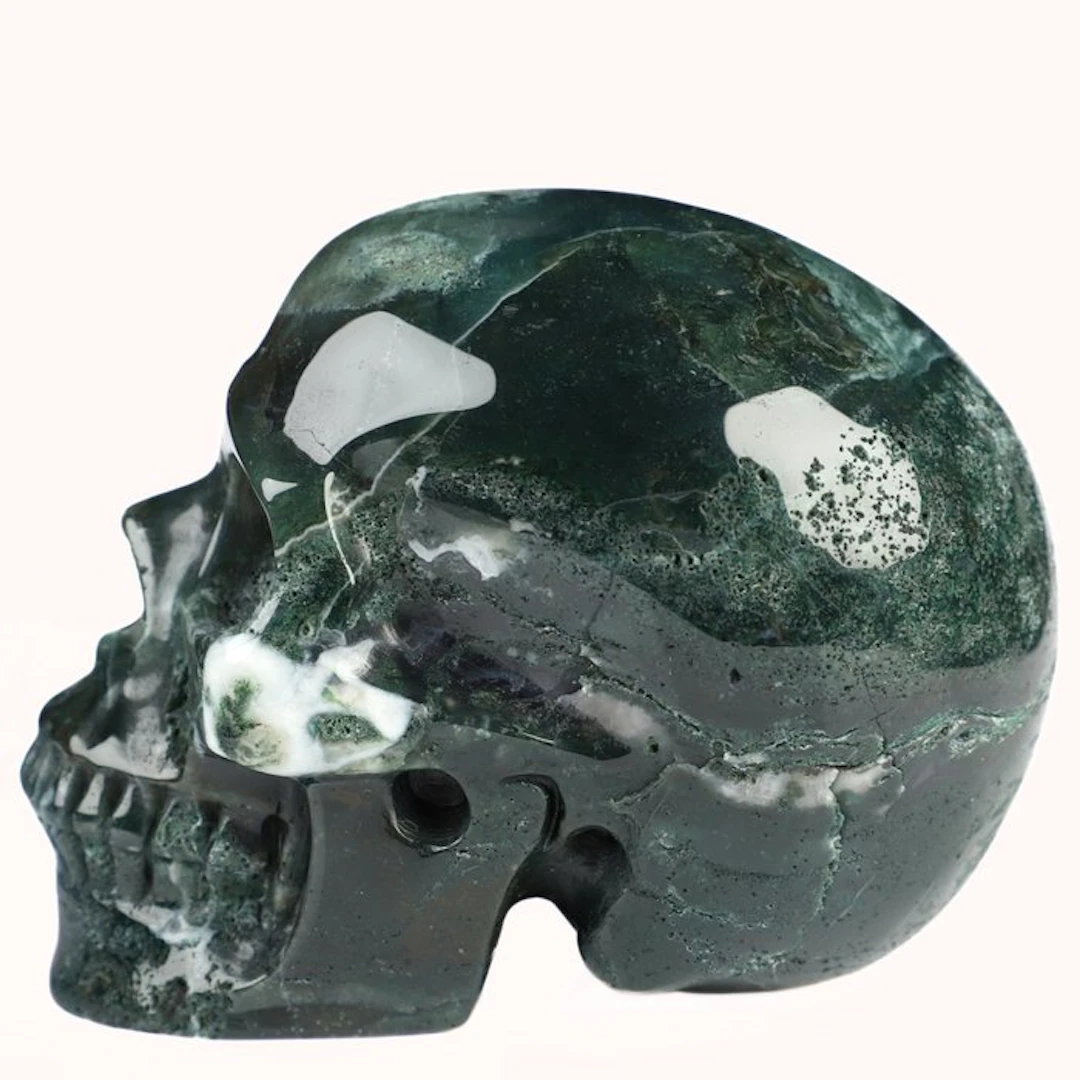
Sometime after March 4, 1918, the USS Cyclops disappeared. The U.S. Navy coal carrier had left Barbados with 306 people aboard and was never seen again. To this day it remains the greatest loss of life in U.S. Navy history not attributed to combat. On December 5, 1945, five Avenger-type torpedo bombers, Flight 19, did not return from their training flight. The patrol plane that went after them, a PBM Mariner with thirteen men aboard, also disappeared. In February 1964, Vincent Gaddis’ article “The Deadly Bermuda Triangle” appeared in Argosy magazine. Since then, the sea area between Florida, Bermuda, and Puerto Rico has carried its eerie reputation into the world. This skull carries such a sea within it. Dark-green moss veils drift through half-transparent agate water like seaweed in a roughed-up sea. White veins and streaks run through it like foam and currents, and on the sides of the skull bright bands race horizontally, like gusts over the water. On the left cheek a bright spot breaks out like foam on a breaking wave. Where the stone becomes clear, one looks deep into a sea so pure that nothing has ever clouded it, and so cruel that it will drag anyone who dares to enter into its depths. But the storm is most clearly revealed in the eyes: there, the vortices swirl inward as in the eye of a cyclone, around which everything revolves. Lloyd’s of London did not find an unusually large number of ship losses there, and the U.S. Coast Guard regards the number of allegedly missing as insignificant given the dense traffic. Yet the Gulf Stream—flowing through the triangle like a river in the ocean on the surface—reaches up to two meters per second and carries along whatever falls into its arms. The agate also bears a river in its name. The oldest known description comes from the Greek naturalist Theophrastus, around 350 B.C. After him and after Pliny the Elder, the stone was found at the river Achates in Sicily and named after it. Linguists today suspect the reverse: that the river took its name from the stone. Some stories do indeed flow in both directions. Material: Moss agate (chalcedony with green, moss-like mineral inclusions), partly semi-transparent, with white chalcedony and quartz patches Origin: India Dimensions: 10.0 x 6.5 x 7.0 cm Weight: 631 g Features: Lively, stormy pattern of dark green moss, semi-transparent agate zones and white streaks; light, moss-speckled spot on the left cheek; horizontally running moss bands on the skull’s sides; fine white quartz veins, among others at the back of the head and the underside; natural small pores in the moss portions
Estimación:€1
Ir a la subastaVer todos los artículos deCatawikioEtnográfica
Estimación:
€1

OCT 27 | 4:00 PM
¡Lleva tu subasta a coleccionistas de todo el mundo!
Publica ahoraAl suscribirte, aceptas la política de privacidad. Cancela tu suscripción en cualquier momento.
Barnebys HQ
Brahegatan 10
BOX 5038
114 37 Stockholm
